
Fukaya scale
Protopulvinaria fukayai
Description
How to identify
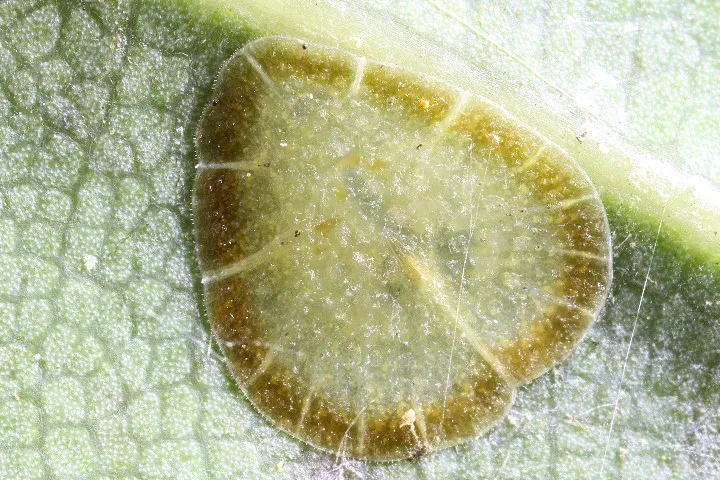
The Fukaya scale (Protopulvinaria fukayai) belongs to the family Coccidae. It is a small insect characterized by adult females protected by a tough, convex scale, typically brown or yellowish-brown in color.
As the female matures and begins producing eggs, its body becomes increasingly convex. During the reproduction phase, a distinct white, waxy ovisac forms under the posterior part of the body, making the insect more visible.
Males are rarely observed and possess a shorter lifecycle. First-instar nymphs, known as crawlers, are mobile, pale yellow, and highly capable of spreading across the plant or being carried by the wind to neighboring branches.
This species is a typical sap-sucking pest that utilizes a needle-like mouthpart to penetrate plant tissues and extract vital fluids.
Accurate identification requires careful inspection of the underside of leaves and young stems, as these are the preferred locations for these insects to settle and feed.
What it damages
The primary hosts of the Fukaya scale include citrus crops such as lemons, oranges, and mandarins. The pest can also be found on various evergreen ornamental plants in subtropical environments.
By sucking the sap from the plant, the insects significantly weaken the host's vigor. Affected plants often exhibit stunted growth and distorted shoots due to the constant loss of nutrients.
A major aspect of the damage is the secretion of honeydew, a sticky substance that promotes the growth of sooty mold. This fungus forms a black coating on leaves, drastically reducing the efficiency of photosynthesis.
Premature leaf drop and decreased yields are common consequences of a heavy infestation. The plant loses its aesthetic value and becomes susceptible to secondary infections.
In severe cases, entire branches may dry out and die, leading to the eventual decline of the plant if management practices are not implemented promptly.
When it appears
The lifecycle of the Fukaya scale is closely linked to temperature patterns. Activity typically resumes during spring as temperatures rise, triggering the emergence of mobile crawlers.
Depending on local climate conditions, several generations may occur throughout a single year. The peak population density is usually observed in the second half of the summer.
As autumn approaches, metabolic rates decline in preparation for overwintering. The pest typically survives the winter as mature nymphs or fertilized females hidden in crevices of the bark.
Warm and humid spring conditions favor rapid population growth, which can lead to significant infestations early in the growing season.
Monitoring for the presence of crawlers is essential for determining the most effective timing for chemical applications, as these stages are most susceptible to treatment.
Signs of infestation
The earliest symptom of an infestation is the appearance of sticky honeydew on the upper surfaces of leaves located below the insect colonies. This sticky residue quickly attracts sooty mold.
Upon close inspection of the leaf undersides or twigs, one can identify stationary, brown, convex bumps, which represent the settled adult females of the Fukaya scale.
The presence of white, cottony egg sacs under the scale is a definitive sign of reproduction, which usually coincides with the plant's active growing phases.
The overall plant appearance reflects the stress of the infestation; foliage may lose its luster, look dusty, and develop a sickly appearance due to the covering of black sooty mold.
- Sticky honeydew residue on leaf surfaces.
- Growth of black sooty mold fungus.
- Presence of brown, bump-like scales on stems.
- Distortion and yellowing of young leaves.
Control measures
Controlling the Fukaya scale is challenging because the hard protective scale provides resistance against contact insecticides. Systemic treatments are generally more effective as they are absorbed by the plant.
The best time to apply control measures is during the crawler stage, as these young nymphs lack the dense protective shield found in adults.
Cultural practices, such as pruning heavily infested branches and ensuring proper plant spacing, help manage the pest population and reduce the risk of mold outbreaks.
Mechanical removal, such as washing the foliage with mild soap solutions and horticultural oils, helps strip away honeydew and physically disrupts the insects' breathing, providing temporary relief.
Biological control, including the encouragement of natural predators like ladybugs or parasitic wasps, serves as a sustainable way to suppress population numbers without relying exclusively on synthetic chemicals.
Taxonomy
- Latin name
- Protopulvinaria fukayai
- Order
- Hemiptera (bugs, aphids, leafhoppers)
- Family
- Coccidae
- EPPO code
- PROPFU
Discussion
No discussions yet — be the first.