
Six-spotted moth
Prolita sexpunctella
Description
How to identify
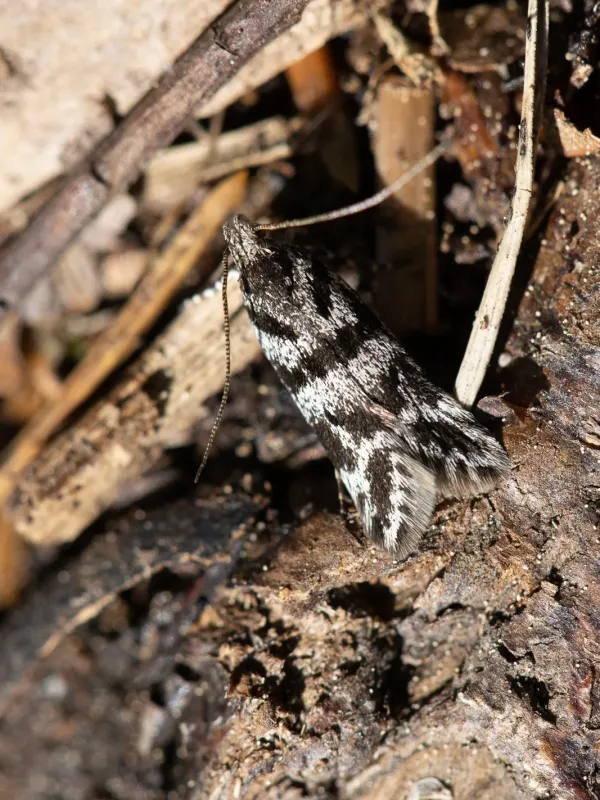
The six-spotted moth (Prolita sexpunctella) is a member of the Gelechiidae family, commonly known as twirler moths. This small moth is characterized by specific markings on its forewings that serve as a primary identification feature.
The forewings typically feature a greyish-brown base with distinct dark spots arranged in patterns. Its body is slender and streamlined, consistent with the morphology of other small moths in this order.
Larvae pass through several instars, changing their appearance as they grow. They are highly active and possess strong mandibles, allowing them to consume plant tissue efficiently during their developmental stages.
Pupation occurs within a sturdy silk cocoon, which the larvae usually construct in the soil or within folded leaves. The pupae are smooth and brown, providing protection against environmental fluctuations.
The life cycle is heavily dependent on ambient temperature and humidity levels. Under favorable conditions, the species can complete its development in a relatively short period, allowing for multiple generations per year.
What it damages
The six-spotted moth targets various herbaceous plants, often causing economic losses in agricultural fields. Its feeding habits directly impact the health and yield of the affected crops.
The larvae feed primarily on the leaf lamina. By skeletonizing the leaves and creating irregular holes, they reduce the total photosynthetic area available to the plant, which weakens the host.
Beyond leaf consumption, heavy infestations can lead to damage in reproductive organs, such as buds or young stems. This can cause stunted growth and reduced seed or fruit production.
Plants weakened by the moth are significantly more susceptible to secondary fungal or bacterial infections. This combined stress often exacerbates the total damage caused to the crop.
Monitoring the density of larvae is crucial for identifying the economic threshold, where chemical or biological intervention becomes necessary to prevent substantial yield reductions.
When it appears
Adult moths typically emerge in late spring as temperatures rise. Their flight activity is primarily nocturnal or crepuscular, meaning they are most active during dusk and dawn.
The species usually undergoes one or two generations per season, depending on the climatic zone. This ensures the presence of larvae on host plants during key growing periods.
Winter is typically survived in the pupal or late-larval stage within the soil profile. This hibernation strategy allows the population to persist from one year to the next.
Weather patterns significantly influence the moth's population dynamics. Cold and wet springs may delay their development, while warm, dry summers often lead to population spikes.
Regular field scouting and the use of pheromone traps are the most effective methods to determine when the moths are active and when control measures should be initiated.
Signs of infestation
One of the earliest signs of infestation is the appearance of silk webbing on the terminal parts of plants. Larvae use this silk to tie leaf margins together, creating protected shelters.
The presence of small, dark excrement pellets on the leaves near the shelters is a reliable indicator of larval feeding activity. These pellets are often visible before the moth itself is spotted.
Damaged leaves often turn chlorotic or brown, eventually dying if the feeding is severe. In some cases, the plant may exhibit noticeable stunting or misshapen growth patterns.
Adults can be observed by inspecting the underside of leaves during the evening hours or by using light traps. They usually fly in short, quick bursts when disturbed.
Carefully unfolding leaves with webbing will often reveal the larvae, which typically react by wriggling or dropping from the plant when threatened.
Control measures
Management of the six-spotted moth requires an integrated approach. Cultural practices, such as rigorous weed control, are essential because weeds often serve as alternative host plants.
Deep autumn plowing is a highly effective mechanical control method. By disturbing the soil, it buries pupae and exposes them to predators and unfavorable environmental conditions.
Biological control options, such as the application of Bacillus thuringiensis, are highly effective against younger larvae and have a low impact on beneficial insects or the environment.
When infestation levels exceed established thresholds, the use of selective insecticides is recommended. It is vital to rotate modes of action to prevent the development of resistance.
- Crop rotation to break the pest's life cycle.
- Removal and destruction of crop residues post-harvest.
- Use of pheromone traps for monitoring and mass trapping.
- Encouraging natural predators such as parasitic wasps.
Taxonomy
- Latin name
- Prolita sexpunctella
- Order
- Lepidoptera (butterflies)
- Family
- Gelechiidae
- EPPO code
- PRLASE
Discussion
No discussions yet — be the first.