
Striped click beetle
Proiectus
Description
How to identify
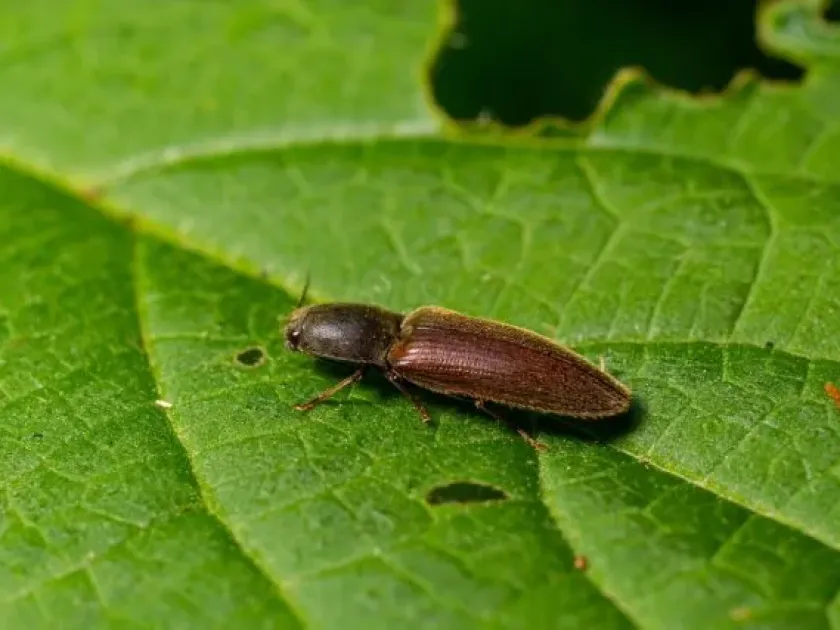
The adult striped click beetle (Latin Agriotes lineatus) belongs to the Elateridae family, order Coleoptera. The insect has an elongated body, reaching 7–10 mm in length, with a brownish-black coloration covered in fine gray or reddish hairs.
The larva of this pest, commonly referred to as a wireworm, is characterized by a hard chitinous body, a cylindrical shape, and a yellowish-brown color. This larval stage is the one responsible for the most significant economic losses in agriculture.
The name "click beetle" comes from their ability to snap their thoracic plates to perform a clicking sound when trying to flip from their backs to their feet. This mechanical defense is a key identifier for adult specimens.
Agronomists monitor populations by conducting soil digs or using bait traps containing grain or seeds. Conducting these surveys in early spring helps assess the risk levels before planting main crops.
The biology of the species is deeply linked to the soil, where the larvae undergo most of their developmental stages. Depending on regional climate conditions, the lifecycle from egg to adult takes between 3 to 5 years.
What it damages
The striped click beetle is a polyphagous pest that affects a wide variety of crops. Primary targets include small grains, corn, potatoes, sugar beets, and sunflowers.
Wireworms live in the soil, feeding on planted seeds, germinating sprouts, and underground plant parts. Damage often leads to the destruction of the seed embryo, resulting in thin, patchy crop stands.
In established plants, larvae chew through roots and tunnel into stems, which causes stunted growth, yellowing of leaves, and eventual plant death. High infestations can reduce crop yields by up to 50%.
Root crops are particularly vulnerable as larvae burrow deep into tubers and roots. This not only lowers the marketability of the produce but also creates wounds that become entry points for various fungal and bacterial infections during storage.
Damage is typically spotty and uneven across the field. If soil moisture is high, larvae concentrate in the topsoil, causing maximum destruction to the root systems of young crops.
When it appears
Overwintering adults emerge in April and May once soil temperatures reach 10–12 degrees Celsius. Following a feeding period, they begin laying eggs in the top layers of the soil.
Embryonic development lasts about a month, followed by the hatching of larvae. In the first few years, these young wireworms feed primarily on decaying organic matter and fine roots, causing minimal damage to crops.
The most destructive phase occurs during the second and third years of larval development, when they become highly mobile and voracious. They migrate to the root zone, often coinciding with the germination period of major agricultural crops.
Peak activity is observed in spring and early summer. As temperatures drop in the autumn, larvae migrate deeper into the soil (up to 40–60 cm) to overwinter safely before returning to the surface in the following spring.
Agrotechnical planning must account for these seasonal patterns. Years with wet conditions often favor high survival rates for eggs and early-stage larvae, leading to population explosions.
Signs of infestation
The primary sign of infestation is the emergence of patchy crop stands where seedlings appear withered or dead for no apparent reason. Close inspection of the root zone will reveal bite marks or severed roots.
In cereal fields, infested areas appear as barren spots. If you dig into the soil in these areas, you are likely to find various sizes of wireworms feeding on the underground remnants of the plants.
Damaged potatoes and root crops show distinct tunneling paths. If cut open, the internal structure is clearly degraded, which makes the crop susceptible to secondary rotting caused by soil-borne pathogens.
Plant wilting during warm, sunny days is another indicator of root damage caused by wireworms, especially in the early stages when the root system is not fully established.
The presence of weeds, particularly couch grass (Elymus repens), serves as an indicator of favorable conditions for the pest. Wireworms often congregate near these weed patches before moving into the surrounding crop rows.
Control measures
Effective management relies on a combination of agrotechnical and chemical strategies. Crop rotation is the first line of defense, avoiding crops that are highly susceptible to wireworm infestation in favor of resistant ones like mustard.
Mechanical soil cultivation, including deep plowing and intensive discing, helps disrupt the larvae's tunnels and brings them to the surface, where they become exposed to birds and desiccation from sunlight.
Weed control is essential, as removing host plants like couch grass significantly reduces the pest's food supply. Additionally, liming acidic soils creates an environment that is unfavorable for wireworm survival.
Seed treatment with systemic insecticides is the most effective method for protecting vulnerable seedlings during the germination and early establishment phases.
If population density exceeds the economic threshold, soil-applied granular insecticides can be used during planting. All control measures should be based on accurate soil sampling data.
Taxonomy
- Latin name
- Proiectus
- Order
- Mites
- Family
- Eriophyidae
- EPPO code
- POIESP
Discussion
No discussions yet — be the first.