
Eupatorium gall fly
Procecidochares utilis
Description
How to identify
The Eupatorium gall fly, scientifically known as Procecidochares utilis, belongs to the Tephritidae family, also known as fruit flies. These insects are characterized by their patterned wings and relatively small size, making them difficult to spot.
Adults possess a camouflage-like coloration, which allows them to blend in with the leaves of their host plant. Their head and thorax are covered in fine bristles, and their wings display a complex network of dark stripes and spots.
The larvae of this species are specialized gall-formers. They have a body structure adapted for living and feeding within the tissues of the plant, which is the primary trait of this genus.
The biology of this species is tightly synchronized with the growth cycle of the host plant, particularly the Eupatorium species. Reproductive success depends heavily on the vigor of the plant.
Identification of the adult flies is best achieved during the flight season, when they are active on the stems and upper surfaces of the leaves.
What it damages
The primary host plant for this pest is Eupatorium adenophorum. Damage occurs mainly at the sites of gall formation, which interfere with the plant's normal growth and nutrient transport.
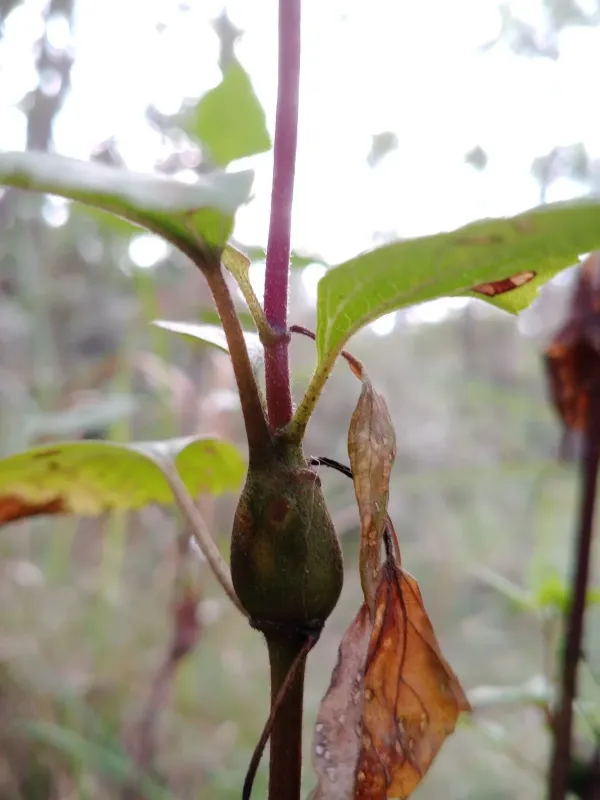
As the larvae feed within the plant tissues, they induce pathological cell growth. This leads to the development of tumor-like growths, known as galls, on the stems and leaf petioles.
These galls impede the flow of nutrients to the upper parts of the shoot. Consequently, the affected plant parts show signs of stunted growth, deformity, and reduced biomass production.
In cases of heavy infestation, the overall health of the host plant is significantly compromised. High population densities can lead to the wilting of entire stems.
From an agricultural standpoint, this insect is considered a pest because it stunts the growth and development of the affected Eupatorium plants, which may have decorative or ecological significance.
When it appears
Adult activity typically begins when the weather warms up, signaling the start of the egg-laying period on young shoots. The flight period is usually spread out over several weeks.
Eggs are deposited directly into the plant tissue. Shortly after the larvae emerge, the plant begins to form a gall around them, a process perfectly synchronized with the plant's active growth stage.
Depending on the climate and the availability of the host plant, this pest may complete several generations within a single growing season.
Overwintering occurs in the pupal stage, protected inside the dry, mature galls, which shields the insects from environmental extremes.
In the spring, as sap begins to flow and the plants start growing, the life cycle of the fly resumes. Temperature is the critical factor driving the speed of their development.
Signs of infestation
The most obvious sign of an infestation is the presence of distinctive lumps or swellings on the stems, which are the galls formed by the larvae.
Visually, these galls appear as irregular, often fused knots. They often differ in color from the healthy stem, usually exhibiting a brownish or pale, corky appearance.
In the early stages of gall development, tiny exit or entry holes may be visible on the surface of the stems where the larvae have been active.
During the day, adult flies can often be seen resting motionless on the upper side of the leaves, especially in sunny spots.
Secondary signs include an overall weak appearance of the plant, including twisted growth, loss of symmetry, and stunted height compared to neighboring healthy plants.
Control measures
The most effective mechanical control is the manual removal and destruction of the galls. Burning the infested plant parts before the next generation emerges is recommended.
Agricultural practices should focus on autumn pruning to remove potential overwintering sites, thereby reducing the population for the following year.
Biological control involves utilizing natural predators or parasitoids that specialize in controlling Tephritidae populations in their native habitats.
Chemical control is generally reserved for nursery settings and involves the use of systemic insecticides during the peak flight of adult flies.
- Regular monitoring of the garden for gall formation.
- Prompt disposal of plant waste and pruning debris.
- Ensuring good plant vigor to help them better withstand minor infestations.
Taxonomy
- Latin name
- Procecidochares utilis
- Order
- Diptera (flies)
- Family
- Tephritidae
- EPPO code
- PROIUT
Discussion
No discussions yet — be the first.