
Fruit fly
Procecidochares
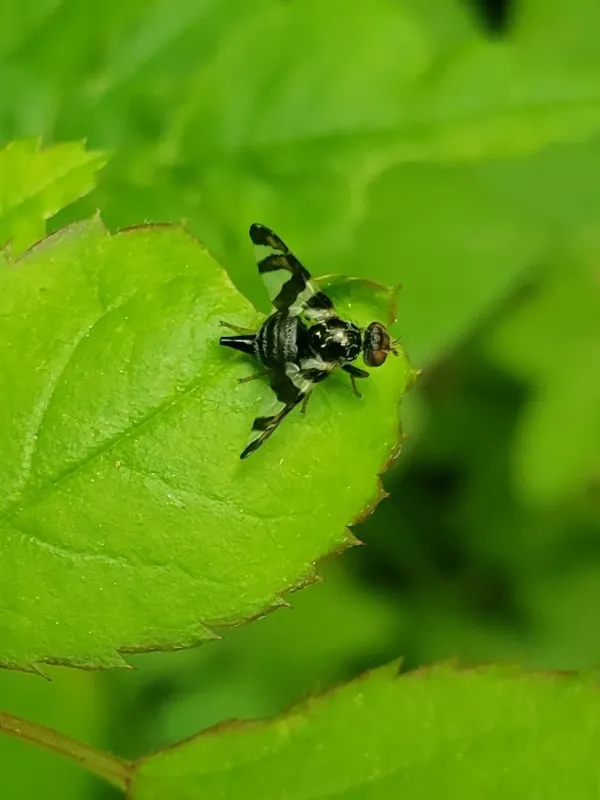
Description
How to identify
Fruit flies of the genus Procecidochares belong to the Tephritidae family, order Diptera. These are small insects, often distinguished by a characteristic spotted pattern on their wings, which is why they are commonly referred to as peacock flies or picture-winged flies.
Adults have a developed proboscis for feeding on nectar, but the primary threat occurs during the larval stage. Larvae are typically white or yellowish, adapted for living inside plant tissues.
Species of this genus are often highly specialized pests, preferring specific plant families, particularly the Asteraceae (composites).
Identifying adult flies in field conditions is difficult due to their small size, so agronomists usually focus on specific signs of plant damage.
These insects undergo a complete metamorphosis: egg, larva, pupa, and imago.
What it damages
The main damage is caused by larvae, which lead a hidden life inside the host plant's tissues. In most cases, ornamental plants and wild composite species are the primary victims.
Damage manifests as the formation of specific tumors or swellings known as galls. The larva stimulates pathological growth of plant tissue, creating a nutrient-rich environment and a protected shelter for itself.
Damaged stems or flower stalks lose their functionality, leading to stunted growth, shoot deformation, and reduced reproductive capacity of the crop.
In cases of high infestation, the pest can lead to the loss of a significant portion of the blooms, which is critical for flower production businesses.
While many species of this genus have limited importance for industrial crops, their role as pests in breeding plots and greenhouses should not be underestimated.
When it appears
Adult activity peaks during the spring and summer, coinciding with the intense growth of young shoots and the formation of flower buds.
The egg-laying period is synchronized with the most vulnerable developmental phases of the host plant, ensuring that larvae have sufficient resources for development.
The pests usually overwinter in the pupal stage inside galls on plant debris or in the soil, waiting for favorable temperatures for the emergence of the next generation.
Climatic conditions such as humidity and temperature directly affect the speed of generational cycles, which is why population numbers often rise during warmer years.
Monitoring the appearance of the first adults is conducted using yellow sticky traps, which allow for an estimation of the pest density in the field.
Signs of infestation
The primary sign of infestation is the presence of characteristic spherical or spindle-shaped growths on stems and flower stalks.
The plant begins to look stunted; shoots may twist or thicken at the sites of larval localization.
Upon closer inspection, one can notice small holes—exit channels through which the winged insects leave the gall after pupation.
A secondary sign is premature yellowing and wilting of the foliage located above the stem lesion point.
- Presence of galls on stems.
- Deformation and bending of young shoots.
- Lack of flowering or wilting of inflorescences.
- Presence of holes in plant swellings.
Control measures
The primary control measure is the mechanical removal and destruction of galls before the adult insects emerge from them.
It is essential to regularly clear fields and surrounding areas of weeds that can serve as natural reservoirs for the pest.
In greenhouse environments, the use of biological control methods, including entomophages that feed on the fly larvae, is highly effective.
Chemical protection involves the use of systemic insecticides during the peak flight period of adults to prevent egg-laying on stem surfaces.
Crop rotation and spatial isolation of plots help significantly reduce the risk of colonization by this species of picture-winged fly.
Taxonomy
- Latin name
- Procecidochares
- Order
- Diptera (flies)
- Family
- Tephritidae
- EPPO code
- PROISP
Discussion
No discussions yet — be the first.