
Banana stem weevil
Polytus mellerborgii
Description
How to identify
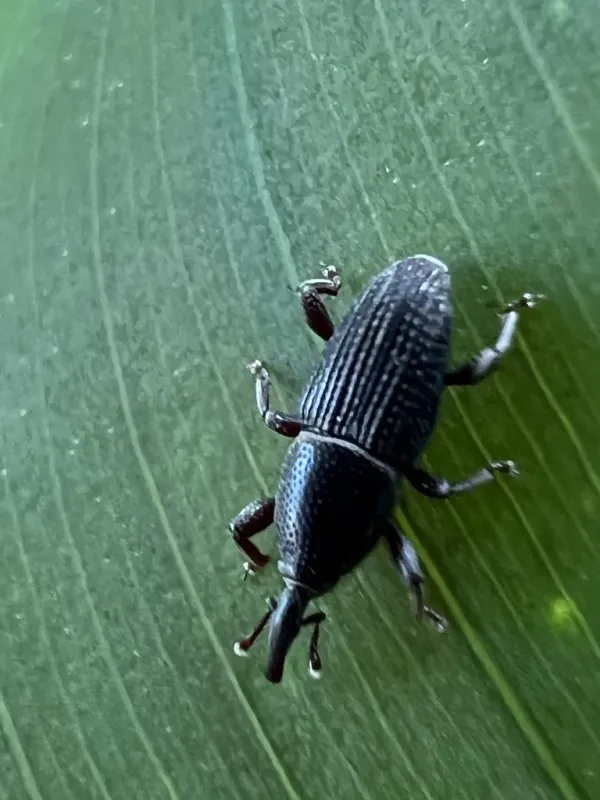
The banana stem weevil (Polytus mellerborgii) is a member of the order Coleoptera and the family Curculionidae. These beetles typically have an elongated body that is dark brown or black in color, measuring approximately 6 to 8 millimeters in length.
The life cycle of this pest is entirely contained within the plant tissues. The female weevil lays its eggs in small cavities that it chews into the base of the pseudo-stem or the banana corm.
The larvae are legless, white in color, and have a well-developed head capsule. They spend their entire development period feeding on the internal tissues of the banana plant.
Pupation occurs within the tunnels bored by the larvae. Once the metamorphosis is complete, the adult beetle chews an exit hole and emerges from the stem or corm.
Population levels can increase rapidly in intensive monoculture systems where phytosanitary practices are neglected and crop rotation is absent.
What it damages
The primary hosts for this pest are various species of banana (Musa spp.). The weevil generally attacks plants that are already weakened or have sustained mechanical damage to their root systems.
The tunneling activity within the corm disrupts the vascular system of the plant, hindering the movement of water and nutrients from the soil to the leaves.
Severe infestation can lead to total destruction of the corm's integrity, resulting in stunted plant growth, low fruit yield, or even the collapse of the plant during windstorms.
Beyond physical damage, the tunnels created by the larvae serve as entry points for various pathogenic fungi and bacteria, leading to secondary rot.
Economic losses are significant, often forcing farmers to perform premature replanting of the affected banana fields.
When it appears
This pest remains active throughout the year, provided that the climatic conditions in the growing region support banana development.
The optimal temperature range for the development of Polytus mellerborgii is between 25 and 30 degrees Celsius, which is characteristic of tropical environments.
High humidity during rainy seasons may reduce the surface activity of adult beetles, but it does not inhibit the larval development occurring inside the plant tissue.
The spread of the weevil to new areas is predominantly driven by the movement of infested plant material used for propagation.
Pest pressure remains consistently high throughout the year as long as a stable supply of host plants is available.
Signs of infestation
Detection in the early stages is extremely difficult due to the secretive behavior of the larvae hidden within the plant structure.
The first external sign is usually the yellowing and premature wilting of leaves, which is often misidentified by farmers as nutrient deficiency or water stress.
A closer inspection of the base of the pseudo-stem may reveal exit holes and small deposits of larval frass, which resemble fine brown sawdust.
Infested plants become structurally unstable and may topple over even during moderate wind, due to the extensive internal damage to the corm.
- Significant reduction in growth rate.
- Signs of necrosis or rot at the stem base.
- Presence of internal tunnels when cutting into the corm.
- Occasional sightings of adult weevils on the surface at night.
Control measures
The primary and most effective management strategy is the use of healthy, pathogen-free planting material, often sourced from tissue culture laboratories.
Cultural practices are essential, including the regular removal of crop debris and the destruction of old stumps that serve as breeding reservoirs for the weevil.
The use of pheromone-based traps is highly effective in monitoring and reducing the population of adult beetles, thereby decreasing the rate of egg deposition.
Chemical control involving the application of insecticides to the base of the plant can suppress infestations, though this must be balanced with environmental safety regulations.
Biological control, using entomopathogenic fungi like Beauveria bassiana, offers a sustainable alternative for managing larval populations within the plantation.
Taxonomy
- Latin name
- Polytus mellerborgii
- Order
- Coleoptera (beetles)
- Family
- Dryophthoridae
- EPPO code
- PLYTME
Discussion
No discussions yet — be the first.