
Conifer rust mite
Platyphytoptus
Description
How to identify
The conifer rust mite (Platyphytoptus) is a microscopic pest belonging to the Eriophyidae family, order Acariformes. These mites are extremely small, typically measuring between 0.1 and 0.2 millimeters, making them invisible to the naked eye.
Their bodies are elongated, worm-like, and pale yellowish-white in color, which allows them to fit perfectly into the narrow grooves of conifer needles where they feed. Unlike spider mites, they do not produce any webbing.
These mites are specialized inhabitants of coniferous plants. They reproduce rapidly during the warmer months, completing their life cycle within a relatively short period, which allows for multiple generations per season.
The overwintering stage usually consists of adult females that hide in protected areas such as needle sheaths, bark crevices, or near the base of buds. They emerge with the onset of spring warmth to initiate the new infestation cycle.
Optimal environmental conditions for these mites include hot and dry weather, which significantly speeds up their life cycle and contributes to rapid population growth throughout the host plant's canopy.
What it damages
Conifer rust mites primarily target species within the Pinaceae family, specifically pines (Pinus), spruces (Picea), and firs (Abies). They tend to favor young trees or those weakened by environmental stress or poor care.
They feed by piercing the surface cells of the needles and sucking out the plant sap. This feeding activity damages the epidermal tissue and chloroplasts, which disrupts the tree’s photosynthetic capacity.
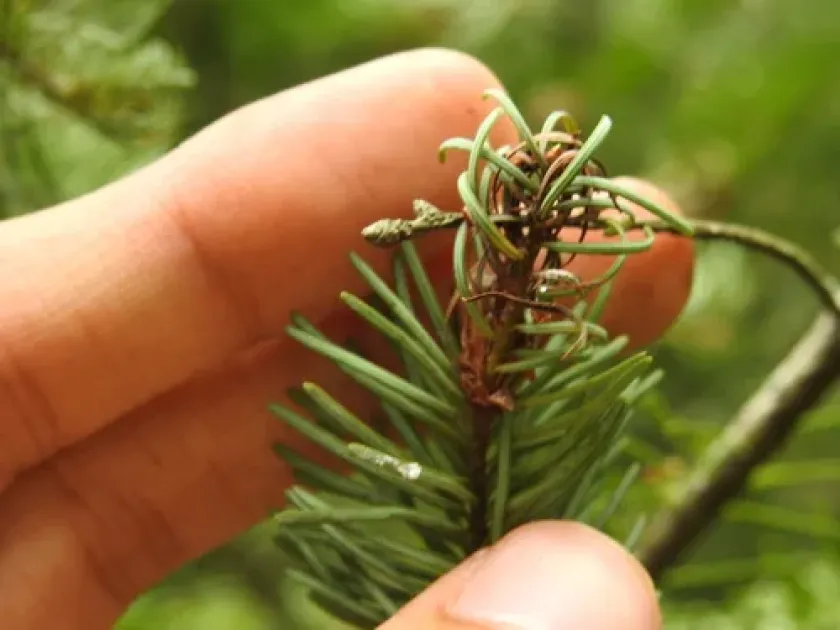
The damaged needles exhibit a loss of turgor, resulting in curling, distortion, and a dull, unhealthy appearance. Affected needles often show stunted growth and look withered compared to healthy foliage on the same tree.
The specific "rust-like" discoloration occurs due to the necrotic response of the plant tissue to the mites' feeding. This bronze or brownish hue is a classic indicator of a severe infestation that significantly impacts the tree's appearance.
Chronic infestation leads to premature needle drop. If left unmanaged, the cumulative damage leads to severe canopy thinning, reduced tree vitality, and makes the tree susceptible to secondary attacks by bark beetles or fungal pathogens.
Signs of infestation
The primary symptom is a change in the needle color from vibrant green to a faded yellow, grey, or rusty brown. The needles look scorched, which can often be mistaken for drought stress or fungal infection.
A closer inspection reveals twisted and malformed needles, particularly on new growth. The foliage loses its natural luster and becomes rough, giving the overall tree a sickly or chlorotic appearance.
Diagnosis requires a magnifying glass or a hand lens with at least 10x to 20x magnification. Mites can be found clustering near the base of the needles or around the bud scales, where they are most protected.
The tree may appear stunted, with reduced annual terminal growth. In advanced stages, severe needle shedding results in a sparse canopy, significantly reducing the aesthetic value of the ornamental planting.
During the spring, check for brown or discolored needles at the base of the previous year's growth. Early detection is critical, as mites can multiply significantly before the discoloration becomes clearly visible across the tree.
Control measures
Controlling conifer rust mites requires the application of specific acaricides, as standard broad-spectrum insecticides are often ineffective against eriophyid mites. Products targeting mites are essential for successful suppression.
Management should begin early in the season as soon as mites become active. Multiple applications spaced 10–14 days apart are usually necessary to target different life stages, including those emerging from eggs.
- Apply acaricides containing active ingredients such as abamectin or spirodiclofen.
- Practice regular canopy irrigation to increase humidity, which naturally discourages mite population growth.
- Prune and destroy heavily infested branches to reduce the overall mite load on the tree.
- Use balanced potassium and phosphorus fertilization to boost the plant's natural defense mechanisms.
It is important to rotate products with different modes of action to prevent the development of mite resistance. Ensure thorough coverage of all needle surfaces, especially inside the canopy where populations often thrive.
Preventive care is highly effective; prioritize healthy soil management and ensure the plants have adequate space to prevent stress. Always inspect new planting stock thoroughly to avoid introducing the pest into the landscape.
Taxonomy
- Latin name
- Platyphytoptus
- Order
- Mites
- Family
- Eriophyidae
- EPPO code
- PLTYSP
Discussion
No discussions yet — be the first.