

Pest · Hymenoptera · affects Apple, Fodder beet, Winter wheat
Especially harmful
Sawflies
Tenthredinidae
Description
How to identify
Sawflies (family Tenthredinidae) belong to the order Hymenoptera. Despite their appearance, they are not flies but relatives of bees and wasps.
The adult sawfly has a distinct saw-like ovipositor used to cut into plant tissues to deposit eggs, which gives the group its common name.
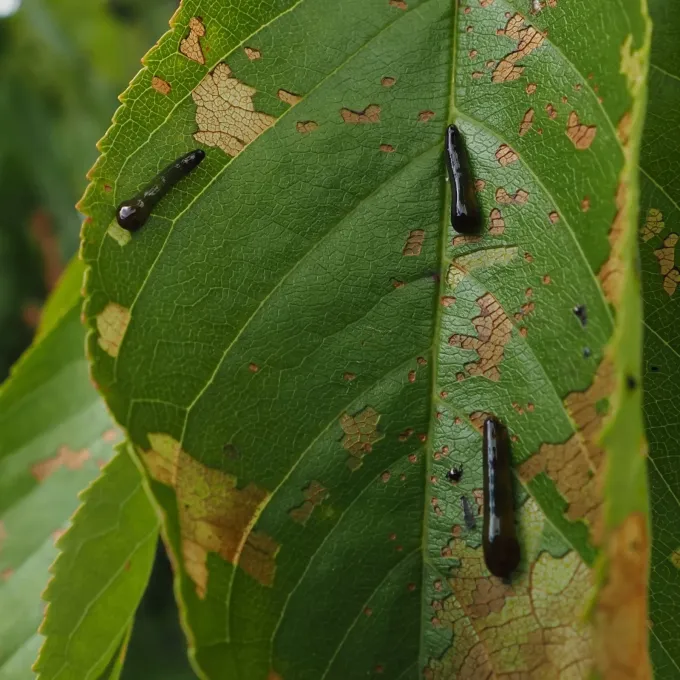
The larvae are known as false caterpillars; they look similar to moth larvae but have more pairs of prolegs, usually ranging from 6 to 8 pairs.
Their head is well-developed with strong mandibles designed for grinding plant tissue, leading to significant defoliation of the host plant.
The bodies of larvae can be brightly colored or camouflaged to mimic their environment, often blending perfectly with leaves or stems.
What it damages
Sawflies affect a wide range of crops, including fodder beet, winter rapeseed, barley, hops, apple, alfalfa, peas, and plums.
Specific species have narrow host ranges, often targeting fruit trees or agricultural crops at different stages of their vegetative development.
The larvae feed on leaves, often starting from the edges or creating circular holes, which significantly reduces the photosynthetic capacity of the plant.
Fruit sawflies are particularly destructive as they burrow into the fruitlets, causing them to drop prematurely or rendering them unmarketable.
Invasive populations can cause rapid defoliation, which stresses the plants and makes them susceptible to secondary diseases and environmental stressors.
When it appears
The life cycle of a sawfly is closely synchronized with the phenology of its host plant to ensure offspring have access to food.
Most species overwinter as pupae or prepupae within the soil, emerging as adults once temperatures rise in the spring.
The adult flight period coincides with the budding or flowering of host plants, as females need these tissues for oviposition.
Larvae feed for several weeks before migrating to the soil to pupate or enter a dormant state, depending on the number of generations per year.
Climate conditions play a crucial role in the development rate, with warmer seasons leading to faster life cycles and potential multiple generations.
Signs of infestation
Early signs of infestation include tiny slits or scars on the leaf tissue where eggs were inserted by the female sawfly.
The most visible symptom is skeletonized foliage, where only the leaf veins remain after the larvae have finished feeding.
Small holes in fruit or "tunnels" leading to the core of the fruit are classic indicators of sawfly damage in orchards.
Frass (larval excrement) found on leaves or the ground beneath the plants is a clear sign that a population is actively feeding.
Observing larvae resting in an 'S' shape or curled up on the underside of a leaf is a definitive way to confirm their presence.
Control measures
Cultural control practices, such as tilling the soil around host plants in late autumn, help expose overwintering pupae to predators and frost.
Hand-picking larvae from small plants or shaking them onto sheets early in the morning is effective for small-scale garden management.
Biological control using parasitic wasps or entomopathogenic nematodes can significantly suppress sawfly populations naturally.
Chemical control should be applied using selective insecticides if monitoring indicates that economic thresholds have been exceeded.
Using yellow sticky traps is a recommended method for monitoring adult flight activity to time insecticide applications accurately.
In brief
14
Damages crops
Content graph
Damages crops · 14
Content graph
Connections · Sawflies
Most often together:
Marketplace
Products · 14


Puska
Три Дельта Компані Інтернешнл, Гонконг, Китай.
Insecticides
1
0
·
1.9K
1 offer
7.76 €per 1 l
Buy


Biology
Taxonomy
- Latin name
- Tenthredinidae
- Order
- Hymenoptera
- Family
- Tenthredinidae
- EPPO code
- 1TENTF
Community
Discussion
No discussions yet — be the first.