
Citrus rust mite
Phyllocoptruta oleivora
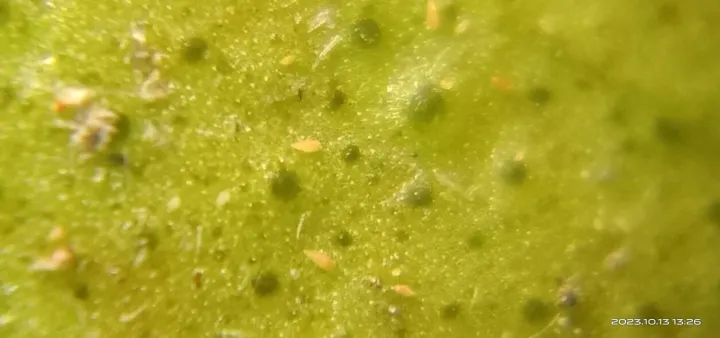
Description
How to identify
The citrus rust mite (Phyllocoptruta oleivora) is a microscopic member of the Eriophyidae family. It is a tiny, wedge-shaped pest, yellow-white in color, measuring only about 0.15 mm in length, making it invisible to the naked eye.
The life cycle of this mite is remarkably fast, particularly in warm and humid conditions. Depending on the ambient temperature, the entire development cycle from egg to adulthood can be completed in just one to two weeks.
Due to its rapid reproductive rate, a single female can contribute to a massive population surge within a short period. In favorable climates, a citrus orchard can host over 20 generations of the mite within a single calendar year.
The mite thrives in environments with high relative humidity and temperatures between 20°C and 30°C. It does not enter a state of true diapause and continues to be active throughout the year where conditions allow.
These pests prefer to inhabit the shaded areas of the tree canopy, specifically targeting developing fruits and the underside of leaves, which often delays early detection by growers.
What it damages
This pest affects all citrus varieties, including lemons, oranges, grapefruits, and limes. The mite feeds by piercing the epidermal cells of the fruit and foliage, extracting the liquid contents.
On lemon fruits, the damage manifests as a silvery discoloration of the rind. On oranges and grapefruits, the result is a distinct, dark brown or rusty-colored scarring, which gives the pest its common name.
The damaged rind becomes thickened and brittle, causing the fruit to lose its commercial value and suffer from dehydration. In severe cases, fruit development is stunted, and severe defoliation can occur.
Beyond the immediate fruit damage, heavy infestations weaken the entire tree. The loss of photosynthetic capacity due to leaf damage impacts the tree's health and reduces fruit yields in subsequent seasons.
Furthermore, the feeding activity of the citrus rust mite can create entry points for pathogens and exacerbate the spread of secondary plant diseases within the orchard.
Signs of infestation
Early identification is difficult due to the mite's microscopic size. The first clear sign is usually a dull appearance of the fruit skin, followed by a bronzing or brownish discoloration.
Leaves affected by the mite may show fine stippling or necrotic spots. As the infestation grows, these spots merge, leading to a general yellowing or browning of the foliage and eventual leaf drop.
Using a 10x magnifying glass, one can observe the mites moving across the surface of the fruit. They are most commonly found near the stem end or in the crevices of the rind where humidity is slightly higher.
Stunted growth of new shoots and a lack of luster in the fruit are primary indicators of a population buildup. Growers should be vigilant when observing early fruit set during high-temperature months.
If the fruit surface feels rough or coarse to the touch, this is a clear sign that the mite population has already caused significant epidermal damage.
Control measures
Managing the citrus rust mite requires an integrated approach that focuses on constant monitoring and the timely application of acaricides. Early intervention is the key to preventing extensive crop losses.
Chemical control involving the use of specialized acaricides is the standard method for large infestations. It is essential to rotate products with different modes of action to prevent the development of mite resistance.
- Application of sulfur-based treatments under suitable temperature ranges.
- Use of systemic and contact acaricides to provide thorough coverage.
- Proper pruning techniques to increase light and airflow throughout the tree canopy.
- Monitoring pest density using hand lenses or trap systems.
- Maintaining vigorous tree health to enhance natural resistance against pests.
Cultural practices, such as proper irrigation and canopy management, can help maintain environmental conditions that are less favorable for mite proliferation. Reducing humidity in the inner canopy significantly limits their growth.
Biological control, including the introduction of predatory phytoseiid mites, has proven to be an effective and sustainable strategy, especially in integrated pest management programs.
Taxonomy
- Latin name
- Phyllocoptruta oleivora
- Order
- Mites
- Family
- Eriophyidae
- EPPO code
- PHYUOL
Discussion
No discussions yet — be the first.