
Citrus rust mite
Phyllocoptruta
Description
How to identify
The citrus rust mite (Phyllocoptruta oleivora) is a microscopic pest belonging to the Eriophyidae family, order Acariformes. Adults are wedge-shaped and pale yellow, measuring only 0.1 to 0.15 mm in length, making them invisible to the naked eye.
The life cycle consists of the egg stage, two larval stages, and the adult stage. Because of their rapid development, they can reproduce extensively under warm and humid conditions, leading to rapid population surges in orchards.
Optimal temperatures for development range from 25°C to 30°C. Under favorable conditions, the mite can complete its life cycle in as little as 7 to 10 days, allowing for up to 20 generations per year.
Dispersal is primarily facilitated by wind, as well as through infested nursery stock and agricultural equipment. They prefer to inhabit the shaded areas of the fruit surface and the underside of leaves.
To identify them in the field, agronomists typically use a 10x or 20x magnifying lens to inspect the shaded parts of the fruit, where the mites congregate to avoid direct sunlight.
What it damages
Citrus rust mites attack virtually all citrus varieties, including oranges, lemons, mandarins, and grapefruit. They are particularly damaging to young, developing fruit and tender vegetative growth.
Damage occurs when the mites feed on the epidermal cells of fruit and leaves, extracting cellular contents. This leads to the loss of chlorophyll and subsequent oxidation, resulting in the characteristic brownish or "rusty" discoloration.
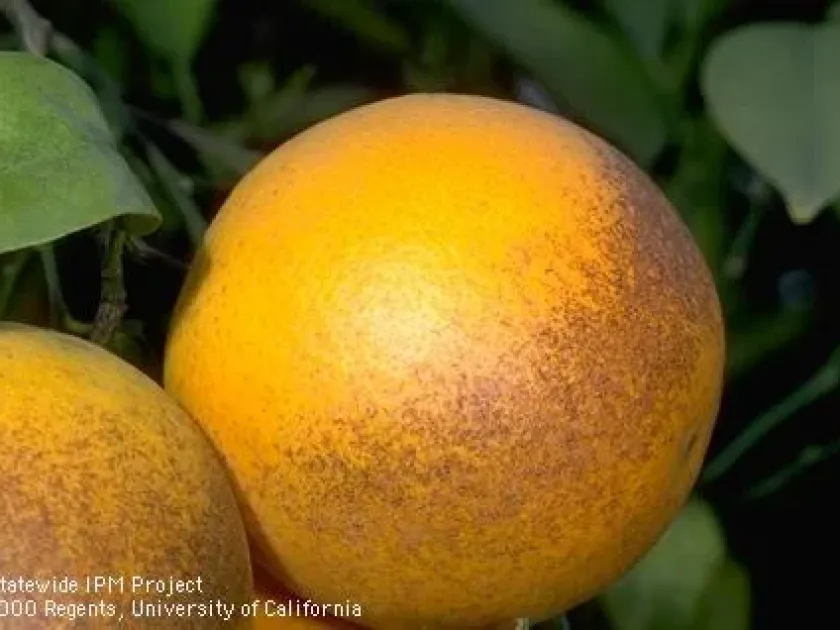
On fruit, this injury manifests as a dull, bronze, or dark brown surface texture. The peel becomes rough and leathery, significantly reducing the commercial value and aesthetic appeal of the harvest.
Affected leaves may curl, show signs of yellowing, and eventually drop prematurely. This defoliation reduces the tree's photosynthetic capacity, which impacts future fruit set and overall plant vigor.
Severe infestations on young fruit can cause significant dwarfing and cracking, rendering the produce unmarketable and susceptible to secondary infections like fungal rot.
When it appears
Peak activity generally occurs during late spring, summer, and early autumn when temperatures are consistently warm. In subtropical climates, the mite can remain active throughout the entire year.
As spring growth begins, the population increases exponentially on new flushes. This is a critical period for scouting and early intervention to keep mite numbers below the economic threshold.
High summer temperatures and humidity provide the most favorable environment for explosive population growth. Periods of drought can temporarily slow activity, but populations often recover quickly after irrigation.
During autumn, as temperatures begin to cool, the mites continue to feed on late-maturing fruit, which can exacerbate the damage as harvest approaches.
Adult females overwinter in bark crevices, around bud scales, or on leaves that remain on the tree, waiting for the return of warmer conditions to resume feeding and reproduction.
Signs of infestation
The most diagnostic sign of infestation is the bronzing or "rusting" of the fruit peel. The smooth, shiny surface of healthy citrus is replaced by a rough, dull, and discolored texture.
Foliage may appear stunted or unhealthy, with microscopic spotting or chlorosis. In advanced infestations, the tree may show signs of general stress, including poor fruit sizing and premature drop.
- Bronze or rust-colored discoloration of the fruit peel.
- Rough and leathery skin texture on citrus fruits.
- Leaf curling and early leaf senescence.
- Premature fruit and blossom drop.
- Stunted growth of new shoots.
It is important to note that the rust-colored patches cannot be washed off, which distinguishes this damage from superficial surface dirt or environmental soot.
Heavy infestations can lead to a condition where the peel becomes extremely thin, leading to rapid water loss and poor shelf life for the harvested fruit.
Control measures
Effective management involves the strategic use of acaricides when monitoring indicates that population levels have reached the economic injury threshold.
A rotating program of different chemical groups is essential to delay the development of resistance. Sulfur-based products and mineral oils are common tools used in integrated pest management programs.
Cultural practices, such as proper tree pruning, help increase light penetration and airflow within the canopy, creating an environment less favorable for mite colonization.
Maintaining tree health through proper fertilization and irrigation helps the plant withstand mite-induced stress, although excessive nitrogen should be avoided as it stimulates excessive succulent growth.
Regular scouting is the cornerstone of control. Using hand lenses to monitor the populations on the fruit allows for targeted spraying, reducing the need for broad-spectrum insecticide applications.
Taxonomy
- Latin name
- Phyllocoptruta
- Order
- Mites
- Family
- Eriophyidae
- EPPO code
- PHYUSP
Discussion
No discussions yet — be the first.