
Pear leaf blister mite
Phyllocoptes lagenosus
Description
How to identify
The pear leaf blister mite (Phyllocoptes lagenosus) is a member of the Eriophyidae family, order Acariformes. It is an extremely small pest, typically measuring only 0.2 to 0.3 mm in length, which makes it invisible to the naked eye.
Its body is worm-like and elongated, which allows it to thrive in the tight spaces between plant tissues. With only two pairs of legs located at the front of its body, it possesses a distinct morphology typical of eriophyid mites.
What it damages
This mite primarily infests pear trees, feeding on the intracellular contents of young leaves and flower buds. By puncturing plant cells, it extracts nutrients necessary for the tree's normal growth.
The damage causes the plant to develop abnormal cell growth patterns known as galls. These structures not only physically damage the leaf but also divert energy away from fruit production, significantly impacting the overall yield.
When it appears
Adult females overwinter under the bud scales of the host tree, remaining dormant until spring. As temperatures rise and bud development begins, they migrate to the emerging foliage to start their life cycle.
The mite goes through several generations during a single growing season. Its development is rapid, and populations can explode during warm, moist periods, leading to widespread tree infestation.
Signs of infestation
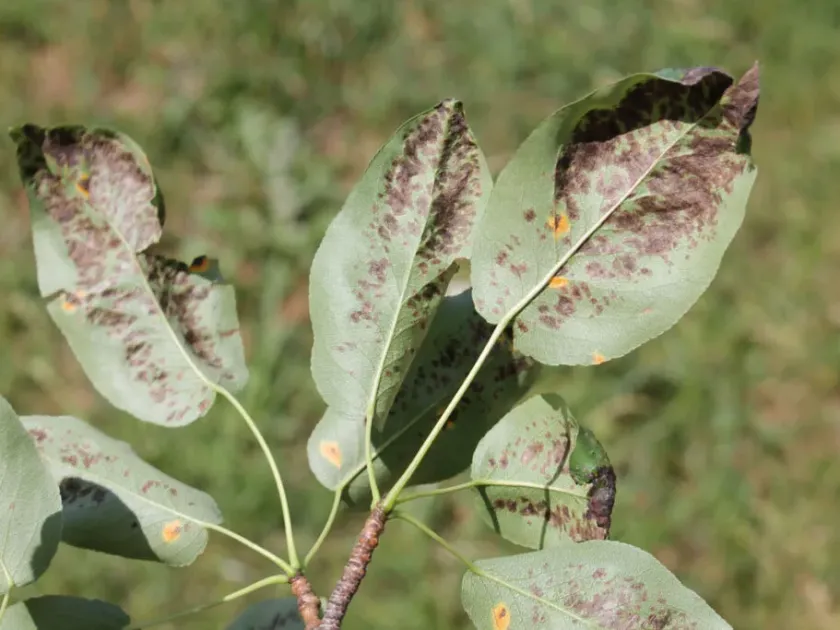
The primary symptom of an infestation is the formation of small, blister-like galls on the leaves. Initially, these galls are light green or yellow, but they darken to brown or black as the tissue dies.
Heavy infestations lead to severe leaf distortion, curling, and early senescence. If left unchecked, the tree may undergo premature defoliation, which weakens the plant and reduces its cold hardiness for the following winter.
Control measures
Control measures should focus on chemical intervention during the most vulnerable periods, specifically during the pre-bloom and post-bloom stages using selective acaricides.
- Apply specialized acaricides in early spring before bud break.
- Prune and destroy heavily infested shoots to reduce local mite populations.
- Utilize sulfur-based sprays to effectively suppress mite activity.
- Ensure proper orchard maintenance to improve tree vigor and resistance to pests.
Taxonomy
- Latin name
- Phyllocoptes lagenosus
- Order
- Mites
- Family
- Eriophyidae
- EPPO code
- PHYCLA
Discussion
No discussions yet — be the first.