
Plum rust mite
Phyllocoptes hypofrons
Description
How to identify
The plum rust mite (Phyllocoptes hypofrons) belongs to the order Trombidiformes and the family Eriophyidae. It is a microscopic mite, measuring less than 0.2 mm in length, which makes it virtually invisible to the naked eye without magnification.
The mite has an elongated, worm-like body and is typically yellowish-white in color. It possesses only two pairs of legs located at the front of its body, which is a diagnostic feature identifying it as a member of the eriophyid mite family.
The lifecycle is tightly synchronized with the host plant. Fertilized females overwinter in bark crevices or near buds. As spring temperatures rise, they emerge to feed on the tender, developing tissues of young leaves and shoots.
During the growing season, these mites produce several generations. The speed of their development is significantly influenced by warm weather, allowing populations to explode within a relatively short period during the summer months.
Dispersal primarily occurs via wind currents, although they can also be transported by pollinating insects or contaminated garden tools. Their ability to survive in very small cracks makes them persistent pests in established orchards.
What it damages
This pest mainly targets plum trees (Prunus domestica) and other stone fruit varieties. By piercing the plant cells and sucking out the contents, the mites induce physiological stress that forces the plant to form abnormal tissue growths.
Signs of infestation
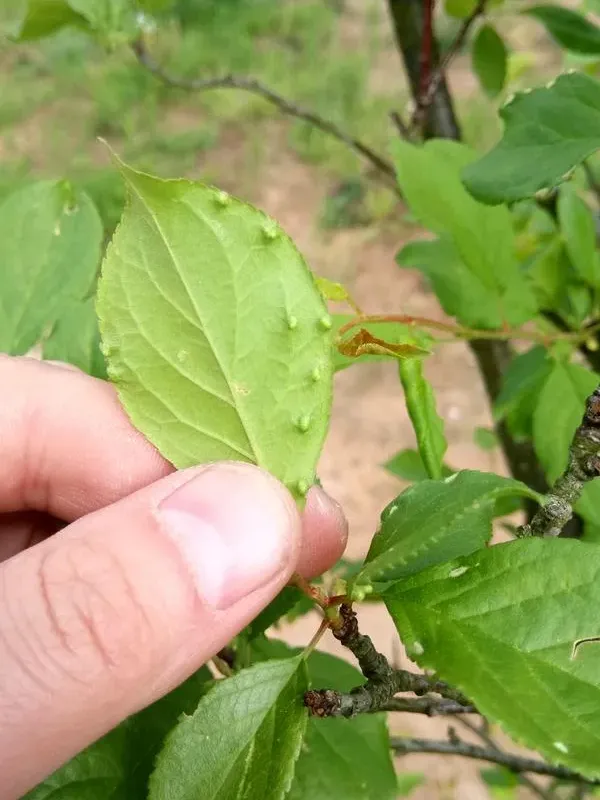
The primary symptom of an infestation is the formation of galls — small, circular bumps on the leaf surface. These galls often change color from green to reddish or brown as they age, significantly altering the appearance of the foliage.
Severe infestations lead to stunted leaf growth, curling, and premature leaf drop. The reduction in photosynthetically active leaf area prevents the tree from storing enough energy, which directly impacts fruit set and the overall development of the tree.
Malformed shoots and thickened, distorted buds are common indicators of established mite colonies. When the infestation is intense, the entire tree may appear weak, with reduced vitality and poor resistance to subsequent environmental stressors.
Diagnosing the presence of the mite is challenging because the pests reside within the galls. Monitoring involves inspecting young leaves for early signs of puckering or discoloration immediately after the flowering stage concludes.
Control measures
Controlling the plum rust mite is difficult because the mites are protected inside the galls where contact insecticides are ineffective. Management relies on timing applications to coincide with the mites' migration periods.
- Apply sulfur-based acaricides during the pre-bloom stage.
- Use systemic acaricides when monitoring shows a threshold level of infestation.
- Prune and destroy heavily infested branches during the dormant winter season.
- Maintain optimal tree vigor through balanced fertilization and adequate irrigation.
- Keep orchard sanitation high by removing debris from around the trunks.
Taxonomy
- Latin name
- Phyllocoptes hypofrons
- Order
- Mites
- Family
- Eriophyidae
- EPPO code
- PHYCHY
Discussion
No discussions yet — be the first.