
Pear leaf blister mite
Phyllocoptes balanites
Description
How to identify
The pear leaf blister mite (Phyllocoptes balanites), also known as the pear bud mite, belongs to the family Eriophyidae. These are extremely small pests, measuring approximately 0.15–0.25 mm in length, making them invisible to the naked eye.
The mite has a worm-like, elongated, and segmented body, typically white or yellowish in color. They have only two pairs of legs, which are located at the front of the body, allowing them to move slowly across the leaf surface.
The life cycle of this mite is highly synchronized with the phenology of the pear tree. Fertilized females overwinter in large clusters, protected under the scales of dormant buds.
As the tree begins to sprout in early spring, the mites emerge from their overwintering sites. They migrate to the newly developing leaves to feed and begin the cycle of reproduction for the new season.
Inside the galls they induce, mites multiply rapidly, creating multiple generations throughout the growing season. This reproductive capacity allows them to colonize new parts of the tree canopy very efficiently.
What it damages
The primary host for this pest is the pear tree. The mite feeds by piercing the epidermal cells of leaves, which triggers the plant to develop characteristic pathological outgrowths known as galls.
These galls initially appear as small raised areas and eventually turn brown or black as the tissue dies. Heavy infestations lead to extensive leaf damage, causing reduced photosynthetic efficiency and premature leaf drop.
When the mite population is high, the damage can extend to fruit clusters, causing deformities and skin blemishes on the developing pears. This significantly impacts the marketability and quality of the harvest.
Young trees are particularly susceptible to stress caused by mite activity. Sustained damage over several seasons can severely retard the growth of saplings and make the entire tree more vulnerable to environmental stress.
Beyond direct physical damage, the constant feeding weakens the tree’s overall physiological state. This makes infested trees more prone to secondary infections, including various bacterial and fungal pathogens.
When it appears
Mite activity commences in early spring as soon as temperatures rise, usually coinciding with the green tip stage of the pear buds. This is when the overwintered females begin to migrate to the opening foliage.
The period from late spring through summer marks the peak of their activity and reproductive cycle. During these months, the mites are constantly feeding, developing, and spreading across the tree.
As autumn approaches and temperatures drop, the mites finish their cycle. The last generation of females seeks shelter in the bud scales or deep within the bark crevices, where they will remain inactive until the following year.
The intensity of the infestation can vary depending on weather conditions. Warm and humid conditions generally favor mite development, while dry spells may slow down the colonization of new leaves.
Gardeners should monitor their trees closely from the early stages of bud burst. Detecting the presence of the pest early is crucial for preventing widespread damage across the orchard throughout the summer.
Signs of infestation
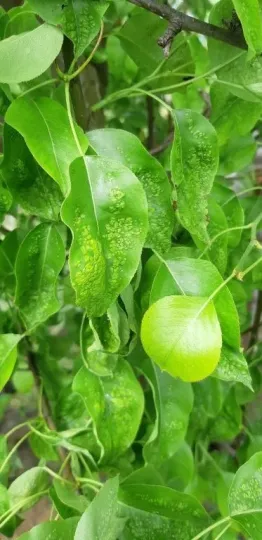
The most distinctive symptom of a pear leaf blister mite infestation is the appearance of small, raised galls on the leaves. At first, these spots are bright green or yellowish, but they darken to brown and eventually black.
The affected leaves often show signs of curling, distortion, and yellowing. In severe cases, the foliage may look scorched, leading to significant defoliation long before the natural onset of autumn.
- Presence of tiny, blister-like galls on the leaf surface.
- Gradual change of gall color from light green to dark brown.
- Deformed and curled leaves throughout the canopy.
- Premature leaf senescence and thinning of the tree crown.
To confirm the presence of the mite, one can use a hand lens to examine the underside of the leaf or the inside of the galls. The mites themselves, appearing as microscopic white specks, will be visible within these structures.
It is important to differentiate mite damage from fungal diseases like pear scab. While scab often manifests as irregular spots with a velvety appearance, mite galls are distinct, raised blister-like tissues.
Control measures
Effective management begins with dormant season treatments. Applying acaricides or sulfur-based sprays before the buds open is the most efficient way to reduce the overwintering population before they spread.
Sanitation is a vital part of the control strategy. During the winter pruning season, heavily infested branches should be removed and destroyed to minimize the number of mites that will emerge in the spring.
In-season control can be difficult because the mites are protected inside the galls. If an infestation is discovered, systemic acaricides may be used, though timing must be precise to catch the mites during their migration phases.
Promoting tree health is essential for resilience. Regular irrigation and balanced fertilization help the tree compensate for leaf loss and support the development of new, healthy foliage throughout the growing season.
Integrated Pest Management (IPM) encourages the preservation of natural predators, such as predatory mites and ladybeetles. Reducing the use of broad-spectrum pesticides can help these beneficial insects keep mite populations in check.
Taxonomy
- Latin name
- Phyllocoptes balanites
- Order
- Mites
- Family
- Eriophyidae
- EPPO code
- PHYCBA
Discussion
No discussions yet — be the first.