
Raspberry eriophyid mite
Phyllocoptes adalius
Description
How to identify
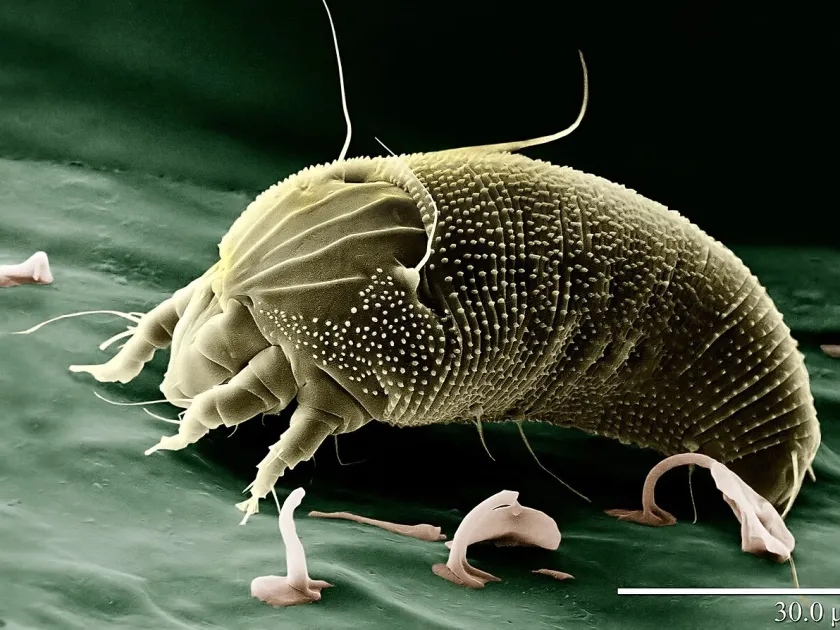
The Raspberry eriophyid mite (Phyllocoptes adalius) belongs to the Eriophyidae family, which consists of tiny, microscopic mites. These pests are worm-like in shape and typically measure between 0.1 to 0.2 mm in length.
Because of their minuscule size, they are impossible to see without the aid of a hand lens or microscope. They are primarily located in the buds and on the underside of leaves, where they form large colonies protected from environmental stress.
Taxonomically, they are classified under the order Acariformes. Unlike spider mites, these mites have only two pairs of legs, a unique characteristic of the Eriophyid family.
The life cycle is rapid, consisting of egg, nymphal, and adult stages. Favorable temperatures allow them to complete their life cycle in just a few days, leading to multiple generations per season.
Identification is mostly confirmed by analyzing the characteristic damage symptoms and using high-magnification field equipment to observe the mites directly in the host tissue.
What it damages
These mites are specialized pests that exclusively feed on raspberry and blackberry plants. They pierce the epidermis of leaves and buds to feed on plant cell contents.
Their feeding causes significant physiological disruption, leading to stunted growth, leaf deformation, and reduced photosynthetic activity in the plant tissues.
Buds heavily infested by these mites often fail to develop normally, resulting in weak shoots or complete bud abortion, which significantly decreases total fruit yield.
The cumulative effect of infestation leads to a decline in plant vigor, making the raspberry canes more susceptible to harsh winter conditions and various secondary diseases.
Economic losses occur due to the reduction in both fruit quantity and quality, as deformed leaves cannot support the development of healthy, plump berries.
When it appears
The mites emerge from their overwintering sites, typically under the bud scales, as soon as temperatures rise in the early spring, coinciding with bud burst.
Population growth is most aggressive during the late spring and summer months when warm and stable weather conditions provide optimal breeding environments.
Throughout the summer, wind and mechanical transport help the mites spread from infested plants to healthy neighbors, widening the area of infestation.
As the season progresses toward autumn, mating occurs, and fertilized females seek shelter in the plant crevices, particularly near the buds, to overwinter.
The pest pressure remains high throughout the entire vegetative period, making monitoring essential from the moment growth starts until the end of the harvest season.
Signs of infestation
The most visible symptom is the curling or distortion of young, apical leaves, often accompanied by chlorotic spots that indicate local cell tissue damage.
Plants may exhibit a characteristic "bunchy" or stunted appearance, where internodes become shortened and multiple weak shoots emerge from a single bud.
Chlorotic spots might appear yellow or bronze, often creating a mosaic-like pattern on the foliage that can eventually lead to leaf necrosis if infestation is severe.
During spring, failed or deformed bud growth is a critical indicator of a high mite population that successfully overwintered in those specific locations.
Differentiating between mite damage and viral infection is crucial, as both can cause leaf curling, but mite damage will show live colonies under magnification.
Control measures
Management strategies should focus on an integrated approach, prioritizing cultural practices to reduce mite populations before they reach economic thresholds.
Removing and burning infested canes is a highly effective cultural method to prevent the spread of the mite population to healthier sections of the plantation.
Chemical control must be timed carefully; the best results are achieved with early spring applications when mites are moving out of their hibernation sites.
- Apply sulfur-based acaricides during the early vegetative stage.
- Rotate chemical products to prevent the development of mite resistance.
- Use systemic acaricides to reach mites protected within leaf tissues.
- Source only certified, pest-free planting stock for new raspberry beds.
Biological control using predatory mites (phytoseiids) can be an effective long-term solution in greenhouses or sustainable farming systems.
Taxonomy
- Latin name
- Phyllocoptes adalius
- Order
- Mites
- Family
- Eriophyidae
- EPPO code
- PHYCAD
Discussion
No discussions yet — be the first.