
Plum gall mite
Phyllocoptes abaenus
Description
How to identify
The plum gall mite (Phyllocoptes abaenus) is a microscopic pest belonging to the order Trombidiformes and the family Eriophyidae. These mites are extremely small, measuring only 0.15–0.2 mm in length, and possess a worm-like, elongated body structure.
Due to their microscopic size, they are impossible to see with the naked eye. They have only two pairs of legs located at the front of the body, which is a characteristic feature of this mite family, allowing them to crawl on leaf surfaces.
Adult females overwinter in sheltered locations, typically beneath bud scales or within cracks in the bark of one- or two-year-old branches. As soon as temperatures rise in the spring and buds begin to swell, they emerge and start feeding on developing plant tissues.
The mite's life cycle is rapid, especially during warm and humid weather. Once they penetrate the leaf tissue, they secrete enzymes that trigger the plant to form galls, which serve as a protected micro-environment for the mites to feed and reproduce throughout the summer.
Dispersal within an orchard occurs passively. Mites are easily carried by wind currents, visiting insects, or even through contaminated pruning tools. This allows the infestation to spread rapidly across individual trees and eventually to adjacent plants.
What it damages
This mite primarily attacks stone fruit trees of the Prunus genus, most notably plums, damsons, and blackthorns. The damage is localized to the leaves, which are essential for the plant's metabolic and photosynthetic processes.
By piercing the plant cells and injecting saliva, the mites cause localized hypertrophy, leading to the formation of galls. These structures divert nutrients away from healthy tissue, weakening the overall vitality of the tree and reducing its ability to photosynthesize.
Severe infestations lead to premature leaf drop, which stresses the tree significantly. This stress can impact fruit development, resulting in smaller, lower-quality yields and a reduced capacity for the tree to store reserves for the following season.
Furthermore, trees weakened by prolonged gall mite activity show decreased winter hardiness. This makes them more susceptible to cold damage and secondary infections by fungi or bacteria that target the weakened bark and vascular system.
In cases of heavy infestation, the cumulative impact leads to reduced growth of new shoots and, if left unchecked, the progressive decline of the tree's health over several years, rendering it less productive and economically unviable.
Signs of infestation
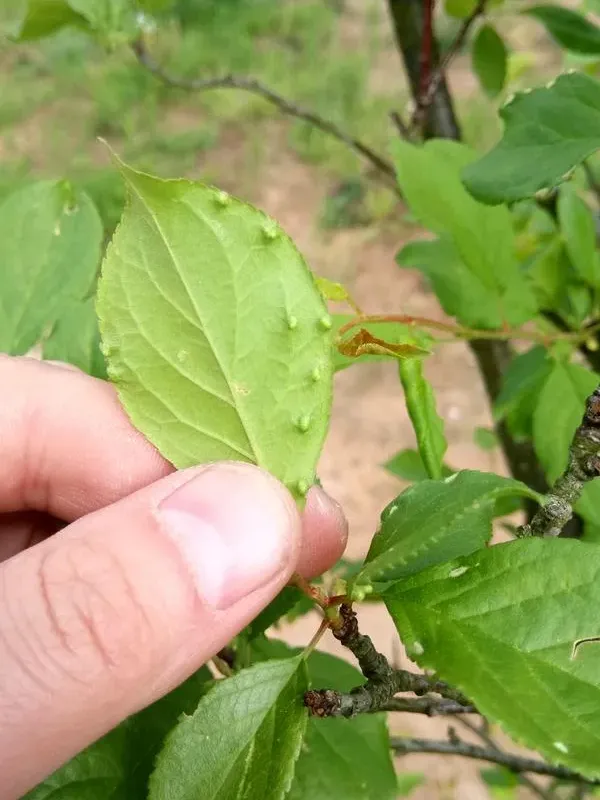
The most prominent sign of a plum gall mite infestation is the appearance of galls on the leaves. These are small, cone-shaped, or elongated protrusions that usually emerge on the upper side of the leaf surface.
When the galls first form, they appear green, matching the color of the leaf. However, as the colony grows and the mites feed inside, the galls often transition to reddish, yellow, or brownish hues, making them highly visible against the leaf background.
Each gall is a hollow structure. On the underside of the leaf, directly below the gall, there is typically a tiny opening or orifice that allows the mites to move in and out of their protected habitat to colonize new parts of the leaf.
Infected leaves often become curled, brittle, and distorted. If the infestation is widespread, the foliage may look stunted or chlorotic. A visual inspection of the canopy in late spring or early summer is usually sufficient to confirm the presence of the pest.
While individual galls might seem harmless, their presence in large numbers across the tree indicates a major infestation that requires immediate attention to prevent further spread and long-term damage to the plant's development.
Control measures
Effective management begins with strict sanitation practices. Growers should manually remove and destroy highly infested leaves and twigs. By burning or bagging this material, the population of the mite is reduced significantly before they migrate to new growth.
Chemical control is most effective when timed with the mites' migration periods. The most critical application window is early spring, just before bud burst, and during the 'green cone' stage when the mites are emerging from their winter hibernation.
Recommended strategies for controlling the plum gall mite include:
- Applying sulfur-based acaricides during the growing season when temperatures are above 18°C (64°F).
- Using systemic acaricides that possess deep tissue-penetrating properties to reach mites inside the galls.
- Maintaining tree health through proper pruning to improve airflow and reduce humidity levels within the canopy.
It is important to emphasize that general-purpose insecticides are rarely effective against mites, as these belong to a different taxonomic group. Always select specific acaricides or biological agents labeled for mite control to ensure success.
Long-term prevention is supported by balanced fertilization and adequate irrigation. A tree that is not suffering from other nutritional or environmental stressors is much better equipped to tolerate and recover from pest attacks when they do occur.
Taxonomy
- Latin name
- Phyllocoptes abaenus
- Order
- Mites
- Family
- Eriophyidae
- EPPO code
- PHYCAB
Discussion
No discussions yet — be the first.