
Phyllocoptes mite
Phyllocoptes
Description
How to identify
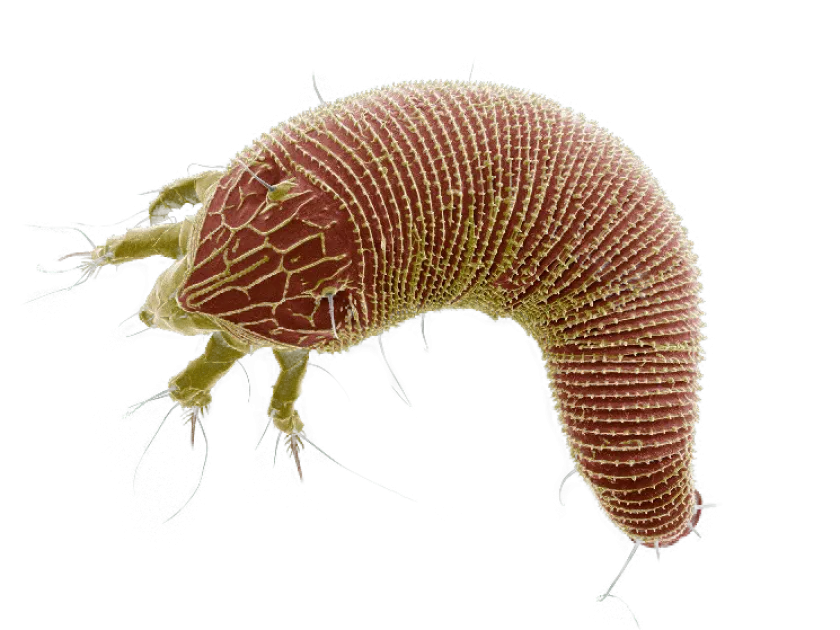
The Phyllocoptes genus belongs to the Eriophyidae family, commonly known as four-legged mites. These are extremely small pests, typically measuring between 0.1 and 0.3 mm in length.
Their bodies are vermiform or fusiform, often tapering at the posterior end, which is a characteristic feature of this family. They are nearly invisible to the naked eye, appearing as tiny yellowish or white specs.
Unlike most mites that have eight legs, these mites possess only two pairs of legs, both situated near the head. This anatomy limits their movement, which is often slow and requires them to use their posterior end as a sucker.
The mouthparts are piercing-sucking, specifically adapted for penetrating epidermal cells and injecting saliva that alters the plant's growth pattern.
The life cycle consists of an egg, two nymphal stages, and an adult. They reproduce rapidly, allowing populations to explode within a single growing season under favorable conditions.
What it damages
These mites affect a wide range of host plants, including fruit trees, berry bushes, and various ornamental species, focusing primarily on young, actively growing tissues.
Feeding triggers the formation of galls, which are abnormal plant growths that provide the mites with protection and a source of concentrated nutrients.
By interfering with plant hormones, the mites cause leaf curling, puckering, and severe deformities, which ultimately reduce the plant's photosynthetic efficiency.
When flowering buds are attacked, the resulting flowers may become stunted or deformed, leading to significant yield losses in fruit-bearing plants.
High levels of infestation weaken the host plant significantly, making it more susceptible to other secondary diseases and reducing its overall lifespan.
When it appears
The activity begins in early spring as temperatures rise, triggering the emergence of overwintering females from bark crevices or dormant buds.
During the summer months, the mites undergo several generations, especially during hot and dry weather periods, which speed up their reproductive cycle.
The peak of their population is usually observed during the period of intensive shoot growth, when young, succulent tissue is most abundant for colonization.
As autumn approaches and temperatures drop, specialized females (deutogynes) are produced to survive the winter in protected niches on the host plant.
Monitoring is crucial throughout the spring and early summer, as rapid multiplication can cause extensive cosmetic and physiological damage in a short time.
Signs of infestation
The most distinctive symptom is the appearance of galls — small bumps, bulges, or pits that vary in color from pale green to deep red or brown.
Some species cause the development of "erineum," which is a dense mat of hair-like growths on the undersides of leaves, often where the mite colony is active.
Leaf twisting, curling, and severe wrinkling are common signs, often making it difficult for the leaves to fully expand or perform normal gas exchange.
Stunted growth of apical shoots is a classic sign of a heavy infestation, where the mite feeding disrupts the normal developmental signals of the plant.
- Irregular patches or spotting on leaves.
- Severe leaf curling or distortion.
- Premature leaf drop in heavily infested branches.
Control measures
Chemical control involves the application of specific acaricides, as traditional insecticides are often ineffective against these types of mites.
The timing of the application is critical; the most effective treatments are usually conducted in early spring, precisely when the mites emerge from their overwintering sites.
Sanitation practices, including the pruning and destruction of infested shoots, are essential to reduce the local population density in the garden.
Maintaining plant vigor through proper fertilization and irrigation helps the host withstand mite damage, as healthy plants show more resilience.
Biological control, such as conserving predatory mites (e.g., Phytoseiidae), is a highly effective way to suppress Phyllocoptes populations in sustainable gardening.
Taxonomy
- Latin name
- Phyllocoptes
- Order
- Mites
- Family
- Eriophyidae
- EPPO code
- PHYCSP
Discussion
No discussions yet — be the first.