
South American tomato pinworm
Phthorimaea absoluta
Description
How to identify
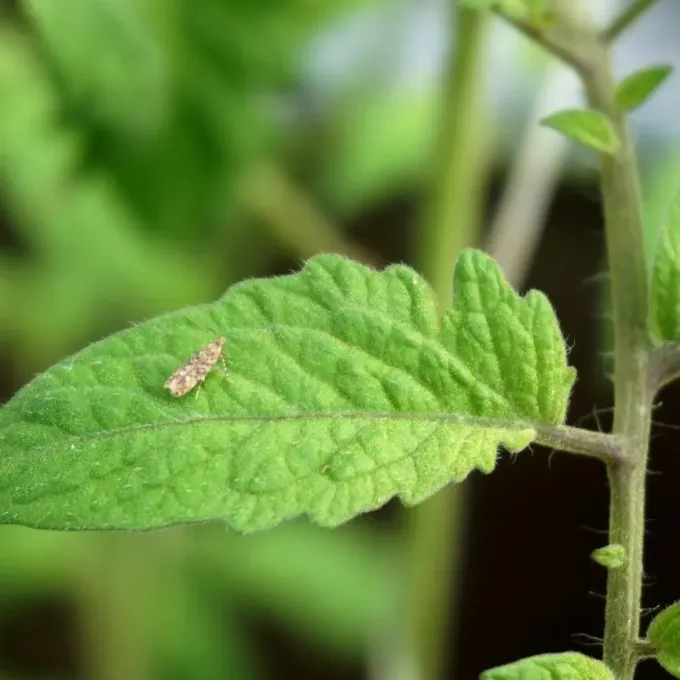
The South American tomato pinworm (Phthorimaea absoluta), also widely known as Tuta absoluta, is a highly destructive moth from the Gelechiidae family. Adults are small, silver-gray moths with a wingspan of approximately 10 mm and distinct black spots on their forewings.
The life cycle encompasses eggs, four larval instars, pupae, and adults. In optimal greenhouse conditions, the entire cycle can be completed in less than a month, enabling multiple overlapping generations per season.
Females are highly fecund, laying up to 250 eggs throughout their lifespan. Eggs are cylindrical, creamy-yellow, and usually deposited on the undersides of leaves or on stems, where they are protected from environmental exposure.
Larvae are the primary damaging stage. They emerge as small, cream-colored caterpillars with a dark head, eventually turning green or light pink as they mature. Their agility allows them to quickly burrow into plant tissues.
Pupation may occur in the soil, on the leaf surface, or within the mines they create. This versatility in pupation sites makes the pest remarkably resilient and difficult to eradicate using standard surface treatments.
##damage##The primary host is the tomato, but the pest also infests potatoes, eggplants, peppers, and various wild solanaceous weeds. It can thrive in both greenhouse environments and open-field cultivation systems.
Larvae are leaf miners, meaning they consume the mesophyll tissue between the leaf surfaces. This creates large, transparent, blotch-like mines that eventually necrotize, severely hindering photosynthesis.
Fruit damage is the most critical economic concern. Larvae penetrate the fruit, leaving entry holes that are prone to secondary infections from bacteria and fungi, causing the fruit to rot rapidly and become unmarketable.
Stem damage is also common, particularly in young plants. The larvae tunnel into the stalks, which can cause stunted growth, wilting, and in severe cases, the death of the entire plant.
Due to the pest's ability to develop resistance to common insecticides, infestations can lead to total crop loss if not managed with a comprehensive Integrated Pest Management (IPM) approach.
##signs##The most recognizable symptom is the presence of irregular, translucent mines on the foliage. These mines often contain black or brown frass (excrement) left by the larvae as they feed inside the leaf.
On fruits, look for small, circular entry points, typically found near the calyx or stem attachment. These holes are often associated with shriveled or discolored skin around the fruit base.
Adult moth activity can be monitored using pheromone traps. Seeing small, gray moths flying around the greenhouse or landing on leaves is a clear indicator of a potential infestation peak.
Wilting of leaves or shoots, despite adequate irrigation, may suggest internal damage caused by larval tunneling within the stem vascular system.
Spiderweb-like structures on leaves or buds, combined with curled and deformed growth, often indicate that the larvae are active in the plant's apical meristems.
##control##Management relies on an integrated strategy involving strict sanitation, biological controls, and judicious chemical use. Removing all crop debris after harvest is essential to break the pest's cycle.
Biological control agents, such as predatory mirid bugs (e.g., Nesidiocoris tenuis or Macrolophus pygmaeus) and egg parasitoids like Trichogramma species, have proven highly effective in controlling larval populations.
Pheromone-based mating disruption is a powerful tool to reduce the number of fertile females, significantly lowering the pressure of the next generation of larvae.
When chemical intervention is required, rotating insecticides with different modes of action is critical to preventing the development of resistance. Selective, biorational pesticides are preferred to minimize impact on beneficial insects.
Core control practices include:
- Installing physical barriers like insect-proof netting in greenhouses.
- Using pheromone and light traps for monitoring and mass trapping.
- Regular inspection of transplants for eggs or larvae.
- Applying biological pesticides like Bacillus thuringiensis.
Taxonomy
- Latin name
- Phthorimaea absoluta
- Order
- Lepidoptera (butterflies)
- Family
- Gelechiidae
- EPPO code
- GNORAB
Discussion
No discussions yet — be the first.