
Phryxe fly
Phryxe
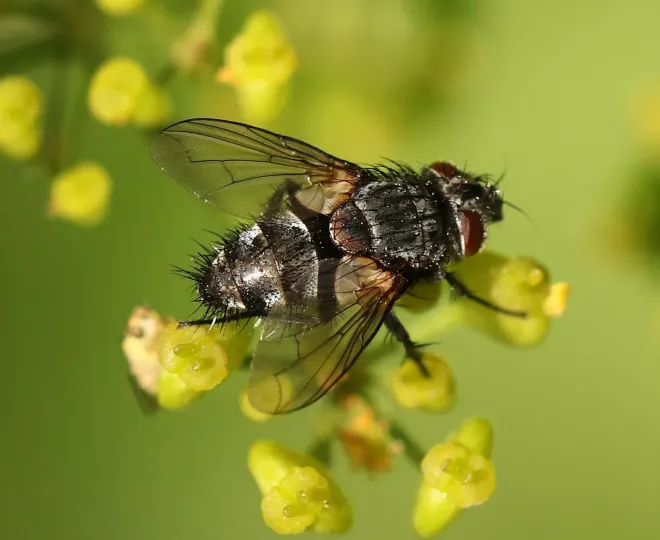
Description
How to identify
The Phryxe genus belongs to the Tachinidae family, known as tachinid flies. These are robust, bristly flies that often resemble houseflies but are more heavily built.
Adult flies typically measure between 5 to 10 mm in length. Their coloration is usually gray, black, or dark brown, sometimes with metallic highlights, providing camouflage in foliage.
Key physical traits include prominent bristles on the abdomen and thorax. They possess large compound eyes and a functional proboscis for feeding on nectar and plant juices.
The wings are strong, allowing for quick, darting flights when searching for hosts or sources of sugar. Their morphology is highly adapted for an active, parasitic lifestyle.
Differentiating species within the Phryxe genus often requires an expert examination of abdominal bristle patterns and genitalia to ensure accurate classification.
What it damages
The Phryxe fly is not a crop pest in the traditional sense; rather, it is a specialized parasitoid that targets specific species of butterfly and moth larvae (caterpillars).
Because these caterpillars are often significant agricultural pests, the Phryxe fly acts as a beneficial biocontrol agent, naturally reducing the damage caused to crops.
Farmers do not need to worry about the fly causing harm to vegetation. Their presence is a sign of a functioning ecosystem where predatory and parasitic insects are active.
However, it is vital to correctly identify the larvae the fly targets to ensure the fly is acting on a relevant pest species in your specific agricultural environment.
In short, these insects are allies to the gardener and farmer, contributing to the biological suppression of caterpillars that feed on cabbage, leaves, and stems.
When it appears
The life cycle of the Phryxe fly is highly synchronized with the developmental stages of its host caterpillars. Adult flies emerge as temperatures warm in the spring.
These flies are most active during the warmer months, typically from late spring through late summer, corresponding with the peak growth cycles of their target hosts.
During the day, adults are busy mating and feeding on nectar. Their lifespan as adults is relatively short, focusing primarily on reproduction and host location.
They typically overwinter in the pupal stage, buried in the soil or protected within leaf litter, emerging when environmental conditions become suitable for host development.
Multiple generations per year are possible in regions with long, warm growing seasons, provided the host population is sufficient to support the parasite’s life cycle.
Signs of infestation
The primary sign of the fly's presence is the discovery of white, oval-shaped eggs glued to the skin of a caterpillar. This is a clear indicator that the host is parasitized.
As the fly larvae develop inside the host, the caterpillar may exhibit reduced feeding behavior, lethargy, and an overall decline in health and vitality.
In the final stages of the parasitoid’s larval development, the caterpillar usually dies. The larva then exits the host to pupate, leaving behind a husk of the caterpillar.
Farmers can monitor for these signs by inspecting leaves for caterpillar activity and checking individual larvae for the presence of parasitic eggs.
Finding small, dark, barrel-shaped puparia in the soil under infested plants is another reliable sign that a successful generation of Phryxe flies has completed its cycle.
Control measures
There is no reason to control the Phryxe fly as it is a beneficial insect. Efforts should instead focus on protecting these natural allies from unnecessary chemical exposure.
Avoid the broad-spectrum use of insecticides, especially during the flowering stage, as these chemicals will kill both the pests and the beneficial Phryxe flies.
Promote biodiversity on the farm by planting flowering borders. Nectar sources are essential for sustaining the adult fly population and increasing their efficiency.
Implement Integrated Pest Management (IPM) practices, which prioritize biological and physical controls over synthetic chemical applications to maintain healthy populations.
By minimizing pesticide use and fostering a balanced environment, you can harness the natural pest-suppression power of the Phryxe fly to protect your crops.
Taxonomy
- Latin name
- Phryxe
- Order
- Diptera (flies)
- Family
- Tachinidae
- EPPO code
- PRYXSP
Discussion
No discussions yet — be the first.