
Archytas apicifer
Archytas apicifer
Description
How to identify
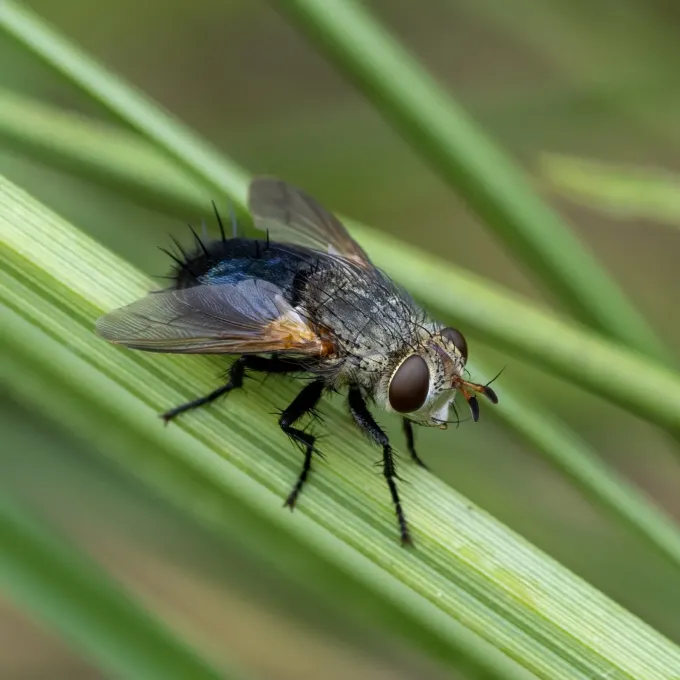
Archytas apicifer is a large fly belonging to the Tachinidae family, order Diptera. Visually, adult individuals resemble bumblebees due to their dense hair covering and coloration, a form of mimicry.
The body length of the insect reaches 10–15 mm, with robust legs and a developed proboscis. The color is predominantly dark with yellow or orange hairs on the abdomen, making them look similar to stinging hymenopterans.
The larvae of this species undergo several stages of development inside the host's organism. They have a typical tachinid shape, adapted for a parasitic lifestyle, and are equipped with specialized spiracles for gas exchange through the victim's tissues.
Identification of the species requires a detailed examination of head structures and setae on the body, as the Tachinidae family contains numerous similar forms that differ only in fine morphological features.
Adults lead an active lifestyle, feeding on flower nectar, while their reproductive strategy is entirely focused on locating host larvae to ensure the development of their offspring.
What it damages
While many tachinid species are beneficial as entomophages, Archytas apicifer is considered in the context of complex biological interactions within agroecosystems. The primary victims are larvae of lepidopteran pests attacking various field crops.
Crops affected by the activity of these flies include corn, sunflowers, and various grain legumes, where host caterpillars commonly develop.
The damage is indirect: excessive suppression of beneficial predator insect populations or disruption of the agroecosystem balance can lead to unintended effects on beneficial species due to the parasite's life cycle.
Larvae inside the host feed on its internal organs, gradually exhausting its vitality, which eventually leads to the death of the pest caterpillar.
Agronomic significance lies in assessing the fly's effectiveness as a regulator of phytophagous insect populations within integrated plant protection systems.
When it appears
The activity of Archytas apicifer adults occurs during the warm season, usually from early summer to early autumn, when the population of host caterpillars is at its peak.
The development cycle is closely tied to temperature conditions: optimal conditions for egg-laying are observed at air temperatures above +20 degrees Celsius.
Overwintering usually takes place in the puparium stage in the soil or plant debris, allowing the insect to survive unfavorable winter conditions until the next growing season.
Adult emergence occurs in waves, which correlates with the appearance of the first generations of pest caterpillars needed for the parasite to continue its reproductive cycle.
The number of generations per season depends on the climatic zone where the agricultural crops are being cultivated.
Signs of infestation
The primary sign of the fly's presence is the discovery of characteristic tiny eggs deposited on the cuticles of caterpillars on plant leaves.
Upon dissecting host larvae, internal tissue damage caused by the active feeding of tachinid larvae can be detected, which is not always visible externally until the moment of the victim's death.
The presence of puparia in the soil near the root zone of plants indicates the successful completion of the parasite's development cycle during the current season.
A decrease in the pest caterpillar population upon the discovery of adult flies indicates an active phase of parasitism within the agroecosystem.
Behavioral signs include the constant presence of adult individuals over agricultural fields while searching for suitable hosts to infect.
Control measures
The use of broad-spectrum insecticides should be limited, as they inevitably destroy beneficial insects, including Archytas apicifer.
The implementation of biological control methods and the creation of refugia for preserving natural populations of beneficial entomophages in fields are recommended.
Optimizing the timing of pesticide applications allows for minimizing the negative impact on tachinid populations while protecting crops from pests.
Crop rotation helps control the population of host species, which indirectly regulates the parasite's population within the agroecosystem.
- Use of selective pesticides
- Minimizing chemical treatments during peak adult activity
- Conservation of entomophages in field margins
Taxonomy
- Latin name
- Archytas apicifer
- Order
- Diptera (flies)
- Family
- Tachinidae
- EPPO code
- ARCSAP
Discussion
No discussions yet — be the first.