
Brazilian wandering spider
Phoneutria
Description
How to identify
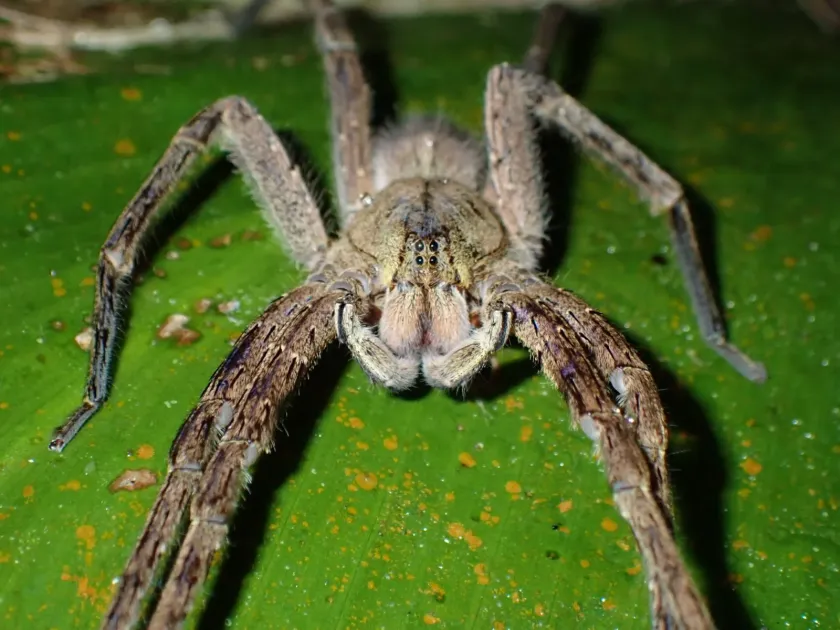
The Brazilian wandering spider (genus Phoneutria), belonging to the Ctenidae family, is a large and highly mobile arachnid primarily found in South American tropical regions.
These spiders are distinguished by their robust bodies and long, spiny legs, often reaching a leg span of up to 15 cm, making them visually intimidating.
They do not spin webs to catch prey, preferring to wander actively across the forest floor and agricultural plantations at night in search of food.
They are famous for their defensive behavior, which includes raising their front legs and swaying side to side when they feel threatened by agricultural machinery or workers.
Proper identification is critical for handlers, as they can easily be confused with other, less dangerous spider species present in the same ecosystems.
What it damages
The Brazilian wandering spider is not a phytophagous pest, meaning it does not feed on plant tissue or cause direct agricultural yield loss to crops like bananas.
However, their economic impact is significant because they frequently use banana bunches as shelter during the day, hitchhiking into export containers.
Their presence in shipping crates leads to severe international trade consequences, including the rejection of entire shipments by quarantine authorities.
Beyond financial loss, these spiders pose a major occupational safety risk, as their venom is potent and can cause serious medical emergencies for plantation workers.
Agricultural companies are consequently forced to invest in extensive phytosanitary protocols to prevent these spiders from entering the global supply chain.
When it appears
As tropical organisms, these spiders remain active throughout the year, with no hibernation phase affecting their behavior in their native habitats.
Population surges are often observed during periods of high humidity and rainfall, which provide optimal conditions for the spiders' prey base.
Interaction with humans on plantations peaks during harvest seasons, as workers disturb the spiders' established hiding spots within the foliage and fruit.
The lifecycle is continuous, with multiple generations possible in a single year provided that food resources and environmental moisture are sufficient.
Nighttime represents the peak window for their activity, meaning that mechanical harvesting during dark hours carries a higher risk of encountering the species.
Signs of infestation
Detection on plantations relies heavily on trained personnel who recognize the typical resting positions of these spiders within the banana bunches.
The presence of dense, silken retreats or structural disturbances in the leaves indicates that a spider may have used the area as a temporary shelter.
Discarded exoskeletons found near the fruit suggest that the population has been established in that specific part of the plantation for a significant duration.
Aggressive behaviors observed during routine pruning or harvesting are clear signs of a territorial encounter with a wandering spider.
In the packing facility, the inspection of fruit gaps and container corners is the most effective way to identify the presence of these unwanted hitchhikers.
Control measures
Effective control involves an integrated approach to pest management focused on minimizing the spider population in high-traffic agricultural zones.
Sanitation is paramount; removing debris and maintaining clear zones around packing sheds drastically reduces the availability of hiding spots.
- Utilizing targeted chemical barriers around the perimeter of the plantation to prevent migration into packing areas.
- Mandatory automated washing and high-pressure air cleaning of banana bunches before they enter the processing line.
- Equipping all plantation and warehouse workers with appropriate protective gear to prevent bites.
Fumigation of export containers remains the standard international requirement to neutralize any individuals that might have bypassed physical inspections.
Continuous monitoring using traps and regular site audits ensures that any increase in spider density is addressed long before harvest activities begin.
Taxonomy
- Latin name
- Phoneutria
- Family
- Ctenidae
- EPPO code
- PHONSP
Discussion
No discussions yet — be the first.