
Brush-tailed rock-wallaby
Petrogale penicillata
Description
How to identify
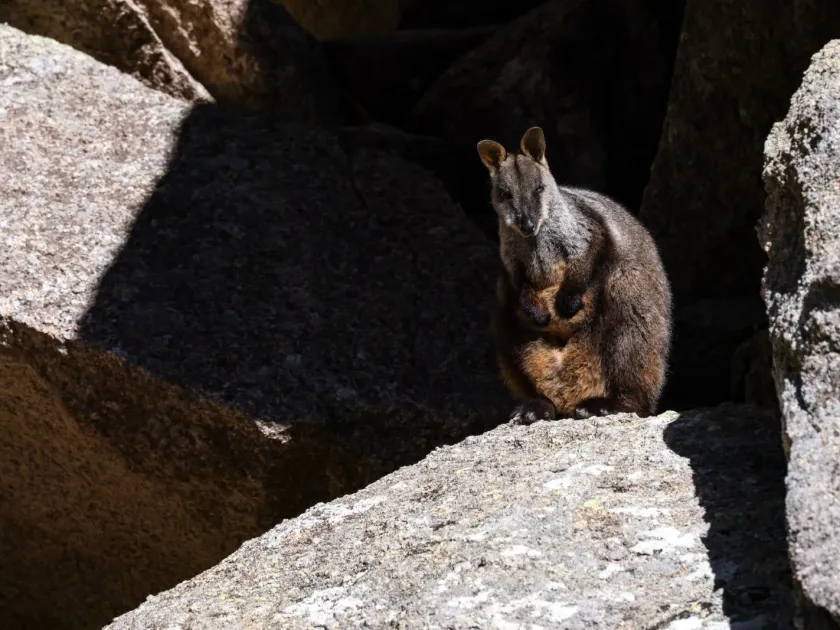
The brush-tailed rock-wallaby (Petrogale penicillata) is a member of the Macropodidae family. It is a medium-sized marsupial perfectly adapted for life in rugged, rocky terrains.
This species is characterized by its long, flexible tail with a distinctive brush of fur at the tip, which assists in balance while leaping across uneven cliff surfaces.
Its coat color ranges from grey-brown to dark brown, serving as an effective camouflage against rock formations, making them difficult to spot during the day.
These animals are primarily nocturnal, spending their daylight hours hiding in deep rock crevices, which makes their presence often go unnoticed until crop damage appears.
They possess a high level of agility and are social creatures that may live in small colonies, which can multiply and cause significant pressure on local vegetation.
What it damages
In agricultural areas near rocky habitats, the brush-tailed rock-wallaby acts as a pest by foraging on a variety of cultivated crops and ornamental garden plants.
They are particularly known for grazing on young grain shoots, vegetables, and stripping the bark from fruit trees, which can severely stunt growth or kill young saplings.
During dry seasons when natural vegetation is scarce, their foraging intensity in agricultural lands increases significantly as they seek supplementary food and water.
Extensive foraging can lead to large patches of ruined crops, resulting in significant yield losses and increasing the operational costs for farmers who must replace damaged plants.
Additionally, wallabies may contaminate water sources or forage intended for livestock, potentially leading to health concerns for domestic farm animals.
Signs of infestation
Identification of their presence usually involves finding characteristic footprints in damp soil or clearings near the edges of rocky habitats or agricultural plots.
Signs of feeding include cleanly nipped plant stalks and branches that show distinct tooth marks, clearly identifiable from other herbivorous pests like insects or birds.
Droppings, typically cylindrical and pellet-like, are commonly found along established trails leading from their rocky shelters to the preferred feeding grounds.
Physical evidence of intrusion, such as holes in netting, flattened vegetation along fence lines, or nocturnal sightings near the fields, confirms their activity.
The presence of patches where the crop has been completely cleared to the ground surface is a major red flag indicating a large group of wallabies feeding nearby.
Control measures
Physical exclusion is the most reliable method, using heavy-duty, high-tensile wire fencing at least two meters high to effectively prevent wallabies from entering fields.
For large-scale operations, sonic deterrents and strobe lights can be utilized to confuse or scare away the animals during their peak nocturnal foraging hours.
Creating a buffer zone by removing brush and dense vegetation between the rocky habitats and the agricultural fields reduces the cover necessary for the animals to feel secure.
Some farmers use specific scent-based deterrents that are unpleasant to marsupials, applied to the perimeter of the crop area to discourage them from grazing on the vegetation.
Regular patrolling and the use of motion-activated cameras are essential components of an integrated pest management plan to monitor wallaby activity throughout the growing season.
Taxonomy
- Latin name
- Petrogale penicillata
- Family
- Macropodidae
- EPPO code
- PETGPE
Discussion
No discussions yet — be the first.