
Eastern grey kangaroo
Macropus giganteus
Description
How to identify
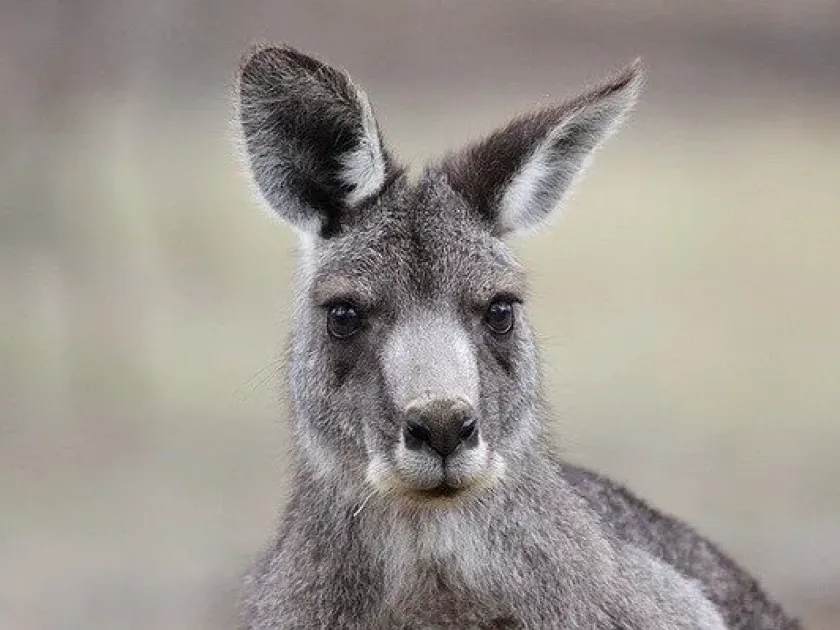
The Eastern grey kangaroo (Macropus giganteus) is a large marsupial belonging to the family Macropodidae and order Diprotodontia. These animals are characterized by powerful hind legs, a thick muscular tail, and a dense, grey-brown coat.
Adult males can reach weights of up to 90 kg, making them formidable creatures that can move across landscapes with incredible agility, leaping at high speeds to traverse distances.
They are highly social animals that live in groups known as "mobs," which can consist of several individuals or large numbers, especially when congregating in areas with abundant food resources.
The species exhibits sexual dimorphism, with males significantly larger than females. Females possess a pouch, which is a key anatomical feature for the development and protection of their offspring.
Their biological adaptation to dry environments and their ability to jump over obstacles make them challenging to monitor and exclude from agricultural fields without specialized infrastructure.
What it damages
Eastern grey kangaroos significantly impact agriculture by feeding on cereal crops such as wheat, barley, and oats, often leading to reduced yields and economic loss for farmers.
Beyond feeding, the physical act of moving in groups results in extensive trampling of crops. This mechanical damage often destroys young seedlings and flattens standing plants, rendering them unharvestable.
Orchards and vineyards face specific threats, as kangaroos may strip bark from young trees and vines, which can stunt plant growth and provide entry points for diseases and pests.
During periods of drought, these marsupials often congregate in irrigated areas and vegetable farms, where they cause concentrated damage that can lead to total loss of local yields.
The persistent presence of a large mob can degrade pasture quality significantly, as they compete with livestock for available grazing resources, which is a major concern for pastoralists.
When it appears
The impact of kangaroos on agricultural land is observed throughout the year; however, their presence is most noticeable during the peak growing season of cultivated crops.
Summer months often see an increase in nuisance behavior as native pastures dry out, forcing the animals to move into crop zones seeking green, succulent vegetation provided by irrigation.
Because these animals do not have a restricted breeding season, they can maintain stable, high-density populations throughout the year, exerting continuous pressure on agricultural surroundings.
Feeding is most intense during twilight and nighttime hours. This crepuscular activity pattern makes it difficult for farmers to manage their presence without utilizing specialized night-vision monitoring.
Spring serves as a critical period, as the lush growth of newly emerged winter cereals provides an ideal food source, drawing large numbers of kangaroos to field margins.
Signs of infestation
Clear evidence of a kangaroo presence includes distinct, large footprints found in the soil, which are easily distinguishable due to the unique gait involving both feet and tail impressions.
Accumulation of droppings at the perimeter of the farm and along established runways between forests and fields serves as a primary indicator of their regular transit paths.
Significant areas of grazed vegetation, where plants appear shredded or unevenly consumed at ground level, indicate the presence of a feeding mob on the crop plot.
Visible damage to fence lines—often including bent mesh or snapped wires—indicates the force with which these animals navigate through farm boundaries to access desired fodder.
The presence of bark damage at the base of young tree trunks or stripped foliage on lower branches is a tell-tale sign that kangaroos have been browsing within a orchard or vineyard.
Control measures
The most reliable control method is the installation of high-tensile mesh fencing at least 1.8 meters high, which prevents physical entry and keeps the mobs contained outside the fields.
Integrated management plans may include the use of acoustic or visual deterrents, although these often have limited long-term effectiveness as kangaroos tend to habituate to stimuli.
Applying specialized chemical repellents to crops can deter feeding, but efficacy is limited by weather conditions such as rain, which washes away the protective barriers.
In many regions, culling programs are implemented under government-regulated licenses to maintain the population at a level that is sustainable for both the ecosystem and agriculture.
Landscape management, such as creating buffer zones with non-palatable vegetation around crop fields, can help divert the animals away from commercial assets and toward natural grazing areas.
Taxonomy
- Latin name
- Macropus giganteus
- Family
- Macropodidae
- EPPO code
- MAKPGI
Discussion
No discussions yet — be the first.