
Giant flying squirrel
Petaurista
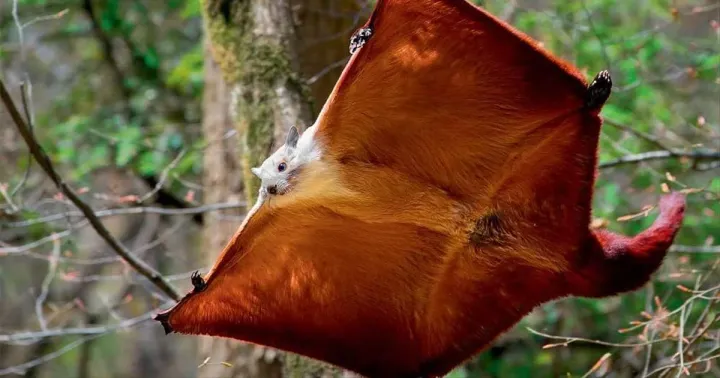
Description
How to identify
The giant flying squirrel (genus Petaurista) is a large, nocturnal rodent belonging to the Sciuridae family, characterized by a patagium that enables gliding.
These animals are native to forest environments but frequently encroach upon neighboring agricultural lands when natural food sources become seasonally scarce.
They are primarily arboreal, utilizing their specialized gliding membrane to travel large distances between trees without touching the ground, making them elusive targets.
Their life cycle involves raising litters in high tree cavities, where they are protected from predators and weather, allowing them to establish stable colonies near food sources.
Due to their nocturnal nature, farmers rarely see them, often discovering their presence only after significant damage to fruit and nut crops has already occurred.
What it damages
The damage caused by Petaurista includes the consumption of ripe fruits, tender buds, and young bark, which negatively impacts tree health and yields.
Orchards located near forest edges are particularly susceptible to infestations, as the squirrels use forest trees for shelter and move into orchards at night to feed.
Beyond direct fruit consumption, they often strip bark from young limbs, which interrupts nutrient transportation and invites bacterial or fungal infections into the tree.
During the dormant season, they feed on fruit buds, significantly reducing the potential blossom volume and leading to lower crop productivity in the following season.
The accumulation of waste and damage to the canopy structure can lead to the gradual decline of orchards if the population density is not managed effectively.
Signs of infestation
Evidence of feeding is the primary indicator, specifically finding fruits under trees with distinct bite marks made by sharp incisors on the peel or flesh.
The discovery of nests, or dreys, constructed from twigs, leaves, and moss located high in tree branches is a clear sign of established residency on the premises.
Audible cues, such as vocalizations heard during late night or early morning hours, often suggest active movement and communication between individuals.
Claw marks on the bark of tree trunks are visible evidence of their vertical movement, particularly on trees with softer or thinner bark textures.
The presence of droppings in concentrated areas beneath specific trees provides a baseline for monitoring the squirrel activity levels within an orchard plot.
Control measures
Installing smooth metal bands or baffles around tree trunks is a highly effective mechanical method to prevent squirrels from climbing into the fruit canopy.
Utilizing motion-activated lighting or sonic deterrents can disrupt the nocturnal foraging behavior of the squirrels, encouraging them to move to less protected areas.
Sanitation practices such as removing hollow logs and pruning trees with large cavities effectively reduce the available nesting sites within the agricultural zone.
Protective netting can be draped over specific high-value trees to create a physical barrier, though this is labor-intensive for larger orchard operations.
- Regular pruning to reduce bridge branches between trees.
- Application of scent-based repellents on tree trunks.
- Active population monitoring using infrared night cameras.
Taxonomy
- Latin name
- Petaurista
- Order
- Diptera (flies)
- Family
- Trichoceridae
- EPPO code
- PETASP
Discussion
No discussions yet — be the first.