
Russet sparrow
Passer rutilans
Description
How to identify
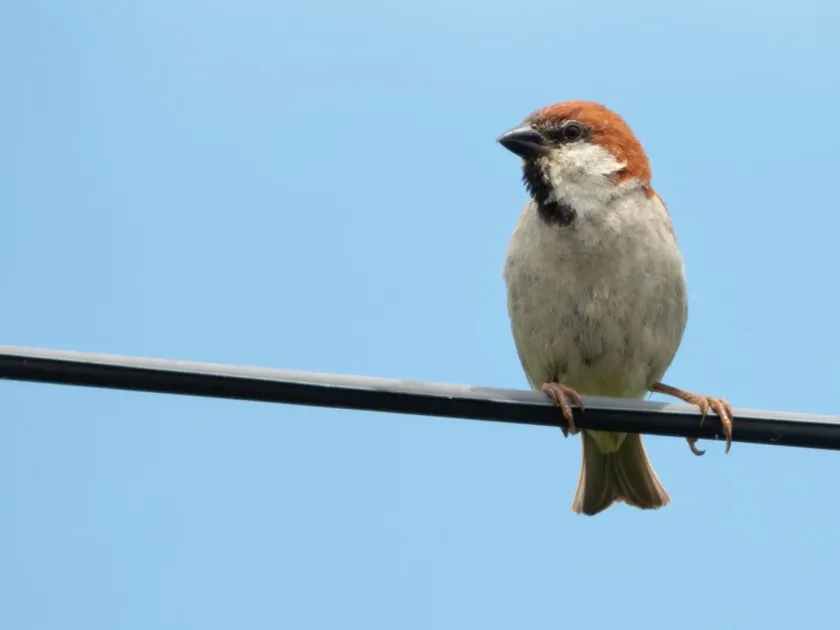
The Russet sparrow (Passer rutilans) is a bird species belonging to the family Passeridae, order Passeriformes. Males are characterized by a distinct bright chestnut-red plumage on the back and crown, distinguishing them from common house sparrows.
These birds primarily inhabit woodland areas, forest edges, and rural agricultural landscapes. They often nest in tree cavities, building crevices, or birdhouses, which provides easy access to nearby farming fields.
The species biology is marked by high adaptability to man-made environments. During the breeding season, they can produce multiple clutches, leading to rapid population growth when food resources are abundant.
Their diet is diverse, shifting from insects during the fledgling rearing stage to seeds and grains during the harvest season, which directly impacts their role as agricultural pests.
Highly social behavior and tendency to form large foraging flocks allow them to exploit agricultural resources efficiently, especially in regions where they have become established as significant crop feeders.
What it damages
Russet sparrows cause significant economic damage to cereal crops by consuming grain during the milky and wax maturity stages. Wheat, rice, and millet are particularly susceptible to their foraging activities.
Beyond direct consumption, the birds physically damage the ears and panicles of plants, causing grain to shatter and fall to the ground, which results in harvest losses during mechanical gathering.
In the early stages of vegetation, they may cause damage to young crops by digging up and eating recently sown seeds, often necessitating costly field reseeding efforts.
Orchards located near their nesting sites are also affected, as sparrows damage various fruits, making them unfit for storage or market consumption due to mechanical injuries and subsequent rot.
Contamination of the harvest with fecal matter poses another problem, potentially introducing pathogens into stored grain and lowering the overall quality and safety of the agricultural product.
When it appears
The peak of damage coincides with the grain ripening season, typically in late summer and early autumn. This is when birds aggregate into large flocks and focus their foraging on mature crop fields.
During the spring sowing period, the birds are attracted to open fields where they forage for exposed seeds. This creates a risk for crop establishment in the early growth phases.
In winter, while populations in some regions might migrate, those that remain may target grain storage facilities, threshing floors, or livestock feed supplies if natural food sources become scarce.
The intensity of field damage is closely linked to the phenological stages of the crops, allowing farmers to anticipate high-risk periods for protection measures.
Weather conditions and the maturity schedule of regional crops influence the duration and scale of flock presence in agricultural landscapes.
Signs of infestation
A primary indicator of infestation is the presence of large, mobile flocks frequently moving between adjacent trees and the grain fields. Audible noise from these flocks is a common early-warning sign.
Visual inspection of the crop reveals ragged or empty panicles where grains have been eaten. This damage is often concentrated along the edges of fields bordering wooded areas.
Droppings found on foliage and soil are clear evidence of the birds' presence and feeding activities on specific parts of the field.
Empty seed husks scattered on the ground or within the rows indicate that birds have been feeding on recently sown seeds, signaling a need for monitoring the uniformity of emergence.
Disturbance of the canopy or broken stems in localized patches can also indicate feeding activity, especially when large numbers of birds are involved in gathering grain.
Control measures
Acoustic deterrents that broadcast recorded alarm calls of the species are highly effective in scaring flocks away from vulnerable fields during the grain-filling stage.
Visual repellents, such as predator decoys, reflective tapes, and dynamic scarecrows, can disrupt the birds' behavior and discourage them from remaining on the fields.
Agronomic management practices focus on timely harvesting to reduce the window of vulnerability, ensuring that the crop is removed from the field as soon as it reaches maturity.
Maintaining field borders by removing unnecessary scrub and weed cover can reduce the nesting and resting opportunities for birds near cultivated plots.
Implementing an integrated approach by rotating different deterrent methods is crucial to prevent the birds from habituating to a single, static source of disturbance.
Taxonomy
- Latin name
- Passer rutilans
- Family
- Passeridae
- EPPO code
- PASSRU
Discussion
No discussions yet — be the first.