
House sparrow
Passer
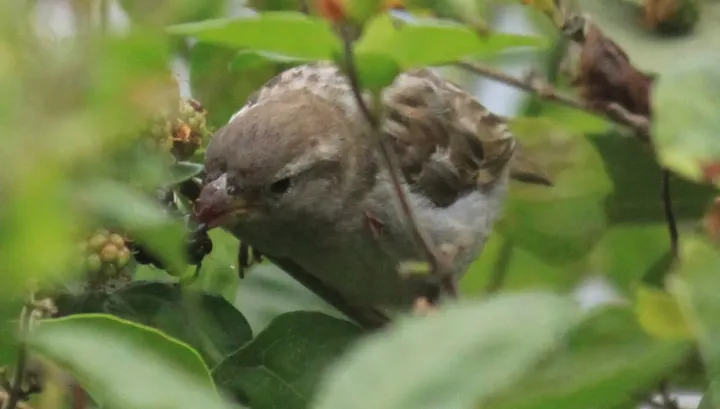
Description
How to identify
The House Sparrow (Passer domesticus) is a bird species of the Passeridae family, widely distributed across global agricultural landscapes.
They are robust birds with a short, strong beak designed for crushing seeds, making them highly efficient at foraging on cultivated crops.
The species exhibits sexual dimorphism: males are distinguished by a grey crown and a prominent black throat patch, while females are buff-brown.
These birds are highly social and gregarious, often forming large flocks that can descend upon fields in significant numbers to feed.
Known for their high intelligence and adaptability, they are capable of learning the flight paths and behavioral patterns of farmers, making them difficult to deter.
What it damages
House sparrows cause extensive damage to cereal crops, including wheat, barley, and oats, particularly during the milk and dough ripening stages.
In sunflower fields, they peck out seeds from the flower heads, leading to yield loss and providing entry points for fungal pathogens.
Vegetable crops are also affected, as sparrows frequently target newly planted seeds and young seedlings, often destroying entire rows in short periods.
Orchards and berry farms suffer significant losses, with sparrows damaging fruits like cherries, grapes, and strawberries, rendering them unmarketable.
They are also problematic in grain storage areas, where they consume and contaminate large quantities of stored harvest with their droppings.
When it appears
Spring marks the beginning of high activity as sparrows target newly sown fields, causing thinning of crops that may necessitate costly replanting.
During the summer months, their impact intensifies as they forage heavily on maturing grains, which are calorie-dense and attractive to growing flocks.
Post-harvest periods find them gleaning leftover grain from fields, which can interfere with subsequent soil preparation and cover crop establishment.
Throughout the winter, flocks congregate near feedlots, granaries, and warehouses, maintaining their presence on the farm and causing localized damage.
The high reproductive rate, with multiple broods per season, ensures that population pressure remains high throughout the primary growing months.
Signs of infestation
Visual identification of damage includes stripped stalks and empty glumes on cereal ears, indicating the birds have removed the grains.
Sunflower heads showing irregular holes and scattered shells on the ground are characteristic signs of sparrow foraging activity.
The accumulation of bird droppings on the foliage and surrounding soil serves as a clear indicator of a frequently used feeding site.
The presence of large, noisy flocks that flush in unison when approached by field machinery is a classic sign of infestation.
Young seedlings that appear cleanly cut at the base or have their succulent cotyledons removed are clear indicators of sparrow browsing.
Control measures
Acoustic deterrents that broadcast predator calls or distress signals are widely used and can be highly effective when rotated to prevent habituation.
Physical exclusion, such as the use of netting over high-value orchards or berry crops, remains the most foolproof method of preventing bird damage.
Visual deterrents like reflective tape, rotating spinners, or scarecrows can provide temporary relief, especially if moved frequently to maintain novelty.
Improving harvest efficiency and minimizing grain spillage significantly reduces the food availability that attracts sparrows to the field in the first place.
- Application of seed treatments that act as taste-based repellents for birds.
- Removal of nesting sites in agricultural buildings and nearby structures.
- Strategic crop planning to avoid planting highly vulnerable crops near established nesting colonies.
Taxonomy
- Latin name
- Passer
- Family
- Passeridae
- EPPO code
- PASSSP
Discussion
No discussions yet — be the first.