
House sparrow
Passer domesticus
Description
How to identify
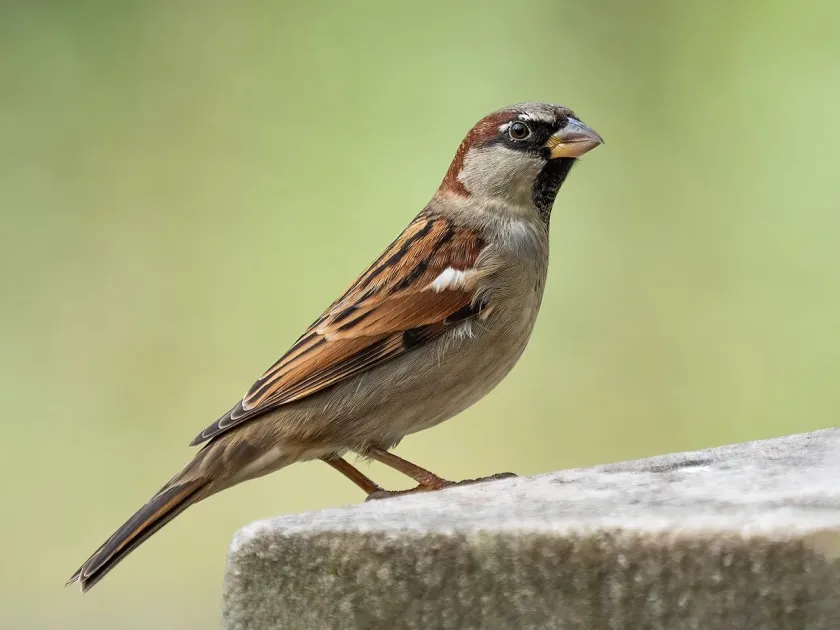
The House sparrow (Passer domesticus) is a small bird of the family Passeridae. It is a highly adaptable species that has successfully colonized agricultural landscapes worldwide.
The bird has a sturdy, conical beak specifically evolved for husking seeds and grains, which makes it a significant consumer of cultivated crops.
Adults are sexually dimorphic; males possess a distinct grey crown, a black throat patch, and chestnut markings, while females are more uniform in shades of brown.
House sparrows are gregarious birds that form large flocks, especially after the breeding season, which allows them to overwhelm fields effectively.
Their rapid reproduction rate, with multiple clutches per year, ensures a large population density in rural areas near food sources.
What it damages
House sparrows are primary pests for various cereal and grain crops. They cause the most severe damage during the milk and soft-dough stages of grain development.
Key crops affected include:
- Wheat and barley.
- Oats and millet.
- Sunflower seeds during maturation.
- Corn, specifically during the flowering and grain-filling phases.
- Peas and other legumes.
Damage is not limited to consumption; the birds often break stalks and stems while landing, leading to shattered grain and direct yield loss.
Early in the season, flocks can dig up and consume seeds from the soil if the planting depth is insufficient, leading to patchy crop emergence.
In addition to field losses, they contaminate grain stocks with feces and feathers, which can lead to hygiene issues in post-harvest storage.
When it appears
The peak period of damage occurs from late summer to early autumn, coinciding with the maturation and ripening of cereal crops.
During spring, they are active in fields immediately after sowing, posing a threat to germinating crops and delicate young shoots.
Throughout the winter, House sparrows aggregate near livestock facilities and granaries, causing ongoing losses of stored feed and seeds.
The seasonal cycle of the bird is closely synchronized with human agricultural cycles, allowing them to exploit different resources throughout the year.
Migratory patterns are limited, meaning that local populations remain a year-round presence in agricultural areas, requiring constant management.
Signs of infestation
The most visible sign of infestation is the presence of localized empty patches in fields, often located near hedges or power lines used by flocks for roosting.
Grain heads in affected areas appear stripped, and broken or flattened plants show evidence of heavy bird traffic during feeding sessions.
Damage to sunflower heads includes pecked seeds and broken florets, which predispose the crop to secondary moisture damage and fungal infection.
Large accumulations of droppings on field margins and farm infrastructure provide strong evidence of the size and persistence of the local flock.
The presence of a noisy flock gathering in the canopy or on fences near the field indicates immediate risk to the ripening crops.
Control measures
Control strategies for the House sparrow prioritize deterrents over lethal methods, as the birds are often protected or limited by environmental regulations.
Acoustic deterrents that play distress calls or predator sounds are highly effective at frightening flocks away from large fields during peak risk times.
Visual deterrents, including reflective tapes, spinners, and scarecrows, can be effective if their positions are adjusted frequently to prevent habituation.
Agricultural practices such as rapid harvesting and proper grain storage management are critical to reducing available food sources.
Maintaining clean facilities at grain terminals and silos reduces the carrying capacity of the local environment for sparrow populations.
Taxonomy
- Latin name
- Passer domesticus
- Family
- Passeridae
- EPPO code
- PASSDO
Discussion
No discussions yet — be the first.