
Eurasian blue tit
Parus caeruleus
Description
How to identify
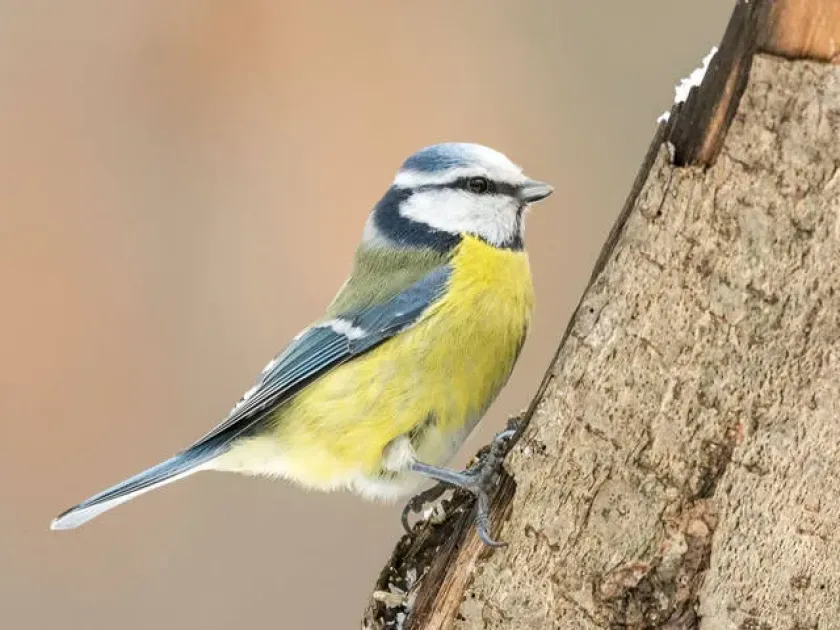
The Eurasian blue tit (lat. Cyanistes caeruleus, formerly Parus caeruleus) is a small bird of the Paridae family. It is recognized by its blue cap, wings, and tail, along with a yellow breast and white cheeks marked by a dark eye-stripe.
The bird possesses a very thin and sharp beak, originally evolved to extract insects from tree bark crevices. This anatomical trait allows them to easily nip through buds and fruit skins.
These birds are exceptionally active and acrobatic, often hanging upside down on slender twigs. They are highly adaptable and frequently frequent gardens, orchards, and parks in search of food.
While primarily insectivorous and beneficial to ecosystem balance, they demonstrate opportunistic behavior by switching to plant material when insect populations are low.
The species is widespread throughout Europe, and its population often increases in suburban areas due to the abundance of nesting sites and supplemental food sources.
What it damages
The most significant damage occurs in early spring when blue tits feed on the generative buds of fruit trees such as apple, pear, and cherry, causing severe yield reduction.
During the ripening season, they damage berries including raspberries, strawberries, and currants. They peck out the flesh, rendering fruit unsaleable and prone to rotting.
In nurseries, they can ruin young saplings by nipping off terminal buds, which distorts the natural growth habit and hinders the formation of a healthy tree crown.
Repeated pecking on young twigs and shoots creates wounds that serve as entry points for pathogens, fungi, and bacterial infections, weakening the plant's health.
The extent of damage depends on the local bird population density and the availability of alternative natural food sources throughout the season.
When it appears
The highest risk period is late winter and early spring, specifically when trees begin to bud and food availability is at its annual minimum.
In mid-summer, when soft fruits begin to ripen, the birds shift their attention to succulent berries, using them as a convenient source of water and sugars.
Autumn and early winter are generally less damaging, as the birds focus on natural seeds, berries in the wild, and remaining insects hidden in bark.
The birds' activity cycle is closely linked to weather patterns; harsher winters lead to increased pressure on orchard buds due to food scarcity.
Orchard managers should monitor tree development phases closely, as the window of susceptibility begins at the onset of bud swelling.
Signs of infestation
The presence of shredded buds and a large number of bud scales on the ground beneath the tree are primary indicators of bird feeding activity.
Visual inspection of the trees reveals twigs with tell-tale small, neat punctures or completely missing buds, often appearing as "bare" stretches of branches.
The berries themselves show characteristic small, deep holes that quickly discolor and may become moldy due to the introduction of spores during the pecking process.
The birds are easily spotted during the early morning hours, acting in small, noisy groups, which is a clear signal of their presence in the orchard.
Damage is typically most pronounced on the outer, thinner branches where the birds can perch easily while feeding.
Control measures
Visual deterrents such as reflective ribbons, spinning mirrors, or shiny discs are effective for temporary bird management in small orchards.
Physical protection using fine-mesh anti-bird netting is the most reliable method for safeguarding berry patches and valuable fruit crops from damage.
Strategically placing feeding stations away from fruit trees can distract the birds and provide them with supplemental food during the critical late-winter period.
Ultrasonic bird repellers can be utilized, though their efficiency may decrease over time as birds often adapt to consistent, repetitive sounds.
Applying specialized botanical-based taste deterrents to tree buds may reduce their appeal to birds, provided the application is reapplied after rainfall.
Taxonomy
- Latin name
- Parus caeruleus
- Family
- Paridae
- EPPO code
- PRUSCA
Discussion
No discussions yet — be the first.