
Willow Tit
Parus atricapillus
Description
How to identify
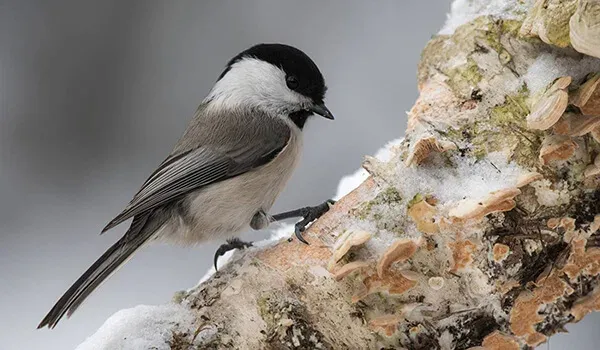
The Willow Tit, scientifically known as Poecile montanus (often historically referred to as Parus atricapillus in older texts), is a small passerine bird common in temperate forests.
It is easily distinguished by its dull, matte black cap that covers the top of the head, contrasting with the white cheeks and a small black patch under the chin.
The plumage is generally earthy-brown on the upper parts and paler on the underparts. Unlike some other tit species, it lacks broad white wing bars, which is a key identification feature.
Measuring around 12 to 14 centimeters in length, this bird is very agile, moving rapidly between branches while performing acrobatic maneuvers.
These birds are usually found in pairs or small family groups, maintaining high activity levels throughout the day as they forage for insects and seeds.
What it damages
In an agricultural context, Willow Tits can become pests in orchards during late winter and early spring when natural food sources are severely limited.
The primary damage consists of the birds feeding on the generative buds of fruit trees such as apples, pears, and plums, which are rich in nutrients.
By consuming these buds, the birds effectively destroy the potential for blossoms, which leads to a direct reduction in the crop yield for the coming season.
While the birds do help control insect populations by consuming larvae, the damage to fruit-producing buds is often disproportionately higher than the benefit they provide.
Small orchards or those situated near forest edges are particularly susceptible to heavy browsing by these birds, especially during harsh weather conditions.
When it appears
The most critical period for potential damage occurs between late February and early April, coinciding with the swelling of buds on fruit trees.
During the depth of winter, Willow Tits rely mostly on seeds and cached insects, but as the weather warms, their metabolic needs increase.
The swelling buds, which contain stored sugars and essential nutrients for the tree, act as an ideal high-energy food source for the birds during the pre-breeding phase.
Once the trees enter the flowering stage and natural insect populations begin to emerge, the diet of the Willow Tit shifts, and the pressure on the buds dissipates.
Longer periods of frost and snow cover are usually linked to higher instances of bird-related bud damage, as the birds are forced to seek sustenance in accessible garden trees.
Signs of infestation
Evidence of feeding activity is usually visible on the ground beneath the trees as small scales and bits of shredded bud tissue.
Direct inspection of the tree branches reveals clear mechanical damage where the central part of the bud has been neatly removed or hollowed out.
Young twigs may appear "stripped" of their terminal buds, giving the branches a sparse or damaged appearance compared to unaffected trees.
Frequent observations of Willow Tits lingering in fruit trees for extended periods, methodically pecking at branches, are a strong sign of active foraging.
If there is no sign of insect infestation, yet buds are missing or damaged in early spring, bird activity is the most likely culprit.
Control measures
Managing the impact of Willow Tits in an orchard involves a combination of deterrent strategies to protect the crop while respecting avian health.
- Deploying reflective bird tape or moving objects in the tree canopy to scare away visitors.
- Using acoustic deterrents that simulate the presence of predatory birds to create a protective buffer.
- Covering small trees or specific varieties with protective netting during the peak bud-swelling season.
Setting up supplemental bird feeders at the edge of the orchard, well away from fruit trees, can successfully divert the birds toward provided seeds and nuts.
Maintaining orchard hygiene, including the removal of dead or rotting wood, reduces the attractiveness of the area to these birds as they seek out hidden insect larvae.
Taxonomy
- Latin name
- Parus atricapillus
- Family
- Paridae
- EPPO code
- PRUSAT
Discussion
No discussions yet — be the first.