
European fruit lecanium
Parthenolecanium glandi
Description
How to identify
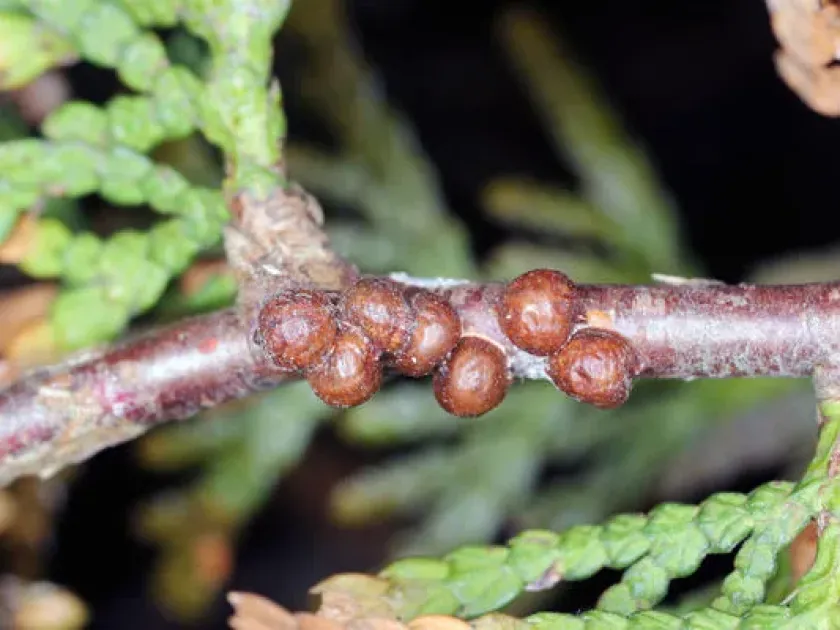
The European fruit lecanium is a scale insect belonging to the family Coccidae. The adult female has a convex, spherical, or oval body, usually chestnut-brown in color, which attaches firmly to the bark of branches and twigs.
The female body size ranges from 3 to 6 mm. The first-instar nymphs, commonly known as crawlers, are very small, mobile, and yellowish, allowing them to disperse quickly throughout the host plant's canopy.
These insects prefer to settle on young shoots and the undersides of leaves, forming dense colonies. As the females mature, they lose mobility and develop a hard, sclerotized shell, beneath which they lay their eggs.
Reproduction is primarily parthenogenetic, which allows for rapid population growth even in the absence of males. Young females often display characteristic transverse dark bands on their bodies.
They overwinter as second-instar nymphs, which have a flattened body and are highly cold-resistant, typically hiding in bark crevices and near the base of buds to survive harsh winter conditions.
What it damages
The European fruit lecanium is a polyphagous pest that attacks a wide range of woody plants. It commonly infests fruit trees such as plums, apricots, peaches, apples, pears, and cherries, as well as various ornamental trees.
The pest extracts sap from the plant tissues, leading to a significant loss of vitality. Young saplings infested by the insect show stunted growth and become increasingly susceptible to winter damage and secondary infections.
On mature trees, infestation can result in premature leaf drop, reduced fruit set, and overall weakening of the canopy. In cases of severe infestation, branches may wither and die, and entire trees may succumb to the stress.
The insect excretes honeydew, a sticky substance that promotes the growth of sooty mold. This layer blocks light from the leaves, significantly reducing the efficiency of photosynthesis and overall plant metabolism.
Failure to control the population often leads to progressive decline in orchard productivity and quality, making this insect a serious concern for both commercial growers and private gardeners.
When it appears
In the spring, as temperatures rise above 8-10 degrees Celsius, the overwintered nymphs emerge from their dormant state and migrate to new shoots to begin active feeding.
By late spring, typically in May, the females finish their development and prepare for the reproductive phase. Egg-laying usually occurs over a period of several weeks in early summer.
June and July are the key months for the emergence and dispersal of the crawler stage. These nymphs crawl onto leaves, where they feed on sap and continue their development through the summer.
In autumn, as the days grow shorter and temperatures drop, the nymphs migrate from the leaves back to the branches and trunks. They seek out sheltered spots within the bark to enter diapause.
The life cycle is generally univoltine, meaning there is one generation per year, although minor variations may occur depending on the specific climatic conditions of the region.
Signs of infestation
The most obvious sign of infestation is the presence of convex, brown, scale-like bumps on the branches. These look like small growths but can be easily scraped off the bark surface.
The presence of a sticky honeydew film on leaves and twigs is a strong indicator of scale insect activity. This film is frequently colonized by black sooty mold, which gives the plant a dark, scorched appearance.
Infested plants may exhibit symptoms of stress, such as leaf yellowing, curling, or early senescence. In heavy infestations, the canopy becomes sparse due to the dieback of heavily infested twigs.
- Presence of tiny yellow crawlers on the underside of leaves during early summer.
- Black sooty mold accumulation on stems and foliage.
- Stunted twig growth and premature dieback of younger branches.
- Visible scale insects clustered around buds during the dormant season.
Detailed inspections during late summer or autumn reveal high concentrations of nymphs near buds, providing an early warning sign for planning control measures for the following season.
Control measures
Cultural control is a primary management strategy. This includes regular pruning and the removal of heavily infested branches, which significantly reduces the initial population density in the orchard.
Scrubbing the trunk and larger branches to remove loose, dead bark can effectively eliminate many overwintering sites, especially when performed early in the spring before the sap begins to flow.
Chemical control is most effective when targeted at the crawler stage in early summer. The use of systemic insecticides helps ensure that the active ingredient is ingested by the pest during feeding.
Dormant sprays using horticultural oils are highly recommended in early spring. These oils create a film that suffocates the overwintering nymphs, providing a non-toxic way to reduce the population.
Biological control agents, including lady beetles and certain parasitic wasps, play a significant role in keeping populations in check. Preserving these natural predators is essential for an integrated pest management approach.
Taxonomy
- Latin name
- Parthenolecanium glandi
- Order
- Hemiptera (bugs, aphids, leafhoppers)
- Family
- Coccidae
- EPPO code
- PRTLGL
Discussion
No discussions yet — be the first.