
European fruit lecanium
Parthenolecanium corni
Description
How to identify
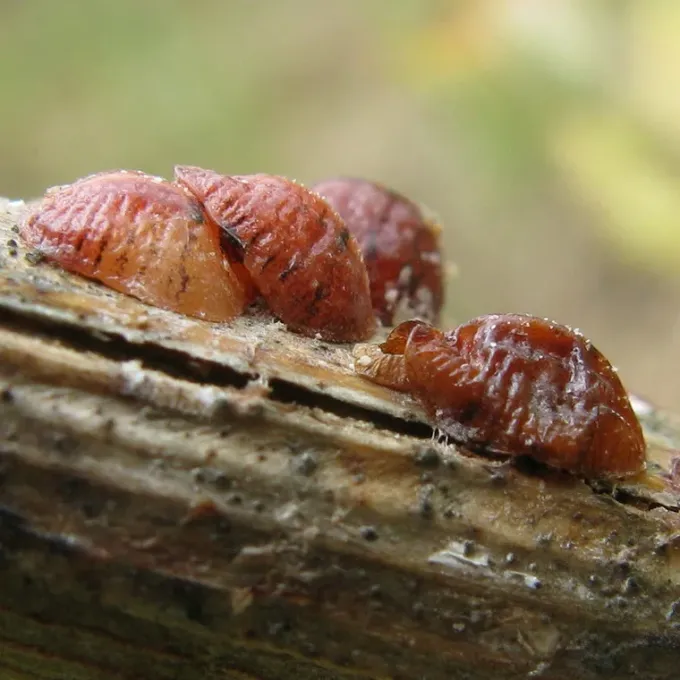
The European fruit lecanium (Parthenolecanium corni) is a significant scale insect pest belonging to the Coccidae family. The adult female is characterized by a hemispherical, brown, hard-shelled body, typically reaching 3-6 mm in size.
These insects are sedentary for most of their adult life. The female's body hardens and forms a protective scale that covers her eggs after she has completed her reproductive phase.
First-instar nymphs, commonly called "crawlers," are small, mobile, and yellowish-brown. They actively move across the host plant to find suitable feeding sites on branches or leaves.
Over time, these nymphs molt and become second-instar nymphs. These are flattened and dark-colored, often blending into the bark of the host tree where they spend the winter months.
As a species, it reproduces largely through parthenogenesis, meaning that large populations can establish rapidly even from a very small number of introduced individuals.
What it damages
This pest is highly polyphagous and infests a vast range of woody plants, including stone fruits, pome fruits, grapes, and various ornamental shrubs.
They feed by sucking sap directly from the phloem of young branches and leaves. This direct feeding depletes the plant's resources and stunts overall development.
A primary consequence of infestation is the production of honeydew, a sticky waste product that serves as a medium for the growth of sooty mold fungus.
The presence of sooty mold on leaf surfaces interferes with photosynthesis, causing weakened growth, leaf drop, and eventually leading to limb dieback.
Heavy infestations reduce tree vigor and fruit quality significantly, often leading to reduced yields and stunted, unproductive branches that require pruning.
When it appears
The European fruit lecanium typically completes one generation per year, though development rates can vary based on local climatic conditions and host species.
During the spring, when temperatures rise above 10°C, overwintered nymphs become active, move to twigs, and begin to feed intensively, rapidly increasing in size.
By late spring or early summer, the females lay eggs under their protective shells. The hatching period for these eggs usually occurs throughout June and July.
The crawler stage is the most vulnerable period in the insect's life cycle, making it the most critical window for targeted control applications in commercial orchards.
As summer draws to a close, the newly emerged nymphs migrate to their overwintering locations on the bark, remaining dormant until the following spring.
Signs of infestation
The most prominent sign of infestation is the presence of numerous brown, convex bumps on the bark of twigs and smaller branches.
Sticky, shiny honeydew deposits on foliage are a clear indicator of active scale populations, as are the frequent presence of ants tending the scale insects.
The development of a black, crust-like coating on leaves and stems, known as sooty mold, indicates that the infestation is well-established and causing stress to the plant.
Infested trees often exhibit sparse foliage, stunted shoot growth, and a generally sickly appearance compared to healthy, uninfested neighbors.
- Hemispherical brown scales visible on twigs.
- Sticky honeydew residue on the undersides of leaves.
- Ant activity on infested stems and branches.
- Sooty mold growth on bark and foliage.
Control measures
Management of this pest relies on an integrated approach, focusing on biological monitoring and well-timed chemical applications to protect tree health.
Dormant season sprays using horticultural or mineral oils are highly effective, as they smother the overwintered nymphs before they start spring growth.
Mechanical control, including pruning and removal of heavily infested limbs during the winter, can drastically reduce the starting population for the upcoming season.
Chemical control using systemic insecticides is most effective when synchronized with the emergence of the crawler stage during early summer months.
Promoting the presence of natural predators, such as ladybird beetles and parasitic wasps, can provide significant natural suppression of scale populations in orchard environments.
Taxonomy
- Latin name
- Parthenolecanium corni
- Order
- Hemiptera (bugs, aphids, leafhoppers)
- Family
- Coccidae
- EPPO code
- LECACO
Discussion
No discussions yet — be the first.