
European fruit lecanium
Parthenolecanium cerasifex
Description
How to identify
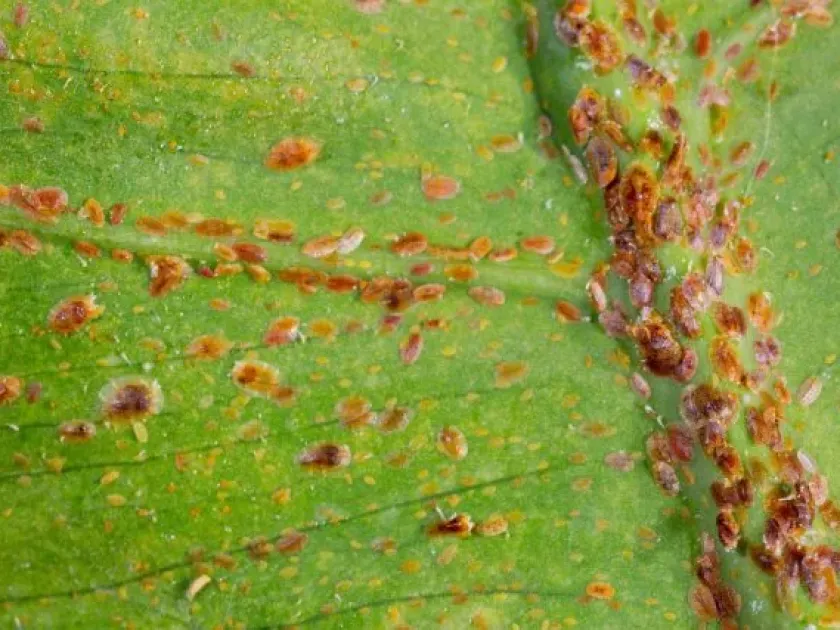
European fruit lecanium (Parthenolecanium cerasifex) is a scale insect belonging to the Coccidae family. The adult female is characterized by a convex, hemispherical shape, typically brownish in color, reaching 4–6 mm in length.
The insect is well-adapted to survive on the bark of woody plants. Its hard, chitinized shell serves as a protective shield against predators and various environmental stressors, making it difficult to control.
The male of this species is rarely seen, as it is winged, very small, and short-lived. Its primary role is restricted to mating, while the female remains attached to the host plant for her entire adult life.
The crawlers (first-instar nymphs) are oval-shaped and highly mobile. Their small size allows them to migrate across branches and leaves quickly, facilitating the spread of the infestation within the orchard.
Identifying the pest at different stages is crucial for timing interventions. The brownish, bump-like appearance on the bark is the most common form observed by orchardists during the dormant season.
What it damages
This pest affects a wide range of fruit-bearing trees, including plums, cherries, apricots, and apples. It feeds by inserting its mouthparts into the phloem of the tree to extract essential sap.
Heavy infestations lead to a significant decline in tree vigor. The loss of sap deprives the tree of nutrients required for fruit development, resulting in reduced crop yield and lower fruit quality.
As they feed, they excrete a sticky substance called honeydew. This substance accumulates on foliage and branches, providing an ideal substrate for the growth of sooty mold fungus.
Sooty mold growth covers the leaves, severely limiting their ability to perform photosynthesis. This often leads to premature leaf drop and the overall weakening of the tree's physiological state.
Prolonged stress from an infestation can cause branch dieback and, in severe cases, the death of young saplings. Infested trees become highly susceptible to other secondary infections and winter damage.
When it appears
The European fruit lecanium typically undergoes one generation per year. Second-instar nymphs spend the winter months tucked away in bark crevices and around buds, remaining in a dormant state.
As spring temperatures rise, these nymphs reactivate and move to twigs to feed. Their growth accelerates rapidly during the flowering period, culminating in the maturation of adult females.
Egg-laying takes place in late spring or early summer. A single female can produce thousands of eggs beneath her protective shell, ensuring the survival of the next generation.
The hatching of crawlers generally occurs in June and July. This is the period when they are most vulnerable to chemical treatments, as their protective shields are not yet fully developed.
By late summer and early autumn, the nymphs settle on the underside of branches to prepare for winter. They remain immobile throughout the cold months to survive the harsh conditions.
Signs of infestation
The presence of stationary, brown, bump-like scales on branches is the primary indicator of an infestation. These structures are often found clustered around buds or along small twigs.
Honeydew, a sticky clear liquid on the bark or leaves, is a tell-tale sign of active feeding. The presence of this substance often attracts ants, which aggressively protect the scales from natural enemies.
A thick black fungal layer (sooty mold) covering the leaves and branches indicates that the infestation has been present for a significant amount of time and is likely widespread.
The appearance of stunted growth or chlorotic (yellowing) leaves can be a secondary symptom of long-term nutrient drainage caused by the scale population.
Orchardists may notice premature leaf yellowing or early leaf drop, which often marks the first stage of noticeable decline in the health of the host tree.
Control measures
Effective management requires a combination of physical and chemical approaches. Pruning and removing heavily infested branches is one of the most effective ways to reduce the population density.
Dormant sprays, such as horticultural oils, are highly effective against overwintering nymphs. Applying these in early spring before bud break can suffocate the pest while it is still vulnerable.
Systemic insecticides should be applied during the crawler emergence phase in early summer. Proper timing is critical to ensure that the chemical effectively targets the insects before they harden.
Integrated Pest Management (IPM) practices, such as encouraging natural predators like ladybirds and parasitic wasps, can significantly keep populations below economic injury levels.
- Monitor branch surfaces for signs of early crawler activity.
- Avoid broad-spectrum insecticides that harm beneficial predatory insects.
- Ensure adequate tree nutrition to improve resistance to infestations.
- Control ant populations that guard the scale insects.
Taxonomy
- Latin name
- Parthenolecanium cerasifex
- Order
- Hemiptera (bugs, aphids, leafhoppers)
- Family
- Coccidae
- EPPO code
- LECACF
Discussion
No discussions yet — be the first.