
Box tree moth
Parotis
Description
How to identify
The box tree moth (Latin: Cydalima perspectalis) is a moth of the Crambidae family. The adult has a wingspan of about 40-45 mm and usually features white wings with a thick brown border, although entirely dark brown forms also exist.
The life cycle begins with eggs laid in clusters on the underside of leaves. They are pale yellow and overlap slightly, creating a scale-like appearance that makes them difficult to detect without careful inspection of the foliage.
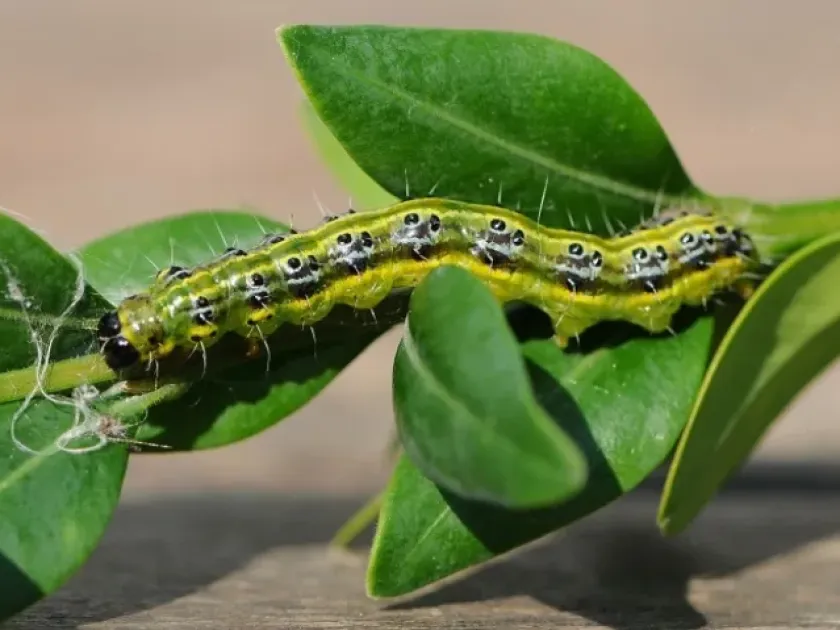
The larval stage, which causes the most damage, consists of caterpillars that grow up to 40 mm in length. They have a bright green body with thick black stripes and white spots, along with a shiny black head capsule.
Pupation occurs within a white, silken cocoon spun between the leaves of the host plant. The pupa starts as a green color and gradually turns brown, remaining hidden from predators within the dense foliage of the boxwood.
Depending on the climate, there can be multiple generations per year. Overwintering occurs during the larval stage, where small caterpillars hide within hibernacula—leaves joined together by silk—waiting for spring temperatures to rise.
What it damages
The box tree moth primarily feeds on Buxus species (boxwood). In heavy infestations, the larvae can strip a plant of all its leaves and even feed on the green bark, causing the plant to wither and die.
Signs of infestation
The first signs of an infestation include chewed leaf edges and the presence of fine webbing covering the shoots. As the larvae grow, they consume larger amounts of leaf tissue, leaving only the midribs behind.
The presence of green or black frass (excrement) at the base of the plant is a significant indicator of activity. These small pellets often accumulate in large quantities, signaling that a colony is present within the bush.
Severe defoliation is a major warning sign. When the leaves become skeletonized, the overall structure of the boxwood becomes visible through the foliage, and the plant loses its dense, decorative appearance.
During the peak of an outbreak, a distinct smell may be noticeable around the affected plants. This odor is often associated with the breakdown of leaf tissue and the presence of large quantities of larval waste.
The presence of rolled leaves held together by silk threads is a clear sign that the moth has completed its cycle and larvae are likely developing inside. Frequent monitoring is necessary to catch the infestation at an early stage.
Control measures
Hand-picking caterpillars is a viable solution for small gardens. If you spot them early, removing the affected branches and the caterpillars manually can significantly reduce the pressure on the shrub.
Biological control using Bacillus thuringiensis is highly effective against young larvae. This bacterial pesticide is safer for the environment and targets the caterpillars specifically without affecting beneficial insects.
Chemical insecticides, such as pyrethroids or systemic neonicotinoids, should be used if the infestation is severe. Thorough coverage is essential, ensuring the product reaches the interior parts of the dense boxwood structure.
Pheromone traps are excellent tools for monitoring moth activity. By tracking the number of adult moths caught, you can time your applications of pesticides more accurately, maximizing the effectiveness of every spray.
Maintaining plant health through adequate watering and balanced fertilization is crucial. A healthy boxwood plant has a better chance of recovering after the moths have been eliminated, provided that the initial damage was not too extensive.
Taxonomy
- Latin name
- Parotis
- Order
- Lepidoptera (butterflies)
- Family
- Crambidae
- EPPO code
- PRTISP
Discussion
No discussions yet — be the first.