
Picture-winged fly
Paraterellia varipennis
Description
How to identify
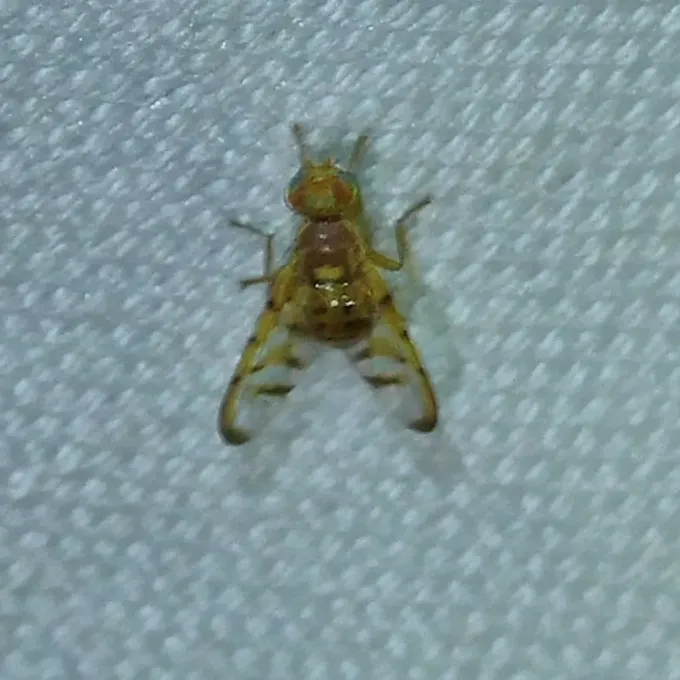
The Paraterellia varipennis, known as a type of picture-winged fly, belongs to the family Tephritidae in the order Diptera. These flies are characterized by distinctive patterns on their wings, which serve as camouflage.
Adult flies are typically small, with yellowish-brown bodies and complex, net-like wing markings that are highly diagnostic for this specific species.
The larvae are specialized feeders that thrive within the flower heads of plants belonging to the Asteraceae family, lacking legs and possessing a simple cylindrical body.
Entomologists identify these flies by observing their unique wing patterns and their specific association with host plant flowers during the active season.
While they are relatively small, their presence is often noted by their rhythmic activity on flower discs during warm and sunny days.
What it damages
The economic damage is caused by larvae that feed on the ovaries, receptacle tissues, and developing seeds within the flower heads of host plants.
Infestation results in reduced seed set, poor seed quality, and weakened overall plant development, which is particularly devastating for seed production fields.
The destruction of generative tissues prevents the plant from producing viable seeds, often leading to a total loss of the flower's reproductive capacity.
Furthermore, larval feeding creates openings in the plant tissue, allowing opportunistic fungi and bacteria to enter, which often leads to rotting.
In high-density populations, these flies can significantly impact the yield of ornamental sunflower varieties or related agricultural Asteraceae crops.
When it appears
The lifecycle of the fly is tightly coupled with the blooming season of its host plants, typically occurring throughout the summer months.
Adults emerge from their overwintering puparia in the spring, coinciding with the early bud formation of potential host plants in the field.
Females lay eggs into the developing flower buds, ensuring that larvae have an immediate and high-quality food source upon hatching.
Overwintering usually occurs in the soil or within dried plant debris in the pupal stage, protecting the species from cold winter temperatures.
Multiple generations may occur in a single year depending on the regional climate, with peak infestations correlating with long periods of flower blooming.
Signs of infestation
Symptoms of infestation often begin with visible punctures on the outside of the flower bud where the female has deposited eggs.
Developing flower heads may show signs of deformation or irregular growth, as the larvae consume the internal tissues necessary for uniform development.
Dissecting a suspect flower head will reveal the presence of creamy white larvae and distinct tunnels carved through the receptacle.
As the larvae feed, they produce frass (excrement) that can sometimes be seen pushing through the scales of the flower head.
Late-stage infestations are often accompanied by wilting or premature browning of the flower head petals, followed by potential tissue rot.
Control measures
Managing Paraterellia varipennis requires a strategy centered on crop sanitation, habitat management, and targeted chemical intervention.
Destroying wild Asteraceae weeds around the perimeter of fields is essential to remove the breeding reservoirs that sustain the population.
Tilling the soil after harvest is a highly effective mechanical measure to bury and kill puparia, significantly disrupting the lifecycle for the next season.
Chemical control should be applied during the early budding stage, targeting adults before they have the chance to oviposit in the flower heads.
- Implement strict crop rotation.
- Monitor fields for adult activity in early summer.
- Use systemic insecticides if necessary for high-value seed crops.
- Remove and dispose of infested flower heads immediately.
Taxonomy
- Latin name
- Paraterellia varipennis
- Order
- Diptera (flies)
- Family
- Tephritidae
- EPPO code
- PTLLVA
Discussion
No discussions yet — be the first.