
Ficus scale
Parasaissetia ficicola
Description
How to identify
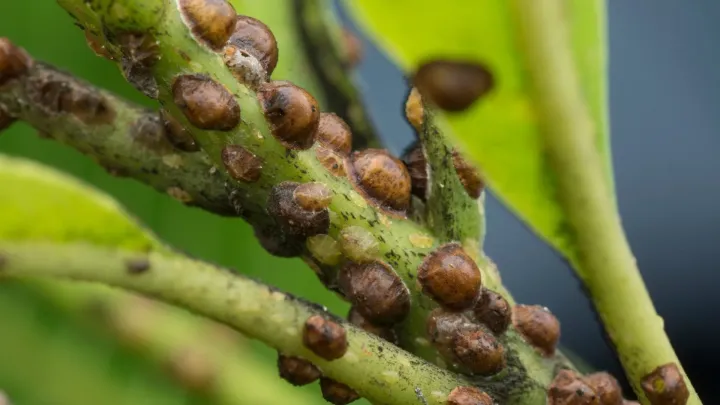
The Ficus scale (Parasaissetia ficicola) belongs to the order Hemiptera, family Coccidae. Adult females have a characteristic convex body of a hemispherical shape, which hardens with age, turning into a protective shell of brown or reddish-brown color.
Unlike armored scales, the shell of the Ficus scale is not detachable from the body, as it is a chitinized part of the insect itself. The size of an adult usually ranges from 2 to 4 mm. Male specimens are extremely rare, as the species primarily reproduces parthenogenetically.
The larvae, often called crawlers, are very active and have an oval, flat body of a light yellow or beige color. They actively move along the plant in search of the most succulent and young tissues to feed on.
Eggs are laid by the female directly under her body, which serves as a reliable shelter for future generations. A single female is capable of laying several hundred eggs, ensuring high reproductive capacity under favorable conditions.
This species is a typical sucking pest that has adapted to life in both indoor greenhouse environments and tropical or subtropical outdoor climates.
What it damages
The primary hosts of this pest are members of the Moraceae family, especially the genus Ficus. The pest is frequently found on Ficus benjamina, Ficus elastica, and other decorative foliage species grown in greenhouses or homes.
In addition to Ficus, the insect can infest a wide range of other plants, including citrus, oleander, gardenia, and various tropical shrubs. The pest prefers environments with high humidity and stagnant air.
In natural habitats, colonies often congregate on the underside of leaf blades along the central vein, as well as on young shoots and leaf petioles, where sap flow is most intense.
High population density can lead to significant weakening of the plant. Severe infestations result in noticeable inhibition of metabolic processes and stunted growth.
In ornamental horticulture, the damage is not only physiological but also aesthetic, rendering plants unsuitable for decorative use due to the loss of leaf and stem quality.
Signs of infestation
The first sign of infestation is the appearance of a sticky substance on leaves and under the plant, known as honeydew. This is the sweet excrement of the insects, which becomes an excellent growth medium for sooty mold.
Sooty mold manifests as a black coating on leaf blades, which disrupts photosynthesis and gas exchange. This secondary symptom is often noticed earlier than the pests themselves.
Upon careful inspection of stems and the underside of leaves, dense, immobile bumps can be found. Attempting to remove such a bump mechanically leaves a characteristic spot or damaged epidermis on the leaf surface.
Leaves of the infested plant begin to yellow, curl, and fall off prematurely. In advanced cases, mass leaf drop occurs, accompanied by the wilting of shoot tips.
The presence of ant colonies on the plant can also serve as an indirect sign of infestation, as ants often "farm" scale insects for their sweet secretions, protecting them from predators.
Control measures
For pest control, it is recommended to start with mechanical cleaning: removing visible individuals with a cotton swab dipped in rubbing alcohol or soapy water. This is effective in the early stages of infestation.
The use of systemic insecticides based on imidacloprid or acetamiprid is highly effective, as the active substance penetrates plant tissues and makes the sap toxic to the pest.
The application of contact pesticides requires thorough spraying of all plant parts, including hard-to-reach areas under the leaves. It is recommended to perform follow-up treatments at 7–10 day intervals to eliminate young crawlers.
Good horticultural practice is essential: ensuring proper ventilation and maintaining an optimal irrigation schedule. Avoiding waterlogged soil reduces the overall attractiveness of the plant to the pest.
- Isolate infested specimens from healthy plants.
- Regularly inspect the underside of leaves.
- Wash leaves with warm water and mild dish soap.
- Use specialized systemic insecticide spikes in the soil.
Taxonomy
- Latin name
- Parasaissetia ficicola
- Order
- Hemiptera (bugs, aphids, leafhoppers)
- Family
- Coccidae
- EPPO code
- PASAFI
Discussion
No discussions yet — be the first.