
Hornet moth
Paranthrene tabaniformis
Description
How to identify
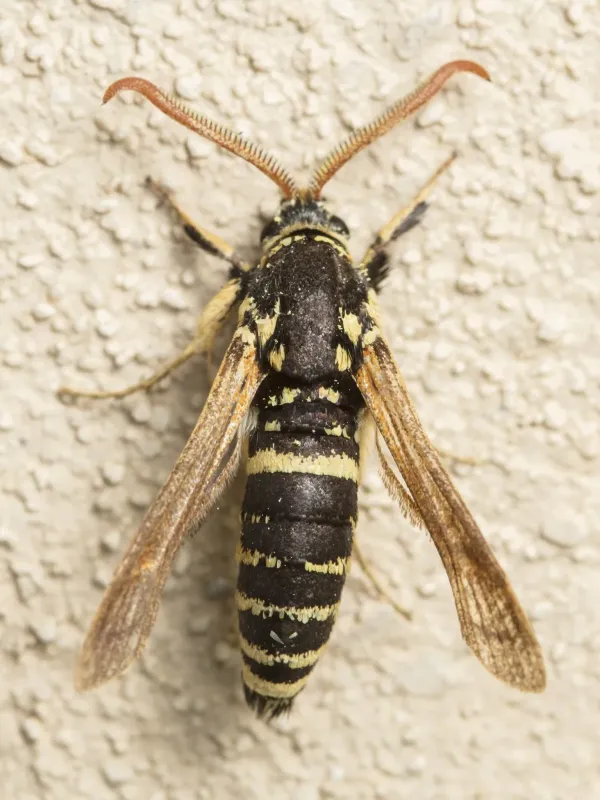
The Hornet moth Paranthrene tabaniformis belongs to the Sesiidae family. Its appearance is a classic example of Batesian mimicry, as it closely resembles a hornet to deter predators.
Adult moths have a wingspan of 25–35 mm with transparent wings, featuring a dark border and yellow bands on the abdomen, perfectly mimicking the look of Vespidae wasps.
The larvae are cream-colored with a brown head capsule. They lead an endophytophagous lifestyle, meaning they develop entirely within the host plant's woody tissue.
The life cycle of this species typically spans one or two years, with the insect spending most of its time as a larva inside the stem or branches.
Adults are diurnal insects, meaning they are most active during the sunny hours of the day, when they can be seen flying around host trees.
What it damages
The primary hosts include species of Populus (poplars, aspens) and Salix (willows). It is particularly destructive in nurseries and young plantations.
Larvae bore tunnels under the bark and into the cambium layer. These tunnels can be extensive and significantly disrupt the vascular system of the tree.
Damage often results in gall-like swellings, trunk deformities, and weakening of the mechanical integrity, making trees prone to wind breakage.
The presence of entry points for larvae also makes the tree susceptible to secondary infections by fungi and bacteria, leading to further tissue decay.
In severe cases, the larvae can cause the death of the terminal leader, resulting in stunted growth or the total death of the affected sapling.
When it appears
Adult moths emerge in late spring and are active throughout early summer, typically peaking in activity between May and July depending on the geography.
Females lay eggs individually on the bark, usually targeting fresh wounds, pruning scars, or areas near nodes where the bark is thinner.
Once the eggs hatch, the young larvae immediately bore into the tissues, beginning their long developmental phase protected from the external environment.
Overwintering occurs inside the host plant's wood in the larval stage. This strategy allows the pest to survive harsh winter conditions quite effectively.
Pupation takes place within the larval tunnel, and the pupa pushes itself partially out of the exit hole just before the adult moth emerges.
Signs of infestation
The most reliable sign of an infestation is the presence of brown, sawdust-like frass (excrement) pushed out from the larval tunnels onto the bark.
Swollen nodes or distorted areas on the trunk or branches indicate where larvae have been feeding and causing the tree to form abnormal scar tissue.
Wilting of the leaves, particularly on the upper part of the tree, can signal that the vascular system is being compromised by internal borer activity.
Discarded pupal cases sticking out of the tree bark are a clear indicator that a new generation of moths has successfully completed its cycle.
- Accumulation of brown frass at entry holes.
- Galls or irregular swellings on trunks.
- Dieback of the terminal leader.
- Visible emergence holes in the bark.
Control measures
Silvicultural management is the first line of defense, focusing on keeping trees healthy and avoiding mechanical wounds that attract egg-laying females.
Regular inspection of plantations allows for the early removal and destruction of infested shoots or saplings before the next generation emerges.
In high-risk areas like nurseries, insecticides can be applied during the flight period of adults to prevent the infestation of new trees.
Pheromone traps are highly useful for monitoring adult populations and can be used to mass-trap males to reduce the mating success in localized areas.
Encouraging natural predators, such as insectivorous birds, is an effective way to maintain the pest population at a low level in established forests.
Taxonomy
- Latin name
- Paranthrene tabaniformis
- Order
- Lepidoptera (butterflies)
- Family
- Sesiidae
- EPPO code
- PARHTA
Discussion
No discussions yet — be the first.