
Locust clearwing
Paranthrene robiniae
Description
How to identify
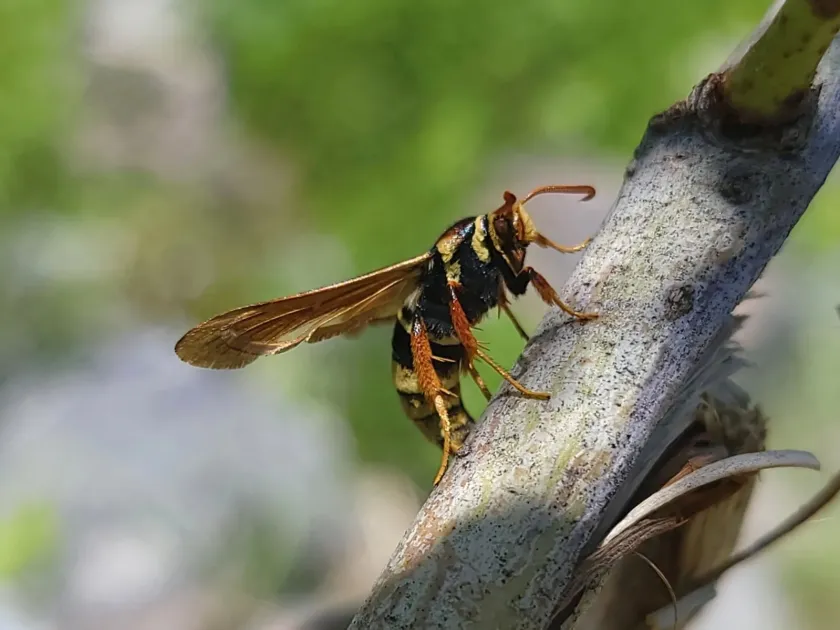
The locust clearwing moth (Paranthrene robiniae) is a clearwing moth belonging to the Sesiidae family. Adults are well-known for their mimicry of wasps.
These moths have transparent wings with dark borders, reaching a wingspan of approximately 25 to 35 millimeters. Their bodies display vibrant yellow or orange bands.
Larvae are creamy-white with a dark, sclerotized head capsule, which is typical for wood-boring lepidopterans living inside tree trunks.
Adults are difficult to spot in nature due to their wasp-like appearance and rapid flight, making them blend perfectly into the environment.
Detection is best performed using synthetic pheromone traps, which allow researchers to identify the presence of the pest within an area during the flight season.
What it damages
The primary host for this species is the black locust (Robinia pseudoacacia), although it also impacts various other woody plants.
Other host species include willows and poplars, making the pest a significant concern for shelterbelts, urban forestry, and ornamental plantings.
The larvae bore tunnels into the sapwood and heartwood, disrupting the vascular system of the tree and hindering the transport of water and nutrients.
Structural damage weakens the trunk, often resulting in limb breakage or the complete loss of young trees under heavy wind or stress.
Beyond structural loss, the entry holes serve as entry points for pathogens, fungi, and other secondary wood-decaying organisms.
When it appears
Adult moths typically emerge from late spring to mid-summer, with peak activity occurring between May and August, depending on the local climate.
Females lay their eggs in bark crevices or near existing wounds. Upon hatching, the young larvae immediately bore through the bark to feed on the inner tissues.
The life cycle can vary from one to two years. Larvae overwinter within their tunnels inside the tree, protected from external environmental factors.
Pupation occurs inside the wood in spring. Before the adult emerges, the pupa uses its specialized structures to break through the bark to the surface.
Warm and dry spring conditions often accelerate the development of the larvae, potentially leading to more synchronized and visible emergence of adults.
Signs of infestation
The most reliable sign of infestation is the presence of "frass" (sawdust-like excrement) accumulating at the base of the tree or in branch crotches.
Tiny exit holes are visible on the bark surface where the larvae have discarded waste or where the emerging moth has left the tree.
Leaves on infected trees may show signs of chlorosis, wilting, or premature shedding as the internal plumbing of the tree is progressively destroyed.
Empty pupal casings, often protruding halfway out of the exit holes in the bark, are definitive evidence of a completed lifecycle stage.
Swelling or abnormal growth patterns on the trunk or branches often indicate the tree is attempting to heal older, chronic larval tunnel damage.
Control measures
Proper silvicultural practices, including the removal and destruction of heavily infested limbs, are essential to reduce the overall pest population.
Minimizing mechanical injuries to tree trunks is a critical preventative measure, as fresh wounds are primary oviposition sites for female moths.
Biological control using entomopathogenic nematodes or Bacillus thuringiensis sprays can be effective if applied during the period of larval hatching.
Systemic insecticides may be used in commercial nurseries, though application requires careful timing to coincide with the brief period of larval migration.
- Monitor flight activity with pheromone-baited traps.
- Seal pruning cuts and wounds with high-quality wound dressings.
- Encourage insectivorous birds that prey on larvae and pupae.
Taxonomy
- Latin name
- Paranthrene robiniae
- Order
- Lepidoptera (butterflies)
- Family
- Sesiidae
- EPPO code
- PARHRO
Discussion
No discussions yet — be the first.