
Poplar clearwing
Paranthrene cyanogama
Description
How to identify
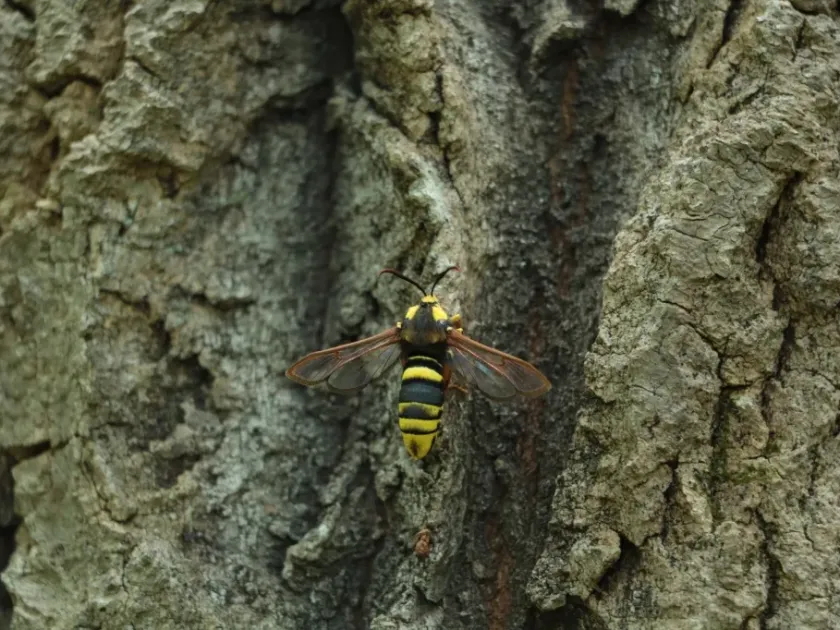
The poplar clearwing Paranthrene cyanogama belongs to the Sesiidae family, also known as clearwing moths. These insects are famous for their Batesian mimicry, resembling wasps or hornets.
Adult moths possess mostly transparent wings with dark edges and distinct wing venation. The wingspan typically ranges from 25 to 35 mm, making them noticeable in flight.
The larvae are whitish caterpillars with dark heads, growing up to 40 mm in length. They are endophagous, meaning they live and feed inside the host tree's wood.
Pupae are brownish in color and equipped with small spines, which allow them to move within the larval tunnels to reach the exit hole before the adult emerges.
The life cycle of the poplar clearwing can span from one to two years, significantly influenced by the regional climate and the physiological state of the host tree.
What it damages
This pest primarily attacks trees of the Populus (poplar) and Salix (willow) genera. Young trees and those under stress are particularly susceptible to infestation.
Damage is caused by the caterpillars as they bore into the bark and feed on the cambium and xylem. This activity disrupts the tree's vascular system and nutrient transport.
Infested areas often develop swellings, calluses, and longitudinal cracks in the bark. These wounds become entry points for secondary pathogens and wood-rotting fungi.
Severe infestations lead to stunted growth, dieback of the crown, and in extreme cases, the total collapse of branches or the death of the entire tree.
This pest is a major concern for forest shelterbelts, urban landscape plantings, and nurseries, where the visual and structural integrity of trees is essential.
When it appears
Adult flight activity typically occurs during the summer months, specifically between June and July. They are most active on warm, sunny days.
Females lay eggs singly or in small clusters on the bark, usually targeting crevices, wounds, or the base of buds to provide cover for hatching larvae.
Upon hatching, larvae bore into the bark, eventually establishing themselves deep within the wood where they spend the majority of their development cycle.
Larvae overwinter inside the galleries within the trunk or branches. This protected environment helps them survive cold temperatures during the winter season.
Pupation takes place in the spring within the larval gallery. The pupa pushes itself partially out of the exit hole just before the moth emerges, leaving an empty shell.
Signs of infestation
A primary indicator of infestation is the presence of "frass" (sawdust mixed with excrement) found at the base of the tree or caught in bark crevices.
- Small, circular exit holes on the tree trunk or thick branches.
- Swollen, deformed areas of bark indicating previous or ongoing larval activity.
- Premature yellowing of leaves or wilting of the upper branches during mid-summer.
- Empty pupal cases protruding from the bark as a clear sign of recent moth emergence.
Early detection involves inspecting the trunk surface and branch unions for any signs of frass, especially during the spring and early summer months.
Control measures
Cultural management is the first line of defense: maintaining tree vigor through proper irrigation, fertilization, and protecting trunks from physical injury.
Sanitation is crucial; heavily infested trees or branches should be pruned and destroyed to reduce the local population of the clearwing moth.
Chemical control with systemic insecticides is most effective when applied during the egg-hatching window before the larvae have fully bored into the wood.
Pheromone traps are used to monitor adult moth populations and timing. These can also be used as a suppression tool in small, high-value nursery environments.
Promoting natural biological control by conserving birds and parasitic wasps helps in maintaining the pest population below the economic threshold.
Taxonomy
- Latin name
- Paranthrene cyanogama
- Order
- Lepidoptera (butterflies)
- Family
- Sesiidae
- EPPO code
- PARHCY
Discussion
No discussions yet — be the first.