
Poplar hornet moth
Paranthrene asiliformis
Description
How to identify
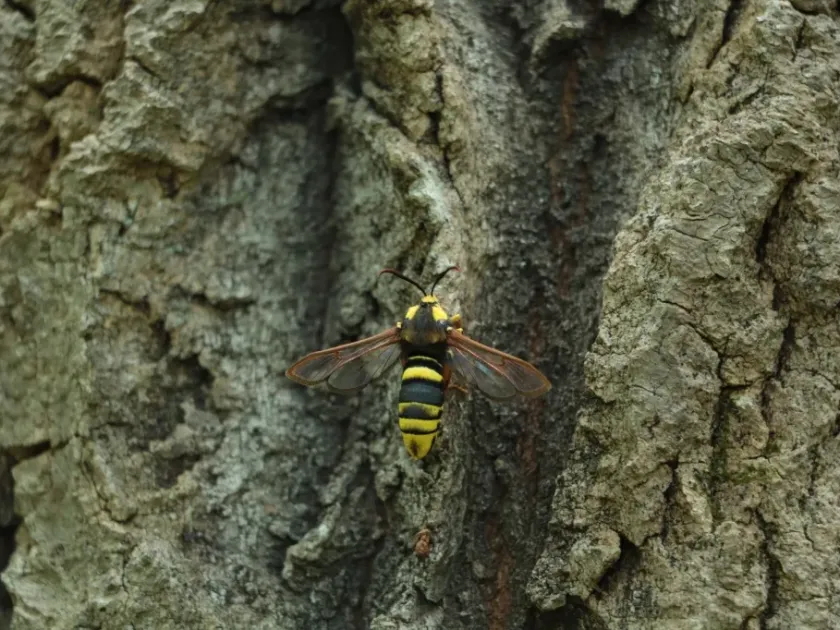
The poplar hornet moth (Paranthrene asiliformis) belongs to the family Sesiidae, known as clearwing moths, which are famous for their mimicry of stinging insects like hornets and wasps.
The adult moth features transparent wings with dark margins and a body patterned with yellow and black bands, effectively confusing potential predators through visual resemblance.
The larvae, which are the main cause of damage, are cylindrical, whitish in color with a dark brown head, and reach lengths of up to 30 millimeters.
The life cycle typically spans two years, with the majority of this time spent as larvae feeding inside the trunks of host trees, protected by the bark and wood.
The pupal stage occurs inside the tree, and the empty pupal case is often found protruding from the exit hole once the adult moth has successfully emerged.
What it damages
The primary hosts for this species include various trees from the Salicaceae family, specifically poplars (Populus) and willows (Salix).
Larvae feed by boring galleries into the bark and cambium layer, which disrupts the tree's vascular system and impairs the transport of water and nutrients.
Severe infestations cause structural weakness, making the trees susceptible to windthrow and secondary infections from fungal or bacterial pathogens.
Young trees in nurseries are at the highest risk of mortality, as the larvae can easily girdle the trunk, causing the tree to wither and die.
In mature trees, the pest reduces the wood quality and aesthetic value, creating unattractive holes and distorted bark tissue that lowers the tree's health and longevity.
When it appears
Adult moths typically emerge from late spring through mid-summer, with peak activity depending on the geographical region and seasonal temperatures.
Females are active during the day and seek out suitable oviposition sites, focusing on cracks in the bark or near existing mechanical wounds on the tree trunk.
Upon hatching, the young larvae immediately begin to burrow beneath the bark, beginning the process of gallery formation that will last for several months or years.
Overwintering occurs while the larvae are in various stages of development within the wood, allowing them to survive cold winters safely protected inside the trunk.
The timing of emergence for the next generation is highly dependent on the cumulative heat, which regulates the development speed of the pupae within the galleries.
Signs of infestation
The most visible sign of infestation is the presence of frass—a mixture of wood shavings and excrement—pushed out from the larval entrance holes.
Empty pupal skins found sticking out of the bark are a definitive sign that the moth has completed its cycle and has successfully left the tree.
Infected areas often show signs of bark disruption, including cracking, swelling, or the formation of galls as the tree attempts to heal the wounds caused by the borers.
Dying branches or yellowing leaves during the growing season can indicate that the internal vascular system has been severely damaged by larval boring activity.
Physical inspection of the trunk surface will reveal circular or elliptical exit holes, which are characteristic of the species' exit points after metamorphosis.
Control measures
Sanitation is key; removing and destroying heavily infested trees is essential to prevent the spread of the population to healthy trees in the vicinity.
Maintaining tree vigor through proper irrigation and fertilization helps the trees resist minor infestations and facilitates faster wound healing.
Chemical control involving systemic insecticides can be applied during the period when eggs are laid and young larvae are just beginning to penetrate the bark.
Pheromone traps are highly effective for monitoring adult moth populations, allowing for precise timing of management interventions during the flight period.
- Avoid damaging the bark during landscaping or maintenance tasks.
- Encourage natural predators such as woodpeckers and parasitic wasps.
- Apply protective wound dressings to prevent female moths from laying eggs.
Taxonomy
- Latin name
- Paranthrene asiliformis
- Order
- Lepidoptera (butterflies)
- Family
- Sesiidae
- EPPO code
- PARHAS
Discussion
No discussions yet — be the first.