
Hornet Moth
Paranthrene
Description
How to identify
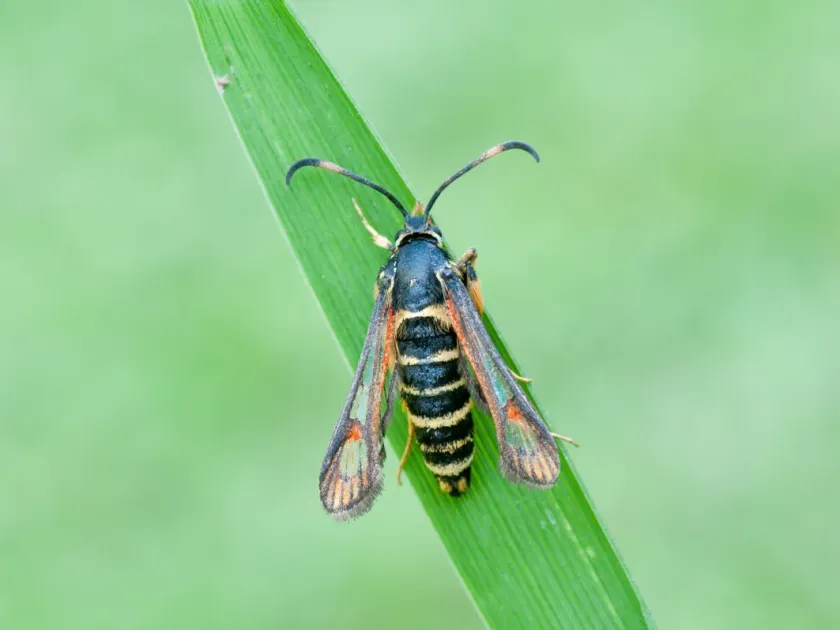
The Hornet Moth (Paranthrene tabaniformis) is a member of the clearwing moth family (Sesiidae). It is a remarkable example of Batesian mimicry, as its appearance closely resembles hornets or wasps.
The wingspan ranges between 25 and 35 mm. The wings are mostly transparent with dark margins. The abdomen features yellow cross-bands, contributing to its convincing hornet-like disguise.
The larvae are whitish-yellow with a brown head, reaching up to 30 mm in length. They spend their entire developmental phase feeding within the woody tissues of the host plant.
The pupae are dark brown, equipped with specialized spines that allow them to push themselves through the larval tunnels to emerge from the bark during the adult stage.
Sexual dimorphism is present: males have serrated antennae, whereas females have thread-like antennae, which helps in identifying the sex during population monitoring.
What it damages
The primary hosts are trees from the genus Populus, such as poplars and aspens. Occasionally, they can also attack willow trees (Salix) during population outbreaks.
Young trees and saplings in nurseries are the most vulnerable. Attacks on young trees can lead to significant stunting, reduced growth, or even the death of the specimen due to vascular disruption.
The larvae tunnel into the trunk and branches, severely weakening the structural integrity of the wood. This makes the affected trees highly susceptible to wind-breakage.
Damage to the root collar is particularly destructive, as it interferes with nutrient transport. This often leads to chronic tree decline, making the tree look sickly and causing premature leaf drop.
Furthermore, the holes bored by the larvae create entry points for secondary pests, wood-decaying fungi, and bacteria, which can accelerate the death of the tree.
When it appears
Adult moths are typically active from late spring through mid-summer, with June being the peak period. They prefer sunny, warm weather and feed on nectar from flowers.
Eggs are laid singly on the bark, usually near existing wounds, crevices, or around the base of buds. The larvae hatch and immediately bore into the bark to begin their tunnel systems.
The life cycle usually takes one year to complete. However, environmental factors or host quality can occasionally extend the development period to two years in certain climates.
Larvae overwinter inside the host tree. In the spring, they resume feeding until they reach maturity, at which point they construct a pupal chamber near the surface of the bark.
Emergence occurs when the pupa pushes itself partially out of the tunnel. Once the moth exits, the empty pupal casing remains protruding from the bark as a visible sign of infestation.
Signs of infestation
Accumulation of coarse, woody frass (sawdust) at the base of the tree or caught in bark crevices is a clear indication of active larval feeding inside the trunk.
The presence of old pupal cases stuck in the bark is a definitive sign that a Hornet Moth generation has successfully completed its cycle on that specific tree.
Weakened branches or yellowing leaves can indicate that the internal larval tunnels have compromised the nutrient flow, resulting in water stress and reduced photosynthetic activity.
Visible swellings or deformed growths (galls) on the trunk are common reactions of the tree to repeated larval damage, representing areas where the tree has attempted to heal its wounds.
In nursery settings, uneven growth among saplings of the same age is a strong warning sign to check for stem borer activity, including those of the Hornet Moth.
Control measures
The primary control method is strict forest hygiene. This involves the timely removal and burning of heavily infested trees to prevent the moths from emerging and spreading.
Promoting vigorous tree growth through proper silvicultural practices, such as adequate watering and soil management, helps trees resist and recover from pest infestations.
Chemical control can be effective if applied during the period when young larvae have just hatched but have not yet deeply penetrated the woody tissues of the trunk.
Biological control involves conserving natural enemies, such as ichneumonid wasps, which parasitize the larvae and pupae of the Hornet Moth, effectively reducing population numbers.
Monitoring the adult population using pheromone traps is essential for timing chemical or biological interventions, ensuring that management efforts are applied when they are most effective.
Taxonomy
- Latin name
- Paranthrene
- Order
- Lepidoptera (butterflies)
- Family
- Sesiidae
- EPPO code
- PARHSP
Discussion
No discussions yet — be the first.