
Paracantha
Paracantha
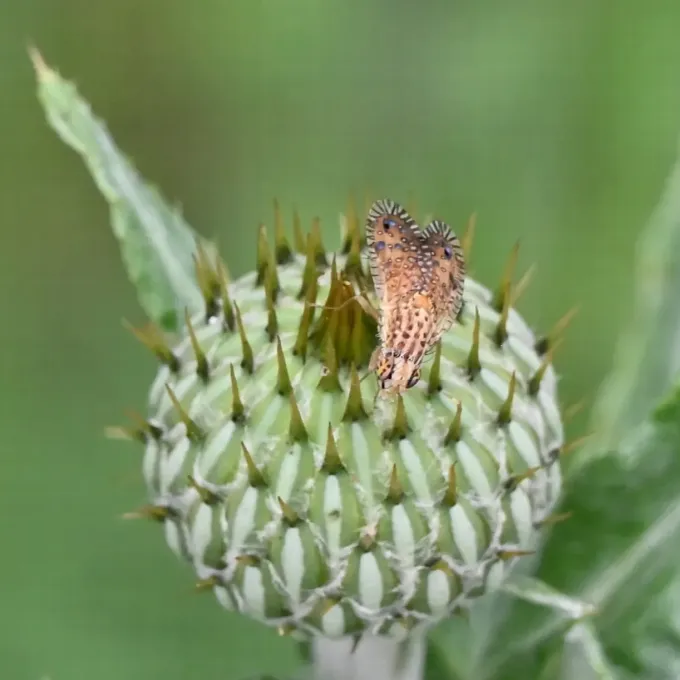
Description
How to identify
Paracantha belongs to the Tephritidae family, order Diptera. These are small insects often characterized by a distinctive spotted wing pattern, which serves as camouflage on flowering plants.
Adults possess specialized mouthparts for feeding on nectar and honeydew. The body of the imago is covered in fine hairs, and the eyes often exhibit a metallic sheen, a notable feature of this species group.
The larvae of Paracantha lead a concealed life. Lacking developed limbs, they have a morphology typical of many leaf-mining flies, making them difficult to detect during standard field inspections.
The life cycle of this insect is closely synchronized with the phenology of its host plants. Paracantha undergoes complete metamorphosis: egg, three larval stages, puparium, and adult.
Detecting this pest is challenging because a significant portion of its life is spent inside the tissue of floral heads, where it is shielded from both environmental factors and manual inspection.
What it damages
The primary hosts for Paracantha are members of the Asteraceae family. In agriculture, they pose a threat to both native wild composites and cultivated ornamental or oilseed plants.
The pest favors plants in the budding or active flowering stage. Larvae feed on developing seeds and receptacle tissues, causing substantial losses in seed yield and viability.
While Paracantha is not always considered a major agricultural pest, in regions with high concentrations of wild host weeds, it can migrate to cultivated plots and cause economic damage.
The breach of the receptacle tissue by larvae allows for secondary infections, including fungal and bacterial pathogens, which often cause more extensive damage to the plant than the insect itself.
Affected plants frequently show stunted seed growth, reduced germination rates, and poor overall seed quality, which is particularly detrimental to seed production operations.
When it appears
Adult activity of Paracantha begins during the peak flowering period of its host plants. In most regions, this coincides with late spring or summer, depending on the local climate.
Females lay eggs directly into the flower buds or young florets, selecting the most nutritionally suitable parts of the plant for the developing larvae.
Larval development occurs within the floral heads throughout the flowering and seed maturation process. The duration of each stage is highly dependent on ambient temperature.
Pupation often takes place either within the dried flower head or in the soil beneath the host plant, a critical factor to consider when designing pest management strategies.
The number of generations per season can vary, but generally, one or two distinct waves of the pest are observed, closely aligned with the vegetation peak of the host species.
Signs of infestation
The first indicator of an infestation is the presence of small puncture marks or entry holes on the involucre of the flower heads, created by the female during oviposition.
Visually, the infested plant may exhibit stunted growth, and flower heads often show visible deformation. Dissecting the head reveals larvae feeding on the achenes and reproductive parts.
- Deformed and prematurely withered flower heads.
- Presence of larval frass within the floral receptacle.
- Secondary fungal spots developing at the injury sites.
- Lower yield of healthy seeds during the harvesting process.
During heavy infestations, increased adult activity can be observed during evening hours around blooming plants, signaling the need for immediate monitoring and control.
Control measures
The primary control measure involves the systematic removal of wild Asteraceae weeds near agricultural fields, as these act as the main reservoir for Paracantha populations.
Agrotechnical methods, such as deep autumn plowing, are highly effective in destroying pupae that overwinter in the upper soil layers, significantly reducing the next season's pressure.
For seed crops, the application of systemic or contact-stomach insecticides may be justified during the budding stage, before the onset of mass flowering.
Biological control strategies may include the release of parasitic Hymenoptera, which target larvae and pupae to naturally suppress the population growth of the pest.
Regular monitoring using pheromone or colored sticky traps allows growers to precisely time their interventions and optimize the use of crop protection products.
Taxonomy
- Latin name
- Paracantha
- Order
- Diptera (flies)
- Family
- Tephritidae
- EPPO code
- PCANSP
Discussion
No discussions yet — be the first.