

Citrus red mite
Panonychus citri
Description
How to identify
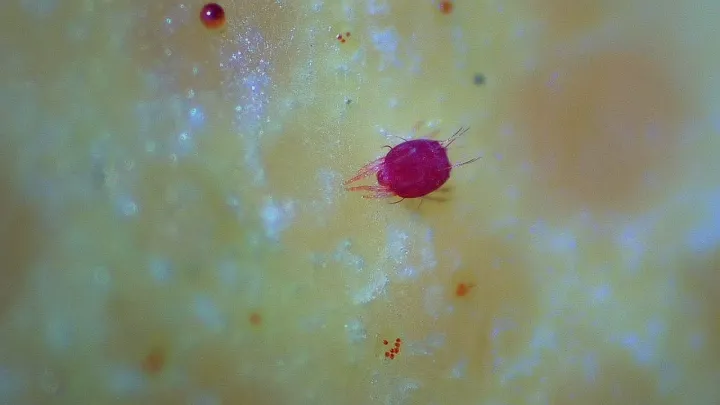
The Citrus red mite (Panonychus citri) is a significant pest belonging to the spider mite family (Tetranychidae). These microscopic pests are easily identified by their distinct bright red or purplish-brown coloration.
Adult females reach a size of approximately 0.3 to 0.4 mm. Their bodies are oval and convex, with long, slender dorsal setae that sit on prominent white tubercles, which helps distinguish them from other mite species.
Eggs of this mite are round, flattened, and red, featuring a unique small stalk on the upper side. This distinctive appearance makes them recognizable even to the naked eye with some experience.
The life cycle involves egg, larva, protonymph, deutonymph, and adult stages. Development is highly sensitive to temperature, with higher metabolic rates observed in warmer environments.
These mites are highly prolific, with females capable of laying dozens of eggs during their lifespan. Under favorable conditions, the population can explode, leading to heavy infestation pressure within a few weeks.
What it damages
The primary hosts of the Citrus red mite are citrus species, including lemons, oranges, mandarins, and grapefruits. They feed by piercing the plant cells and extracting sap, destroying chlorophyll in the process.
Beyond citrus, this mite is a known polyphage, capable of affecting a variety of other crops including tea, figs, pears, peaches, and various ornamental plants, causing economic losses across different sectors.
Feeding damage results in chlorotic spots, which eventually lead to leaf drop. This process directly impacts the plant's ability to perform photosynthesis, stunting growth and reducing overall health.
Fruit quality is also significantly degraded. Infested fruits develop silvery or bleached patches on the rind, which makes them unsuitable for fresh market sales and lowers the harvest value.
Long-term infestation weakens the entire plant, making it more susceptible to secondary infections, such as fungal pathogens, and can lead to branch dieback in severe cases.
When it appears
The pest is most active during periods of moderate to high temperatures, typically between 15°C and 25°C. In greenhouses or tropical climates, it can remain active throughout the entire year.
In seasonal climates, the mite begins its activity in early spring, colonizing new foliage as it emerges. Populations typically peak in late spring and early summer before potentially declining during high heat.
During unfavorable weather conditions, such as extremely dry or cold spells, the mites may enter a state of dormancy or slow their reproductive cycle significantly.
They spread primarily through wind currents, moving from infested leaves to healthy ones. Their mobility is highest during the warmer parts of the day when humidity is lower.
Autumn cooling usually signals a reduction in population activity, though in mild regions, eggs and adults can successfully survive the winter by sheltering in the crevices of tree bark.
Signs of infestation
The first sign of an infestation is the appearance of tiny, light-colored stippling marks on the upper surface of the leaves. These marks are the entry points for the mite's feeding apparatus.
Unlike many other species, Panonychus citri produces very little visible webbing. This lack of silk can lead growers to overlook the pest until the damage has become widespread.
As the infestation progresses, leaves lose their deep green luster and become dull, grayish, or "dusty" in appearance. Severe damage almost always results in premature defoliation.
Careful inspection of the leaf undersides with a hand lens will reveal the presence of moving red mites and their eggs. The presence of eggs is a key diagnostic factor for active populations.
General signs include reduced vigor of the tree, failure of new shoot development, and an overall unhealthy appearance that does not respond to fertilization or irrigation adjustments.
Control measures
Effective management requires the strategic use of acaricides. To prevent the development of resistance, it is crucial to rotate chemical classes throughout the season.
Biological control methods are highly effective, especially in protected environments. Releasing predatory mites like Phytoseiulus persimilis or Amblyseius species can naturally regulate populations.
- Monitor leaf populations regularly using a magnifying lens.
- Prune trees to ensure proper airflow and light penetration.
- Use summer oils for mechanical control of eggs and mobile stages.
- Avoid over-application of nitrogen, which can encourage mite reproduction.
Cultural practices, such as maintaining adequate tree hydration, improve the plant's ability to tolerate mite damage and speed up recovery after a chemical treatment program.
When applying pesticides, it is vital to cover the undersides of the leaves thoroughly, as this is the primary habitat for the mite and the site of most egg-laying activity.
Content graph
Connections · Citrus red mite
Most often together:
Marketplace
Products · 4


Biology
Taxonomy
- Latin name
- Panonychus citri
- Order
- Mites
- Family
- Tetranychidae
- EPPO code
- METTCI
Community
Discussion
No discussions yet — be the first.