
Pea weevil
Oxystoma craccae
Description
How to identify
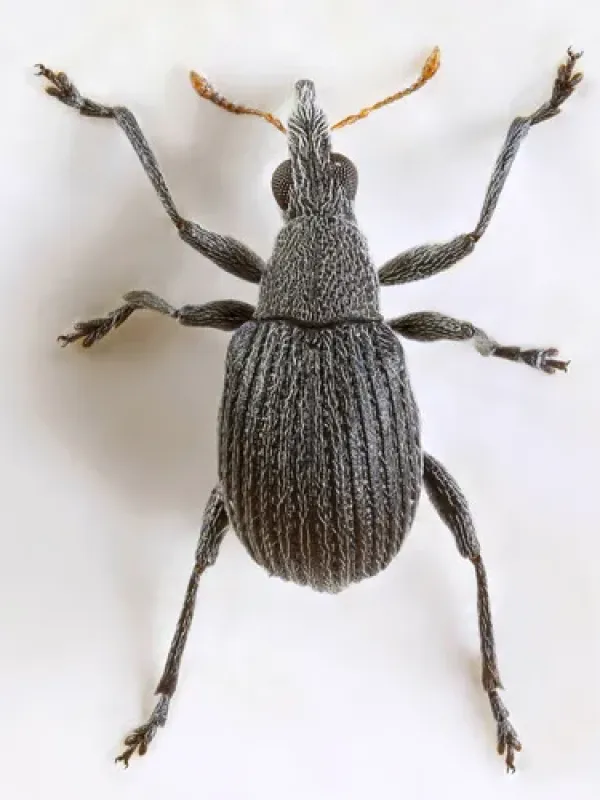
The pea weevil (Oxystoma craccae) belongs to the Curculionidae family and is a specialized pest affecting various leguminous plants. Adult beetles are small, typically ranging from 2 to 3 mm in length, with the distinct elongated snout characteristic of the weevil family.
The body of the beetle is usually black, sometimes displaying a subtle metallic luster. A key diagnostic feature for identification is the presence of longitudinal grooves on the elytra, which can be observed under a magnifying lens.
Larvae are legless, cream-colored, and curved in shape. They develop entirely within the host plant's reproductive organs, making them difficult to detect without opening the pods during the growing season.
Adults possess functional wings and are capable of flying over significant distances to locate suitable host crops. They emerge from hibernation in the spring as soon as soil temperatures reach favorable levels.
The lifecycle includes a complete metamorphosis through egg, larva, pupa, and adult stages. This pest typically completes one generation per year, making its activity highly synchronized with the development of the host legume crops.
What it damages
The pea weevil causes damage primarily to leguminous crops, with common pea (Pisum sativum) and vetch (Vicia) being the most susceptible. Both adults and larvae contribute to yield loss.
Adult beetles feed on leaves and young buds, creating small, characteristic holes. While this foliage damage is noticeable, the most severe economic impact comes from the larvae feeding inside the seeds and developing pods.
Larval feeding destroys the seed tissue, rendering the affected pods unsuitable for human consumption and significantly reducing the seed's viability and overall quality for agricultural storage.
High infestation levels lead to premature ripening, pod yellowing, and shriveling, causing direct loss in crop tonnage. Secondary fungal infections may also occur at the entry points created by the weevils.
Losses can be substantial, often reaching double-digit percentages if left unmanaged, particularly when fields are located adjacent to perennial legumes that harbor the pest population.
When it appears
Adults emerge from their overwintering sites, such as leaf litter and plant debris, in early spring when soil temperatures reach 8-10 degrees Celsius. Initially, they survive by feeding on wild legumes in the surrounding areas.
A mass migration of adults into cultivated pea fields typically occurs during the budding and early flowering stages. This is the period when beetles are most active and prone to mating.
Egg-laying is a prolonged process that mirrors the flowering phase of the host plant. Females deposit eggs directly into the developing pods, ensuring that larvae have an immediate food source upon hatching.
Larvae develop inside the seed for approximately 3 to 4 weeks before pupating, either within the damaged seed or in the soil. The emergence of the new adult generation usually happens in the second half of the summer.
Once the new generation of adults emerges, they feed briefly before entering diapause or seeking protected areas for hibernation, effectively completing the annual cycle before the harvest is finalized.
Signs of infestation
The first indicator of a pea weevil infestation is the presence of distinctive circular notches on the edges of leaves. These feeding marks are clear evidence that adults have begun colonizing the crop.
In fields, one might notice flower buds that appear withered or drop prematurely, suggesting that adults have been feeding within the floral structures of the pea plants.
The most definitive sign is observed by opening pods during the seed-filling stage. Finding larvae, frass (excrement), or hollowed-out seeds is conclusive proof of an active infestation.
Entomological sweep netting is the standard method for monitoring adult population density. This should be performed during cool morning or evening hours when the insects are less mobile and easier to capture.
Plants heavily infested by larvae often show uneven growth, distorted pods, and overall poor plant health, which can be distinguished from environmental stress by the presence of physical entry holes on the pods.
Control measures
Effective management begins with strict spatial isolation, keeping new legume plantings at least 500 meters away from fields used for legumes in the previous season to prevent early colonization.
Cultural practices, such as deep plowing immediately after harvest, are highly effective in destroying overwintering populations and larvae residing in the soil or crop residues.
Chemical control, utilizing systemic or contact insecticides, is most effective if applied during the period of peak adult activity, precisely before eggs are deposited into the developing pods.
- Choose early-maturing varieties to escape the peak infestation window.
- Use high-vigor certified seeds to ensure rapid crop establishment.
- Implement pheromone traps to monitor adult flight patterns accurately.
- Remove surrounding weeds that serve as alternative host plants for the beetles.
An integrated approach that combines timely chemical intervention with preventative field hygiene provides the most sustainable and reliable results in preventing significant yield loss.
Taxonomy
- Latin name
- Oxystoma craccae
- Order
- Coleoptera (beetles)
- Family
- Brentidae
- EPPO code
- OXYMCR
Discussion
No discussions yet — be the first.