
Oak timberworm
Arrhenodes minutus
Description
How to identify
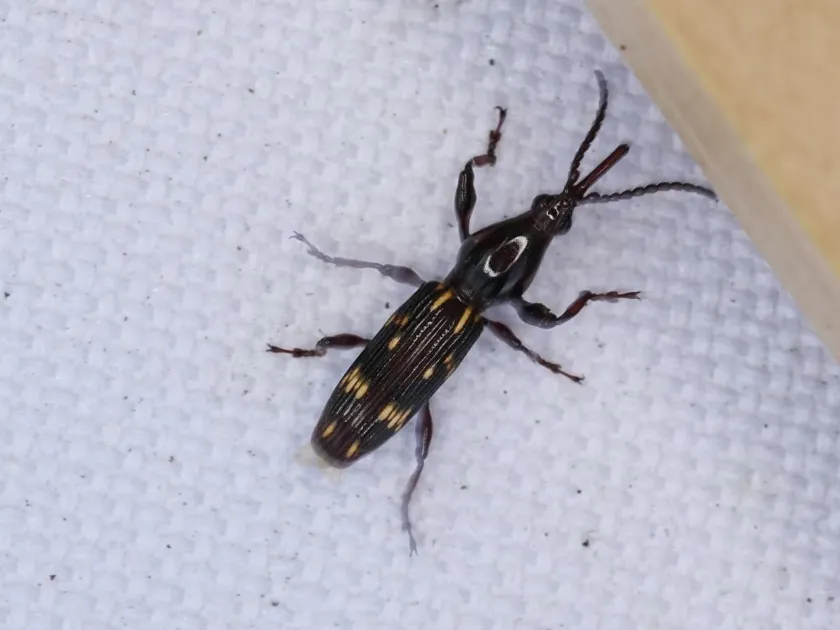
The Oak timberworm (Arrhenodes minutus) belongs to the Brentidae family of beetles. It is easily recognized by its extremely elongated, slender body, reaching lengths of 10 to 15 mm, and a prominent rostrum (snout).
These beetles are typically dark brown or black, often featuring yellowish spots on the elytra. Significant sexual dimorphism exists, with males having a notably different snout structure compared to females, specialized for drilling.
The larvae are cylindrical, legless, and white, specifically adapted to live within dense wood. They possess strong mandibles capable of creating deep galleries inside the tree trunk.
Adults lead a secretive lifestyle, often gathering in tree canopies. They are most active during the warmer months, favoring sunlit forest environments where they can easily locate hosts.
The biology of this species is tied to the physiological state of the host tree. They are known to target weakened or stressed oaks, exploiting their compromised defensive systems.
What it damages
The primary hosts for the Oak timberworm are various species of oak (Quercus). While they prefer old or damaged trees, infestations can occur in healthy trees under high pest pressure.
Besides oaks, the beetle can impact other hardwoods such as beech and chestnut. Damage is localized in the stem and sapwood, where larvae thrive by consuming internal tissues.
The galleries excavated by larvae disrupt the flow of water and nutrients, leading to a decline in tree vigor. Prolonged infestation significantly reduces the overall health and stability of the tree.
The wood quality is severely compromised due to these tunnels, making it unsuitable for high-value timber production. This creates significant economic losses in forestry operations.
Furthermore, the exit holes and internal tunnels act as infection sites for wood-decay fungi, which can accelerate the structural failure of the tree trunk.
When it appears
The life cycle of the Oak timberworm is complex and can span several years. Adults typically emerge and are most active during late spring and throughout the summer months.
Females bore into the bark to deposit their eggs. Once hatched, the larvae immediately begin tunneling deeper into the wood to feed and grow in a protected environment.
The larval stage is the longest part of the life cycle, lasting two to three years. During this period, the larvae remain entirely enclosed within the timber, making them difficult to detect.
Pupation takes place within the wood in specially constructed chambers. This transition marks the end of the larval stage before the adult emerges.
Adult emergence is synchronized with favorable environmental conditions, ensuring that the next generation can successfully mate and disperse to colonize new trees.
Signs of infestation
The most visible indicator of an infestation is the presence of numerous small, circular exit holes on the tree's bark. Fine wood dust, or frass, is often found accumulating near these holes.
In cases of heavy infestation, bark cracking and peeling may occur. Canopy dieback or thinning foliage can also be indirect signs of significant internal stem damage.
Trees affected by this pest show decreased resistance to physical stress, such as strong winds, due to the compromised structural integrity caused by the internal network of galleries.
Upon closer inspection, stained areas on the bark or signs of fungal growth often appear where larvae have compromised the tree's protective barriers.
Cross-sectioning of affected timber reveals characteristic winding channels filled with wood fragments and waste, confirming the presence of the pest.
Control measures
The most effective management strategy is the timely identification and removal of infested or severely weakened trees to prevent the spread of the population.
Promoting overall forest health through proper spacing and regular thinning helps maintain tree vigor, making them less susceptible to initial colonization.
Insecticide applications are generally only effective during the adult flight period. Successful control requires careful timing based on pheromone trap monitoring.
In urban or park settings, targeted tree maintenance, such as removing dead branches and sanitizing wounds, can help reduce the attractiveness of trees to beetles.
- Remove and destroy infested logs promptly.
- Maintain tree health with adequate water and nutrients.
- Use pheromone traps for population monitoring.
Taxonomy
- Latin name
- Arrhenodes minutus
- Order
- Coleoptera (beetles)
- Family
- Brentidae
- EPPO code
- ARRHMI
Discussion
No discussions yet — be the first.