
Oxystoma
Oxystoma
Description
How to identify
Oxystoma is a genus of small beetles belonging to the family Curculionidae, commonly known as weevils. These insects are recognized as significant pests of various leguminous crops, including peas and vetches.
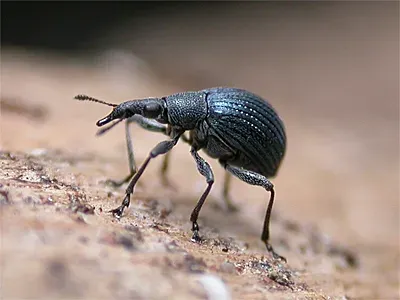
Adult weevils are typically small, measuring 2 to 3 mm in length, with a black body that often exhibits a metallic sheen. Their most prominent feature is the elongated rostrum or snout.
Larvae are legless, white or yellowish grubs with a distinctive brown head. They are highly specialized and spend their entire developmental period hidden inside the developing seeds of the host plant.
As members of the order Coleoptera, they undergo a complete metamorphosis. Their life cycle is tightly synchronized with the flowering and pod-setting stages of the leguminous host plants.
Adults overwinter in the upper soil layers or under leaf litter. They emerge in early spring, and their ability to fly allows them to colonize new legume fields rapidly as temperatures rise.
What it damages
Oxystoma primarily attacks crops such as peas, vetch, and various pulse species, causing direct yield losses in both commercial production and home gardens.
While adult feeding on foliage causes minor structural damage, the most severe economic impact is caused by larvae. Larvae consume the endosperm and embryo of the developing seeds inside the pods.
Seeds infested by Oxystoma show hollow cavities, which significantly reduce their germination capacity, making them useless for seed stock and reducing market value for human consumption.
The feeding activity creates wounds that allow secondary pathogens, such as fungi and bacteria, to invade the pods, further deteriorating the quality and shelf-life of the grain.
Heavy infestations can result in up to 20% loss in total grain weight, with additional losses occurring due to the loss of protein content and quality downgrading of the harvested crop.
When it appears
The activity of Oxystoma begins in early spring, following the first period of sustained warm weather. Adults migrate to leguminous fields as soon as the seedlings emerge or begin active growth.
The most critical phase for crop damage is the period from bud formation to early flowering, which is when the females lay their eggs on or inside the developing pods.
Larval development occurs throughout the pod-filling stage. The duration of this stage is heavily influenced by ambient temperature, with warmer conditions accelerating the pest life cycle.
A new generation of adults usually emerges in mid-summer, depending on the latitude and local climate. These adults then transition into a period of aestivation and subsequent hibernation.
The seasonal cycle concludes as temperatures drop in late autumn, forcing the weevils to seek shelter in soil crevices, hedgerows, or near field margins where they will overwinter.
Signs of infestation
Initial signs of infestation are visible as small, circular, or irregular holes in the leaflets and stipules, which indicate the presence of adult beetles feeding on the green tissues.
Adult beetles can often be spotted on the plants during the day; however, they are highly sensitive to vibration and tend to drop from the plant to the ground when approached.
Internal infestation is harder to detect visually from the outside, but careful inspection of pods might reveal small puncture marks made by females during oviposition.
The clearest sign of severe damage is the presence of hollowed-out seeds with small larval exit holes or the accumulation of granular frass inside the pods upon splitting them.
General crop decline, including the wilting of blossoms or premature pod drop, can also serve as an indicator of significant pest pressure within the field.
Control measures
Effective management starts with strict crop rotation, ensuring that legumes are not grown on the same field more than once every four years to break the weevil's life cycle.
Post-harvest deep tillage is a crucial cultural control method, as it buries the stubble and disrupts the overwintering sites of the adults, significantly reducing their survival rate.
Early planting of legume crops is recommended to ensure that the plants progress through their vulnerable reproductive stages before the peak population density of the pest occurs.
If population counts exceed economic thresholds during the bud development stage, systemic or contact insecticides are recommended to mitigate widespread damage.
- Using certified, high-quality, and treated seeds for planting.
- Removing wild legume weeds along field borders to eliminate alternative hosts.
- Encouraging natural predators by minimizing broad-spectrum insecticide usage.
- Regular field scouting during the flowering period to assess pest levels accurately.
Taxonomy
- Latin name
- Oxystoma
- Order
- Coleoptera (beetles)
- Family
- Brentidae
- EPPO code
- OXYMSP
Discussion
No discussions yet — be the first.