
Wormwood gall fly
Oxyna parietina
Description
How to identify
The wormwood gall fly, scientifically known as Oxyna parietina, belongs to the Tephritidae family within the order Diptera. It is a specialized pest primarily targeting mugwort and related species.
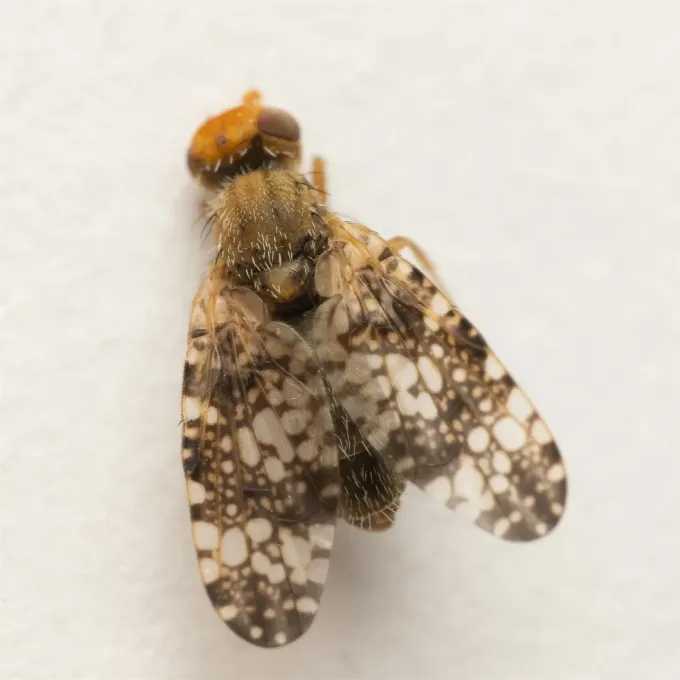
Adults are small flies characterized by a distinct pattern of dark spots and bands on their wings, which is a diagnostic feature used for identification. Their body coloration, typically yellowish-brown, acts as effective camouflage among dense vegetation.
The larvae are apodous (legless), cylindrical in shape, and possess a cream-white color. They spend their entire development phase protected within the galls they induce on the host plants.
Identifying this pest in the field requires close inspection of stems and flowers. Adults are elusive, and sweep netting or specialized traps are recommended to confirm their presence in an area.
As a host-specific herbivore, its occurrence is highly predictable, being restricted to locations where its primary host, Artemisia vulgaris, is abundant.
What it damages
The primary host for Oxyna parietina is the common mugwort (Artemisia vulgaris). The pest causes damage by inducing the plant to create gall structures.
The larvae feed within these galls, which are essentially abnormal tissue growths. This process diverts nutrients away from the plant's normal growth, leading to stunted stems and distorted development.
The formation of galls significantly impairs the quality of the harvested biomass, which is particularly detrimental for medicinal and aromatic plant production.
In addition to structural damage, the infestation can lead to a reduction in the number of healthy flowers and, subsequently, a lower seed yield for the host plant.
Severe infestations weaken the plant's overall vitality, making it more susceptible to other environmental stressors and secondary infections.
When it appears
The life cycle of the wormwood gall fly is strictly synchronized with the phenology of its host plant. Adult activity typically coincides with the period of rapid vegetative growth and early flowering.
Females deposit eggs directly into the tender tissues of the stem or the base of flower buds, ensuring a stable food supply for the emerging larvae.
The larval stage spans the majority of the growing season, during which they grow and develop within the shelter of the induced gall.
Pupation generally occurs inside the gall, which serves as a protective chamber for the insect throughout the cooler months or during the transition between generations.
Monitoring efforts should be intensified in mid-summer, as the presence of developing galls becomes increasingly visible and indicative of an active infestation.
Signs of infestation
The most visible indicator of infestation is the presence of hard, rounded, or spindle-shaped galls located along the stems of the mugwort plants.
Affected flowers or clusters may show signs of premature wilting, discoloration, or general malformation, preventing normal reproductive development.
Careful observation of the stems may reveal small exit holes. These are created by the adult flies as they emerge from the pupal stage, signaling that the generation cycle has been completed.
Infested plants often display chlorosis or a pale green appearance in the upper segments, reflecting the metabolic strain caused by the parasitic larvae.
If the stems are harvested or split open, one can find the white, legless larvae or brown puparia, confirming the presence of Oxyna parietina.
Control measures
The most effective management strategy is cultural control: the prompt removal and destruction of infested stems before the adults emerge.
Maintaining a clean field by burning or properly composting the collected plant debris reduces the overwintering population for the subsequent growing season.
In medicinal herb production, the use of insecticides is often restricted; therefore, non-chemical approaches such as crop rotation and isolation from wild habitats are preferred.
Encouraging the presence of natural enemies, such as hymenopteran parasitoids that target gall-forming flies, can help keep the pest population below economic thresholds.
Scouting for early signs of gall formation allows for targeted manual removal, which is a highly effective control measure for smaller plantations.
Taxonomy
- Latin name
- Oxyna parietina
- Order
- Diptera (flies)
- Family
- Tephritidae
- EPPO code
- OXNAPA
Discussion
No discussions yet — be the first.