
Oxyna
Oxyna
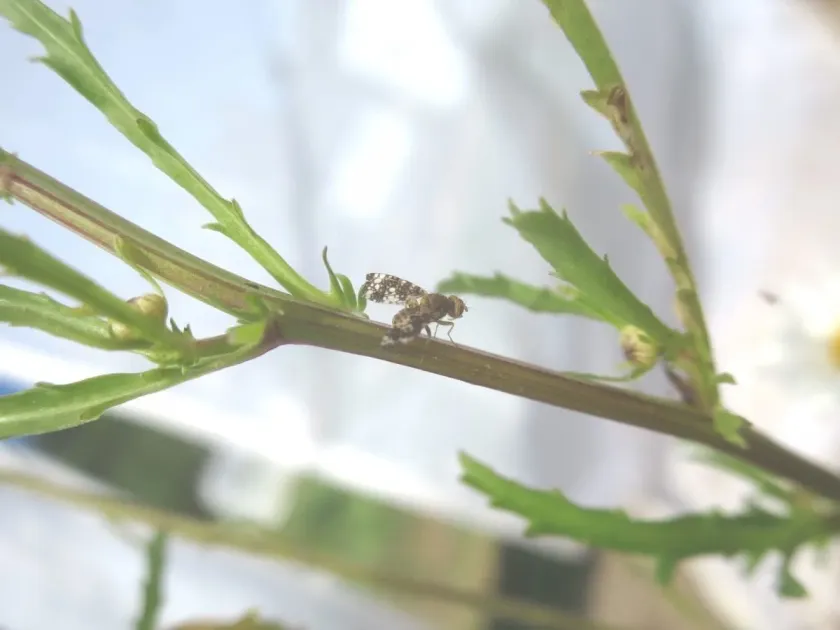
Description
How to identify
Oxyna is a genus of fruit flies belonging to the family Tephritidae. These small insects are known for their patterned wings, which provide excellent camouflage when resting on host plants.
Adult flies typically measure between 3 and 5 millimeters in length. Their coloration ranges from yellowish to brown, allowing them to blend into the floral structures of their host species.
The larvae are apodous (legless) and possess a cylindrical body shape. They lead a cryptic lifestyle, living and feeding exclusively within the tissues of their host plants.
Taxonomically, the genus belongs to the order Diptera. These flies are highly specialized, with different species targeting specific plants within the Asteraceae family.
Field identification is usually based on characteristic plant deformations, while species-level confirmation requires examination of the wing venation and specific anatomical features.
What it damages
The primary hosts of Oxyna are various plants within the Asteraceae family. This includes both wild weeds and important ornamental or medicinal crops such as mugwort and yarrow.
Larvae feed internally on flower heads, buds, or stems. This feeding activity disrupts the plant's vascular development and prevents the healthy formation of seeds.
For seed production farms, this pest poses a significant threat. Damage to the flower heads directly reduces the yield and the overall quality of the harvested seeds.
In ornamental horticulture, the presence of Oxyna larvae leads to stunted and deformed flowers. Such damage renders the produce aesthetically unacceptable and unsellable.
While these insects play a natural role in ecological balance, they are categorized as pests when their populations reach levels that compromise agricultural and floral productivity.
When it appears
The life cycle of Oxyna is tightly synchronized with the phenology of its host plants. Adult activity usually commences in late spring as temperatures begin to rise.
Females lay their eggs into unopened flower heads or leaf axils. Embryonic development is generally rapid, ensuring larvae emerge precisely when plant tissues are most nutritious.
The larval stage is the most prolonged and destructive period of the life cycle. During this time, the insect resides inside the host, causing progressive damage.
Overwintering typically occurs in the pupal stage, often within the soil or inside desiccated plant debris from the previous season.
In regions with long growing seasons, multiple generations may occur within a single year, necessitating sustained monitoring and control efforts throughout the summer.
Signs of infestation
One of the earliest signs of an Oxyna infestation is the formation of galls or swellings on stems and flower stalks. The plant reacts to larval feeding by producing abnormal tissue growth.
Affected flower heads may show signs of premature yellowing, wilting, or asymmetrical development. Buds often fail to open properly due to the internal damage.
When infected plant parts are dissected, one can find internal cavities containing larval frass and tissue decay. The larvae themselves may be visible within these chambers.
- Development of galls on stalks.
- Premature yellowing and drying of flower heads.
- Deformed buds with poor petal development.
- Presence of exit holes indicating adult emergence.
Widespread infestations lead to a noticeable decline in plant vigor and a significant loss in seed viability, affecting the overall health of the crop field.
Control measures
Integrated pest management strategies are essential for controlling Oxyna. Sanitation, including the removal of weeds belonging to the Asteraceae family, is a critical first step.
Deep autumn plowing of fields helps destroy pupae overwintering in the soil, effectively reducing the initial population density for the following season.
When chemical intervention is required, systemic insecticides can be used. Applications must be timed carefully to occur before the larvae bore into the plant tissue.
Hand-picking and burning infested flower heads during the early stages of the season is a highly effective control measure for small plots or gardens.
Implementing a crop rotation strategy is the most sustainable approach. Avoiding the planting of susceptible hosts in the same area for several years helps break the pest's reproductive cycle.
Taxonomy
- Latin name
- Oxyna
- Order
- Diptera (flies)
- Family
- Tephritidae
- EPPO code
- OXNASP
Discussion
No discussions yet — be the first.