

Pest · Lepidoptera (butterflies) · affects Maize, Common sunflower, Apple
European corn borer
Ostrinia
Description
How to identify
The European corn borer (Ostrinia nubilalis) is a destructive pest of the family Crambidae, known for its significant economic impact on agricultural production globally.
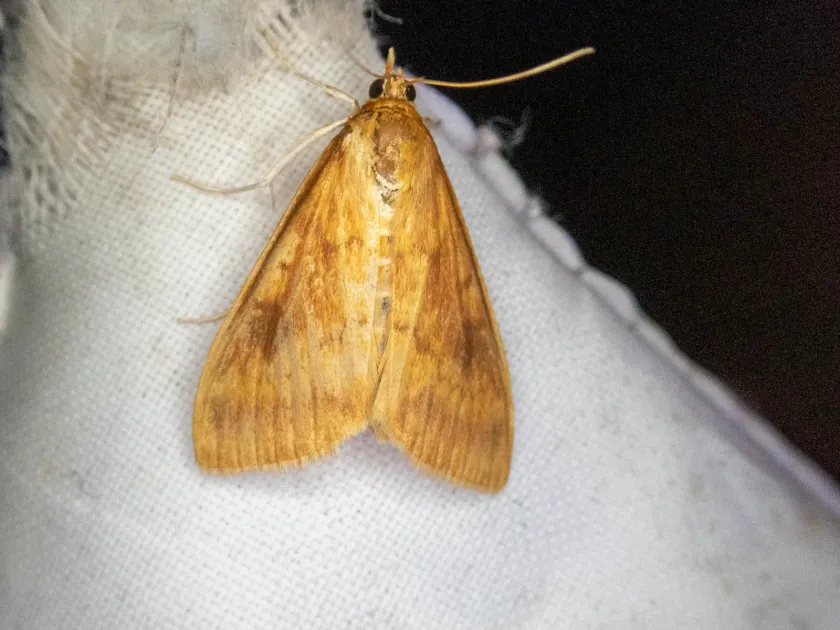
Adult moths have a wingspan of approximately 25–30 mm. The front wings are generally yellowish-brown with dark, wavy lines, while the hind wings are lighter in color.
The larvae, or caterpillars, reach up to 25 mm in length. They are typically light tan or pinkish with a dark stripe along the back and small dark spots on each body segment.
Pupae are found inside the stalks of host plants. They have a brown, cylindrical shape, allowing them to remain protected throughout the cold winter months until spring.
The lifecycle includes complete metamorphosis: egg, larva, pupa, and adult. The number of generations per year is heavily dependent on the local climate and temperature.
What it damages
While corn is the primary host, this pest is highly polyphagous and can infest various crops, including sunflowers, sorghum, and many garden vegetables.
Larvae consume leaf tissue, but their most destructive activity occurs after they bore into the stalks, where they tunnel through tissues and disrupt nutrient transport.
Damaged stalks become physically weak and prone to lodging, which significantly reduces the efficiency of mechanical harvesting and leads to increased yield loss.
Feeding inside the stalk also creates entry points for fungal pathogens, such as Fusarium, which can cause stalk rot and further reduce the quality of the harvest.
The economic impact manifests in both reduced grain weight and increased susceptibility to secondary infections, posing a major challenge for corn growers.
When it appears
Adult moths emerge in late spring or early summer, following the accumulation of sufficient degree-days and warming temperatures in the field.
Egg-laying activity is concentrated on the underside of corn leaves. Eggs are deposited in masses and hatch within a few days depending on environmental humidity.
The first generation of larvae emerges in early summer, often coinciding with the rapid vegetative growth stage of the corn crop.
In regions with multiple generations, the second generation attacks the crop during the late summer, focusing on the ears and thicker lower stems.
Winter survival is achieved by the final generation of larvae, which enter diapause inside the protective environment of stalks or cob residues until the following spring.
Signs of infestation
The earliest signs of an infestation include small, irregular holes on the leaves, which are caused by larvae feeding before they move deeper into the plant.
The presence of fine, sawdust-like frass (bore dust) at the leaf axils or near entry holes in the stem is a classic indicator of larval burrowing.
Broken tassels are a common observation, resulting from larvae feeding in the upper stalk areas, which disrupts pollination and plant development.
Stalk breakage or leaning plants, particularly before harvest, often indicate severe internal tunneling and compromised structural integrity of the crop.
- Shot-hole patterns in leaves.
- Bore dust on stalks.
- Broken tassels.
- Lodging of stalks.
- Visible larvae in ears.
Control measures
Cultural management starts with deep tillage or stalk shredding after harvest to destroy the overwintering sites of the larvae within crop residues.
Biological control methods, such as the release of Trichogramma wasps, can effectively parasitize the eggs and reduce the overall population pressure in the field.
Chemical control with insecticides is most effective during the early larval stage, specifically before the pests tunnel deep into the stem where they are shielded.
The use of genetically modified hybrid varieties has become a standard and highly efficient practice for managing this pest in large-scale agricultural production.
Regular scouting using pheromone traps is essential for timely decision-making and ensuring that any protective interventions are applied at the most vulnerable stage of the pest.
Content graph
Connections · European corn borer
Most often together:
Marketplace
Products · 1
Biology
Taxonomy
- Latin name
- Ostrinia
- Order
- Lepidoptera (butterflies)
- Family
- Pyralidae
- EPPO code
- OSTRSP
Community
Discussion
No discussions yet — be the first.