
Sawtoothed grain beetle
Oryzaephilus surinamensis
Description
How to identify
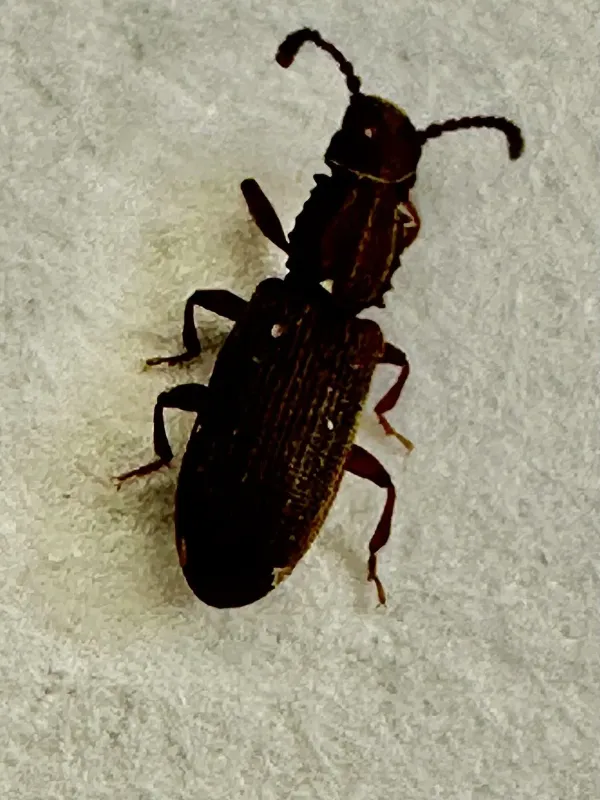
The Sawtoothed grain beetle (Oryzaephilus surinamensis) belongs to the Silvanidae family. It is a tiny beetle, roughly 2.5–3.5 mm long, with a slender, flattened body that is well-adapted for squeezing into tight gaps and cracks.
The most distinctive feature is the thorax, which bears two longitudinal ridges with six distinct, saw-like teeth on each side. This unique morphology makes identification relatively easy under simple magnification.
The larvae are yellowish-white and move actively through the stored product. They feed on fine particles and debris, completing their development within the food source.
The entire life cycle is temperature-dependent. In optimal warehouse conditions (approx. 25–27 °C), the beetle can complete its life cycle in as little as 30 to 45 days, facilitating rapid population growth.
While adults possess wings, they rarely fly. Instead, they migrate through bulk grain or warehouse structures by crawling, often hitchhiking on pallets, bags, or transport vehicles.
What it damages
As a secondary pest, the Sawtoothed grain beetle primarily attacks already damaged grains, flour, or processed cereals. It lacks the mandibles required to penetrate the hard outer hull of sound, healthy kernels.
However, once it gains access, it causes significant damage. The infestation ruins the quality of commodities by contaminating them with frass, larval skins, and dead insects, making the product unfit for human consumption.
The feeding activity and insect metabolism produce heat and moisture, which triggers the "hot spot" phenomenon. This promotes mold and fungal growth, further deteriorating the quality of the stored goods.
Their ability to infest various types of stored goods makes them a persistent threat to the entire agricultural supply chain, from elevators to retail stores.
- Flour, bran, and various milled grains.
- Breakfast cereals, pasta, and cookies.
- Dried fruits, nuts, and oilseeds.
- Pet food and various animal feed mixtures.
- Tobacco and cocoa products.
Signs of infestation
The primary sign of infestation is the presence of adult beetles on the surface of grain piles or inside food packaging. Any fine, powdery residue or clumps in stored materials should be inspected closely.
A musty or moldy odor often accompanies an infestation, especially in large silos where beetle activity has led to localized heating and increased moisture content.
Small exit holes in cardboard or plastic packaging indicate that the beetles have successfully breached the primary containment, suggesting the infestation is already widespread in the area.
Professional inspection often involves the use of pheromone traps placed in key areas of the warehouse to track population levels and identify the source of the infestation.
Routine monitoring of warehouse equipment, particularly in conveyor systems and storage bins, often reveals early signs of beetle activity before large-scale damage occurs.
Control measures
Sanitation is the cornerstone of pest management. Keeping storage areas clean, removing spilled grain, and minimizing dust accumulation eliminates the food sources necessary for the beetle's survival.
Temperature management is highly effective. Aeration of grain to reduce its moisture content below 14% and cooling it below 15 °C significantly slows down reproductive rates and inhibits beetle development.
For severe infestations in warehouses, professional fumigation using aluminum or magnesium phosphide is the standard method for eliminating populations hidden deep within grain masses.
Regular inspection of incoming stock and the use of insect-proof sealing for storage facilities prevent re-infestation. Clean, dry pallets should be used, and equipment must be disinfected between batches.
In households, infested items should be discarded immediately. Cupboards should be vacuumed thoroughly, particularly in cracks and corners, followed by cleaning with vinegar to eliminate any remaining eggs or larvae.
Taxonomy
- Latin name
- Oryzaephilus surinamensis
- Order
- Coleoptera (beetles)
- Family
- Silvanidae
- EPPO code
- ORYZSU
Discussion
No discussions yet — be the first.