
Merchant grain beetle
Oryzaephilus mercator
Description
How to identify
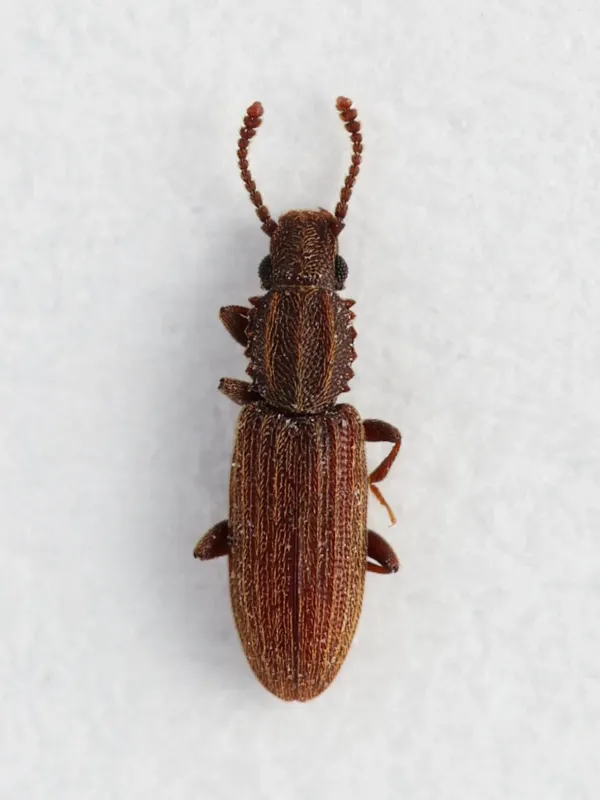
The Merchant grain beetle (Oryzaephilus mercator) is a small beetle belonging to the Silvanidae family. Adult beetles have flattened, dark-brown bodies measuring about 2.5 to 3.5 mm in length.
A key identifying feature is the presence of six distinct tooth-like projections on each side of the pronotum. It is closely related to the Saw-toothed grain beetle, but O. mercator can be distinguished by its larger eyes and shorter temples behind them.
These beetles are capable of flight, which allows them to spread rapidly throughout grain storage facilities, silos, and mills. The larvae are yellowish, worm-like, and typically grow to 3 mm in length.
The life cycle is highly temperature-dependent. At optimal temperatures of 25–30°C, the beetle can complete its development from egg to adult in as little as 30 to 40 days, facilitating rapid population growth.
A single female can lay up to 300 eggs during her lifespan, depositing them directly into food sources or cracks. In heated indoor environments, breeding occurs continuously throughout the year.
What it damages
The Merchant grain beetle is a significant stored-product pest that infests a wide range of goods, including cereals, flour, pasta, dried fruits, and pet food.
It is generally considered a secondary pest because it primarily thrives on previously damaged kernels or processed cereal products, though it can attack whole grains when infestation densities are high.
Both adults and larvae consume the grain endosperm, leaving behind damaged kernels, frass, and hollowed-out shells, which significantly reduces the quality and volume of stored stock.
Contamination with excrement, cast skins, and dead insects leads to the rapid development of mold and fungi, which can render entire batches of food products unsuitable for market.
Beyond physical consumption, the economic impact includes the loss of product commercial value, high costs of fumigation, and the need for discarding severely infested commodities.
Signs of infestation
The most common sign of an infestation is the presence of the beetles themselves, which tend to aggregate on the surface of grain piles, especially where moisture levels are elevated.
A persistent, stale, or musty odor in a storage area is a major indicator of an active infestation and potential self-heating processes occurring within the grain mass.
In cases of flour or meal infestation, the product may become clumpy due to the silk webbing produced by larvae during the pupation process, often mixed with accumulated excrement.
Observing fine grain dust at the bottom of bins or storage containers is a classic sign of insect activity, indicating that the grain kernels have been hollowed out.
The use of pheromone traps is an effective way to detect early activity, allowing for intervention before the insect population reaches damaging levels.
Control measures
Sanitation is the first line of defense; regular cleaning of bins, silos, and processing machinery is essential to remove food residues that attract and support beetle populations.
Managing the moisture content of grain (below 14%) and cooling the grain mass below 10°C are highly effective non-chemical methods to halt the insect's development.
Residual spraying of empty storage units using approved insecticides is a standard practice to eliminate existing populations and prevent new infestations.
Fumigation of infested commodities with registered fumigants remains the most reliable method for eradicating the Merchant grain beetle in both stored grain and finished food products.
- Maintain airtight storage conditions
- Use physical barriers like fine-mesh screens
- Conduct regular stock rotation (FIFO)
- Perform seasonal inspections of all storage areas
Taxonomy
- Latin name
- Oryzaephilus mercator
- Order
- Coleoptera (beetles)
- Family
- Silvanidae
- EPPO code
- ORYZME
Discussion
No discussions yet — be the first.