
Orthotelia sparganella
Orthotelia sparganella
Description
How to identify
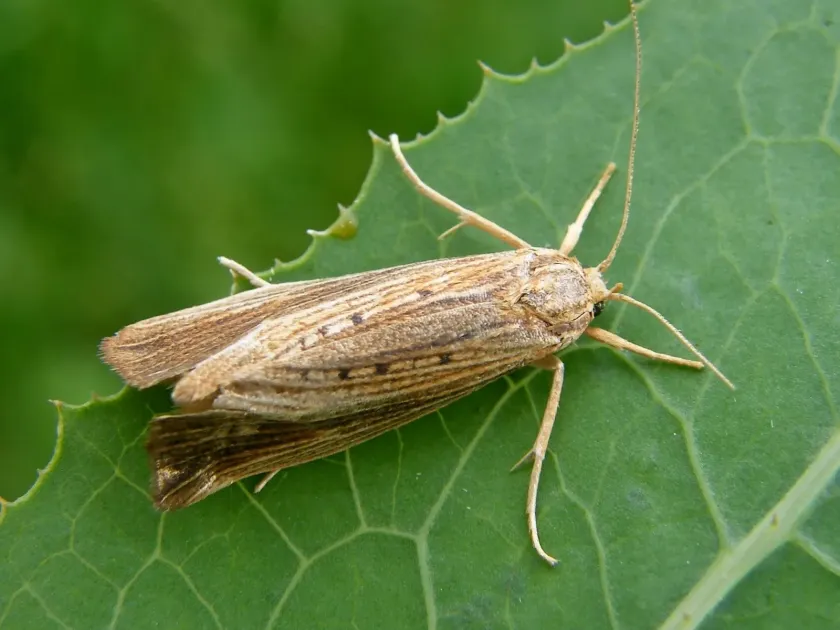
Orthotelia sparganella is a moth belonging to the family Orthoteliidae, order Lepidoptera. The adult moth has a wingspan of approximately 20 to 25 millimeters.
The forewings exhibit a pale yellowish-brown or straw-colored appearance with distinct dark longitudinal stripes and subtle spots across the surface.
Larvae, commonly known as caterpillars, can reach a length of 20 mm. They feature a yellowish-white body, a dark head, and prominent thoracic plates.
Pupation typically occurs inside the host plant's stem, where the caterpillar constructs a silk-lined chamber to protect itself during transformation.
The species is naturally adapted to moist environments, as its primary hosts are aquatic and wetland plants, though it easily migrates to agricultural fields.
What it damages
This pest primarily targets plants within the Apiaceae (umbelliferous) family, including carrots, celery, parsley, and parsnips, causing significant damage.
It also feeds on wild species such as bur-reeds and cat-tails, which serve as natural reservoirs that facilitate the spread of the insect to vegetable farms.
Caterpillars bore into the center of stems and leaf petioles, disrupting the nutrient supply system and causing the plant to wither and weaken.
Damage to the growth point often results in stunted development, deformation of the foliage, and a substantial decrease in the quality of the root crops.
In cases of high infestation, particularly in fields near wetlands, the pest can significantly reduce overall crop yields if left unmanaged.
When it appears
The first generation of moths typically emerges in late spring or early summer, depending on regional temperature patterns and climate conditions.
Females deposit eggs on the base of stems or foliage, and once the larvae hatch, they immediately begin feeding on the internal tissues of the plant.
During the summer months, the larvae undergo multiple development stages, continuing to bore deeper into the stems as they grow in size.
A second generation of moths may emerge in mid-to-late summer, extending the period of risk for late-planted vegetable crops and potential damage.
Overwintering occurs primarily in the pupal stage, hidden within the debris of host plants or in the soil, allowing the species to survive harsh winter conditions.
Signs of infestation
The primary indicator of an infestation is the presence of small entrance holes at the base of leaf petioles, surrounded by larval excrement (frass).
Plants may show signs of premature yellowing and wilting, which indicates that the internal stem structure has been compromised by the feeding larvae.
By splitting the stem or petiole, one can observe tunnels filled with brown debris, confirming the presence of the caterpillar inside the plant.
Root growth is noticeably hindered, leading to smaller, distorted vegetables that are susceptible to secondary rot and poor storage quality.
The observation of adult moths flying in the vicinity of crop rows during dusk is a warning sign that egg-laying is occurring and action is required.
Control measures
Effective management begins with deep autumn plowing, which destroys the overwintering pupae hidden in plant debris and soil.
Maintaining field margins free from wild Apiaceae weeds is a crucial cultural practice to eliminate the pest's natural breeding grounds.
Adhering to a strict crop rotation schedule prevents the pest from establishing a consistent population cycle within the same plot over successive years.
Systemic insecticides are the most effective chemical control when applied at the moment of larval emergence, before they tunnel into the plant tissues.
- Using light traps can help monitor the moth population and time the application of protective measures accurately.
- Biological control agents, such as specialized bacteria, can be used as a targeted approach to reduce larval numbers without harming the environment.
Taxonomy
- Latin name
- Orthotelia sparganella
- Order
- Lepidoptera (butterflies)
- Family
- Glyphipterigidae
- EPPO code
- ORTESA
Discussion
No discussions yet — be the first.